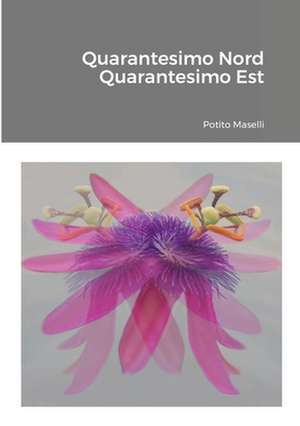
Quarantesimo Nord Quarantesimo Est
Autor Potito Maselliit Limba Italiană Paperback – 8 dec 2012
Preț: 85.20 lei
Puncte Express: 128
Carte tipărită la comandă
Livrare economică 18 noiembrie-02 decembrie
Livrare prin curier în România Termenul estimat este afișat lângă disponibilitate.
Transport gratuit de la 400.00 lei Plată online sau ramburs, în funcție de opțiunile comenzii.
Retur gratuit în 14 zile Comandă securizată și suport în română.
Specificații
ISBN-13: 9781471087370
ISBN-10: 1471087379
Pagini: 162
Dimensiuni: 148 x 210 x 9 mm
Greutate: 0.2 kg
Editura: Lulu.Com
ISBN-10: 1471087379
Pagini: 162
Dimensiuni: 148 x 210 x 9 mm
Greutate: 0.2 kg
Editura: Lulu.Com
Notă biografică
Potito Maselli: An Architect-Restorer Between Worlds and Words For years, Potito Maselli has made Istanbul his home-a city that is not just where he lives but a crossroads of eras and civilizations, where every stone tells a different story. Here, amid the long shadows of Byzantine churches and the sacred geometries of mosques, he has refined his approach to restoration, learning to see in the layers of time not just a technical challenge but a richness to preserve. His professional journeys have taken him to places where history still seems to pulse with life. In Antioch and Zeugma, where Roman mosaics rise from the earth like fragments of colored dreams, he worked with near-surgical delicacy, striving to conserve not just the tiles but their ability to speak across centuries. At Saint Catherine's Monastery, at the foot of Mount Sinai, amid dust and incense, he encountered the Byzantine gold of the Transfiguration mosaic-a work that seems to vibrate with its own light in the heart of the desert. And then there was Yemen, where a 16th-century mosque appeared to him like a jewel: on the outside, a dazzling whiteness carved like lace into stone; inside, an explosion of colors that danced through alabaster windows and painted domes. All around, the mudbrick houses with their stained-glass windows seemed to absorb and reflect that same light in a play of radiance he grew to know and love. Even in the Vatican, working within Raphael's Rooms, he brought with him the sensitivity honed elsewhere-that attentiveness to how light shapes both space and meaning. For him, every restoration has been a dialogue with those who created the art centuries before. It comes as no surprise, then, that these experiences have also found their way into his novels. In his writing, the scents of the souks, the sun's gleam on marble, the hush of sacred spaces return with almost physical intensity. The atmospheres of the places he has restored seem to have migrated onto the page, as if his technical work had always had a literary counterpart. Perhaps because, in the end, whether in restoration or in writing, what he seeks is always the same: to rescue from the dust of time not just forms, but the soul of things.