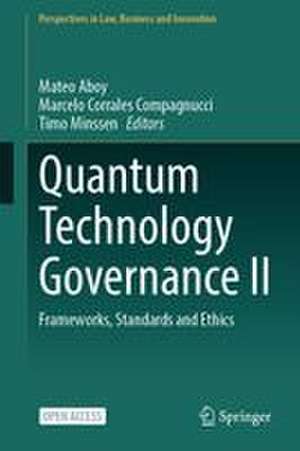
Quantum Technology Governance II: Perspectives in Law, Business and Innovation
Editat de Mateo Aboy, Marcelo Corrales Compagnucci, Timo Minssenen Limba Engleză Hardback – 3 sep 2026
Din seria Perspectives in Law, Business and Innovation
- 18%
 Preț: 1157.05 lei
 - 15%
 Preț: 721.12 lei
 - 15%
 Preț: 660.95 lei
 - 18%
 Preț: 982.09 lei
 - 18%
 Preț: 1039.02 lei
 - 18%
 Preț: 984.66 lei
 - 18%
 Preț: 967.05 lei
 - 18%
 Preț: 754.00 lei
 - 18%
 Preț: 981.92 lei
 - 18%
 Preț: 891.13 lei
 - 18%
 Preț: 699.52 lei
 -
 Preț: 352.69 lei
 - 18%
 Preț: 888.87 lei
 - 24%
 Preț: 886.10 lei
 - 24%
 Preț: 761.39 lei
 - 24%
 Preț: 1071.07 lei
 - 18%
 Preț: 1151.76 lei
Preț: 425.54 lei
Nou
Puncte Express: 638
Carte disponibilă
Livrare economică 13-19 noiembrie
Livrare express 31 octombrie-06 noiembrie pentru 49.66 lei
Livrare prin curier în România Termenul estimat este afișat lângă disponibilitate.
Transport gratuit pentru acest produs Plată online sau ramburs, în funcție de opțiunile comenzii.
Retur gratuit în 14 zile Comandă securizată și suport în română.
Specificații
ISBN-13: 9789819237678
ISBN-10: 981923767X
Pagini: 248
Ilustrații: XVI, 229 p. 1 illus.
Dimensiuni: 160 x 241 x 20 mm
Greutate: 0.49 kg
Editura: Springer
Colecția Perspectives in Law, Business and Innovation
Seria Perspectives in Law, Business and Innovation
ISBN-10: 981923767X
Pagini: 248
Ilustrații: XVI, 229 p. 1 illus.
Dimensiuni: 160 x 241 x 20 mm
Greutate: 0.49 kg
Editura: Springer
Colecția Perspectives in Law, Business and Innovation
Seria Perspectives in Law, Business and Innovation
Notă biografică
Mateo Aboy is Director of Research in Biomedical Innovation, AI, QT & Law at the Faculty of Law, University of Cambridge. He is a member of the Centre for Law, Medicine & Life Sciences (LML) and the Centre for IP & Information Law (CIPIL) at the University of Cambridge. He holds degrees in electrical & computer engineering (BS, BSEE, MSECE, MPhil/DEA, PhD ECE), law (LLB, SJD/PhD/LLD), and international management (MBA), as well as professional registrations as a Professional Chartered Engineer (CEng, EU/ES COIT), Certified Licensing Professional (CLP), Patent Practitioner with a Bar Admission/licensed to practice in patent cases before the United States Patent Office (USPTO), Fellow of Information Privacy (FIT, IAPP), Certified Privacy Information Professional (CIPP/E), Certified Privacy Manager (CIPM), Lead Implementer of Information Security Management Systems-ISMS (ISO 27001), Lead Auditor of Medical Device Quality Management Systems (ISO 13485), Lead Implementer of Privacy Information Management Systems - PIMS (ISO 27701), and Certified Data Protection Officer (C-DPO).
Marcelo Corrales Compagnucci is Associate Professor and Associate Director at the Center for Advanced Studies in Bioscience Innovation Law (CeBIL), Faculty of Law, University of Copenhagen in Denmark. He is also Inter-CeBIL Research Affiliate at the Petrie-Flom Center for Health Law Policy, Biotechnology, and Bioethics at Harvard Law School. He specializes in information technology, privacy, and data protection law. His research interests are the legal issues involved in disruptive innovation technologies and biomedicine. He wasa research associate with the Institute for Legal Informatics (IRI) at Leibniz Universität Hannover in Germany, and a visiting research fellow in various research centers around the world, including Harvard Law School, Cambridge University, the Max Planck Institute, University of Edinburgh, Turin University, and the Academia Sinica in Taiwan. He has a Doctor of Laws (LL.D.) degree from Kyushu University in Japan. He also holds a Master of Laws (LL.M.) in international economics and business law from Kyushu University, and an LL.M. in law and information technology and an LL.M. in European intellectual property law, both from the University of Stockholm in Sweden.
Timo Minssen is Professor of Law at the University of Copenhagen (UCPH). He holds the UNESCO Co-Chair in the Right to Science and is the Director of UCPH's Center for Advanced Studies in Bioscience Innovation Law (CeBIL). He is also an Inter-CeBIL Research Affiliate at Harvard Law School and at the University of Cambridge. His research and practice concentrates on IP-, Competition & Regulatory Law in emerging technologies, including the law and ethics of AI, quantum technologies, and health & life science innovation. Timo holds a German law degree from the University of Göttingen, and biotech & IP -related LL.M. M.I.C.L., LL.Lic. and LL.D. degrees from Lund & Uppsala University. He had been an Epigenetics fellow at the Pufendorf Institute for Advanced Studies, and a Visiting Professor at the Technical University of Munich, the Universities of Cambridge and Oxford, Waseda Law School, Harvard Law School, the Max Planck Institute for Innovation & Competition, and at the Chicago-Kent College of Law. Moreover, he was trained in the German Court system, the European Patent Office, law firms & start-ups. Timo serves as an advisor to the WHO, WIPO, OECD, the EU Commission, companies, national governments, and law firms. At UCPH he leads several interdisciplinary research projects on legal issues in emerging biotechnologies, precision medicine, ATMPs, antimicrobial resistance, pandemic preparedness, advanced medical computing, medical devices, and in sustainable innovation.
Marcelo Corrales Compagnucci is Associate Professor and Associate Director at the Center for Advanced Studies in Bioscience Innovation Law (CeBIL), Faculty of Law, University of Copenhagen in Denmark. He is also Inter-CeBIL Research Affiliate at the Petrie-Flom Center for Health Law Policy, Biotechnology, and Bioethics at Harvard Law School. He specializes in information technology, privacy, and data protection law. His research interests are the legal issues involved in disruptive innovation technologies and biomedicine. He wasa research associate with the Institute for Legal Informatics (IRI) at Leibniz Universität Hannover in Germany, and a visiting research fellow in various research centers around the world, including Harvard Law School, Cambridge University, the Max Planck Institute, University of Edinburgh, Turin University, and the Academia Sinica in Taiwan. He has a Doctor of Laws (LL.D.) degree from Kyushu University in Japan. He also holds a Master of Laws (LL.M.) in international economics and business law from Kyushu University, and an LL.M. in law and information technology and an LL.M. in European intellectual property law, both from the University of Stockholm in Sweden.
Timo Minssen is Professor of Law at the University of Copenhagen (UCPH). He holds the UNESCO Co-Chair in the Right to Science and is the Director of UCPH's Center for Advanced Studies in Bioscience Innovation Law (CeBIL). He is also an Inter-CeBIL Research Affiliate at Harvard Law School and at the University of Cambridge. His research and practice concentrates on IP-, Competition & Regulatory Law in emerging technologies, including the law and ethics of AI, quantum technologies, and health & life science innovation. Timo holds a German law degree from the University of Göttingen, and biotech & IP -related LL.M. M.I.C.L., LL.Lic. and LL.D. degrees from Lund & Uppsala University. He had been an Epigenetics fellow at the Pufendorf Institute for Advanced Studies, and a Visiting Professor at the Technical University of Munich, the Universities of Cambridge and Oxford, Waseda Law School, Harvard Law School, the Max Planck Institute for Innovation & Competition, and at the Chicago-Kent College of Law. Moreover, he was trained in the German Court system, the European Patent Office, law firms & start-ups. Timo serves as an advisor to the WHO, WIPO, OECD, the EU Commission, companies, national governments, and law firms. At UCPH he leads several interdisciplinary research projects on legal issues in emerging biotechnologies, precision medicine, ATMPs, antimicrobial resistance, pandemic preparedness, advanced medical computing, medical devices, and in sustainable innovation.
Cuprins
Quantum Technology Governance: Frameworks, Standards & Ethics Perspectives.- Quantum Governance in the Making: Why Standards Matter.- A Governance Stack Framework for Quantum Technology Applications in Life Sciences: Examining Ontological and Integration Challenges.- Toward a Framework for Ethical Quantum Computing: Foundations and Research Directions.- Quantum Computing and Ethical Exceptionalism: Lessons from Classical Computing.- Quantum Computing and the Right to Science: A Stress-Test and a Test Case.