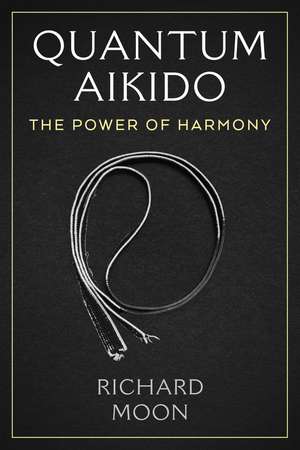
Quantum Aikido: The Power of Harmony
Autor Richard Moonen Limba Engleză Paperback – 12 feb 2026
• Draws on quantum mechanics and physics, like wave–particle duality and the unified field theory, to define the energetics of Aikido
• Explores concepts of Aikido such as musubi (to tie together), connection, and reconciliation to re-link the individual with the universal
• Provides lessons for everyday life to enhance personal and professional relationships and diffuse threatening situations
Aikido is a martial art that offers a philosophy of harmonizing energy. The techniques of Aikido focus on aligning oneself with the world in total harmony, and this begins by winning over the discord in our own minds.
Richard Moon applies the insights of quantum mechanics to explore key concepts of Aikido—such as musubi (to tie together), connection, unification, and reconciliation—to re-link the individual with the universal. As quantum physics and Aikido reveal, the dualism of two conflicting opposites is an illusion. It is the unified field of the two that creates life and from which reality emanates. The essential teaching of Quantum Aikido is to live as an expression of the single source of yin and yang rather than in polarity.
Embodying this teaching transforms one’s experience of life from being a struggle to a dance. These lessons can be applied every day to enhance personal and professional relationships and diffuse threatening situations. The author’s creative, flow-oriented approach illustrates how to negotiate challenges by absorbing and using the energy of any given situation to create innovative solutions.
The state of being described in Quantum Aikido exercises whole-brain thinking and self-reflexivity to help readers develop the measured temperament of a warrior. By offering ways to unify our being and live in acceptance and harmony, this book opens doorways to transformation and positive change.
Preț: 92.85 lei
Preț vechi: 122.77 lei
-24%
Puncte Express: 139
Carte disponibilă
Livrare economică 20 noiembrie-02 decembrie
Livrare express 31 octombrie-06 noiembrie pentru 52.65 lei
Livrare prin curier în România Termenul estimat este afișat lângă disponibilitate.
Transport gratuit de la 400.00 lei Plată online sau ramburs, în funcție de opțiunile comenzii.
Retur gratuit în 14 zile Comandă securizată și suport în română.
Specificații
ISBN-13: 9781644119778
ISBN-10: 1644119773
Pagini: 224
Ilustrații: 3 b&w illustrations
Dimensiuni: 152 x 229 x 18 mm
Greutate: 0.27 kg
Editura: Inner Traditions/Bear & Company
Colecția Park Street Press
ISBN-10: 1644119773
Pagini: 224
Ilustrații: 3 b&w illustrations
Dimensiuni: 152 x 229 x 18 mm
Greutate: 0.27 kg
Editura: Inner Traditions/Bear & Company
Colecția Park Street Press
Notă biografică
Richard Moon is an innovative Aikido instructor, holding the rank of 6th Dan with Hombu Dojo, Aikido World Headquarters. Since 1971, he has studied under Robert Nadeau Sensei. A skilled mediator and personal coach, Moon has worked in international peace-building and has taught strategy, leadership, and team development to leaders of major corporations.
Extras
1
CREATIVITY IS BORN FROM THE FIELD OF POTENTIAL
Haina ia mai ana ka puana
Let the story be told
Tell and retell the story
STORY, SYNAPTIC PATHWAYS, AND SYSTEMS OF THOUGHT
Since the dawn of human consciousness, our ancestors have gazed into the vastness of the night sky, imagining patterns in the stars and creating stories about them. The human brain and being develop through discerning patterns and exploring meaning, all of which drives life’s action and thus produces life’s outcome. Through connecting seemingly significant data points, and constructing designs and descriptions, brain function attempts to simplify the incomprehensible into a working understanding of WIGO—a phrase coined by Samuel Bois in The Art of Awareness—that stands for What Is Going On. The stories we create about what is going on in reality form the decisions and strategies of what to do about it.
Descriptions of experience real or imagined—stories—emerge, making meaning while creating understanding of interaction with the world. The process of making meaning is a semantic transaction that projects experience into language, giving birth to ideologies, beliefs, fables, myths, and legends.
Sharing stories around the fire creates culture, fostering shared understanding, somatic patterns, and synaptic pathways. Culture shapes individuals who, in a reciprocal process, shape the values, principles, and traditions of the social network. Stories develop into systems of thought that individually and collectively create evolving social structures—religious, political, educational, and otherwise.
Stories are based on past experiences, thus they offer an educated viewpoint from which to make intelligent, strategic predictions for future action. Stories encapsulate the basis of a culture’s knowledge and serve as repositories thereof. Stories, in other words, function as software programs for life.
From a tiny point in a universe beyond imagination, our senses abstract a minute fraction of experiential reality that can be seen or understood through the lens of attention. The designs of data assemble themselves as information, not just in thought, but in the material world—physiologically, neurologically, and bio-electromagnetically. Selected data is passed to awareness. It is then organized, collated, and systematized through habituated thought patterns and mental models, cultural as well as personal. This process gives birth to story, which then affects the course of our lives as if it were reality.
Every thought, description, idea, and mode of understanding, and most importantly the entire inner dialogue, creates story, with or without one’s awareness of it. The implications of the power of story—especially the inner dialogue, or stories repeated internally—reveal hidden power in creating the experience of life. Fashioning the stories that inform life comes out of an essential human need: the need to know what to do. Story, making meaning, describing, and predicting are compelling, virtually compulsive human activities that respond to that need. Though meaning-making may not be thought of as creativity, it is.
FAMILIAR PATHWAYS
Rain washes down a soft dirt hillside, creating gullies along paths of least resistance. The next time it rains, water flows following and reinforcing the same pathways. Physiologically, stories form neural pathways and patterns in the brain. Patterns form out of ideas, images, inner dialogue, and the stories of others, and once these patterns are adopted, they tend to set quickly. Feelings, like thoughts, quickly default down familiar pathways of affect in the form of synaptic signals, shaping persona and character.
As synaptic pathways deepen, stories, positions, and thought patterns, as well as emotional states and responses, fire off semi-mechanically, habituating into a fixed and familiar affect and stance. Once created, neural connections become established patterns, repetitively following and reinforcing the same pathways.
In the process of crystal formation, the first shape that forms as crystallization begins is referred to as the seed crystal. Every aspect that forms following inception tends to match the shape of the seed crystal. In the same way, the first stories, systems of thought, or beliefs become, in effect, a primary model or archetype, the seed crystal on which future stories are based.
From birth onward, the impressionable synaptic system absorbs stories and attitudes, positions and patterns. Early imprints filter out of the vastness that which is valued enough to be noticed. The first pathways we form design what future information will be received and how it will be valued, and ultimately, the quality of the story that will be developed. Early patterns form the foundation of thought structures and tonality of affect, and these patterns habituate before rational thought exists to assess their accuracy and evaluate their usefulness.
It takes considerable intention to challenge belief systems adopted before the development of critical thinking, before the concept of coherent thought is understood. Even once critical thinking develops, we require the intent of a warrior to change established beliefs and fixed neural pathways. By the time our level of maturity and consciousness develops enough that we are able to ask these questions, the patterns are so established that they operate not only unquestioned but undetected as if they didn’t exist.
Early installment and repetition of stories and the synaptic pathways that support them establish what knowledge becomes inculcated as true. Like the key codes of a computer, early stories decide the meaning of every keystroke that follows. Barring an act of grace, unless attitudes, beliefs, and emotional tones are disturbed, or acted on by the force of intent, they will keep repeating and reinforcing. These stories of being include the degree of physical tension one lives in, right down to postures, muscular tonalities, and facial expressions.
Down this path, life defaults to established and habituated synaptic patterns that come to feel familiar, normal, true. Habituated thoughts, feelings, and behaviors mean that we rarely consider what else, if anything, might be possible. Beliefs and postures, attitudes, and tonalities, when accepted without question, live beyond conscious perception, and as such discredit, ignore, and generally remain unaffected by contradictory information. When set early and given sufficient repetition, established synaptic pathways become truer by the day. They “just feel right,” whether they are or not.
Both the emergence of creativity as well as the habit of defaulting to established behavior exist in the field of potential. Stories enable a process of re-creating experience, which can either function as a source of power in the creation of stories that serve, or cause us to default to the unquestioned repetition of established patterns regardless of their value or efficacy. Life either develops creativity or operates by habit, depending on intent’s alignment in the realm of the spirit.
Experience—everything seen and felt, and how the world “seems”—emanates from a relative position, location, quality, or focus of attention. The quality or location of one’s attention is the foundation on which the quality of one’s life experience is built. Attention’s dynamic relationship to experience influences the formation of both thought and life. The ability to position the focus of attention is a fundamental meta-skill, influencing one's state of presence.
When creativity emerges, it matches the level and quality of our consciousness functioning, which changes moment to moment and day to day. The quality of creativity can only be affected from a state of consciousness aware of creative possibility. Even then, knowledge is power only when activated. Otherwise, one lives as the world prevalently lives, according to the effects of established patterns.
Monasteries, ashrams, temples, dojos, and esoteric schools all train their students, at some level, in the skills that give birth to the power of creativity. A tremendous focus of human consciousness has been Figuring out what to do to achieve this power. Schools of art and business, as well as sales, marketing, and all forms of propaganda and mind manipulation look at limited aspects of this larger study. Each looks through a certain window and develops a partial description.
As the world, moving from village to country, nation to globe, recognizes itself as one system, ecologically, commercially, politically, and evolutionarily, belief systems based on a single window become less useful. A holographic understanding assembles and develops, changing the story that serves as a basis for operation. This exploration, guided by the leading edge of those who study consciousness, seems to be permeating into the mainstream as human consciousness becomes increasingly aware of the interconnectedness of life.
In the night sky in the desert, where there is no ambient light, the stars come forth at a level of visibility never seen in the city. Similarly, opening to the universal energy in a positive spirit brings forth a field of consciousness that is less obscured. An infinite field of possibilities appears that we never realized existed there. The sky not has changed. Rather, the drive to the desert changes the location of attention. In the realm of the spirit, a dimensional shift in consciousness changes perception of what is so. While under such circumstances we experience an infinite mystical opening into wonder, we are at the same time undergoing the most mundane physical process involving neurons and synapses, electricity and chemicals, and in the quantum world, intent.
CREATIVITY IS BORN FROM THE FIELD OF POTENTIAL
Haina ia mai ana ka puana
Let the story be told
Tell and retell the story
STORY, SYNAPTIC PATHWAYS, AND SYSTEMS OF THOUGHT
Since the dawn of human consciousness, our ancestors have gazed into the vastness of the night sky, imagining patterns in the stars and creating stories about them. The human brain and being develop through discerning patterns and exploring meaning, all of which drives life’s action and thus produces life’s outcome. Through connecting seemingly significant data points, and constructing designs and descriptions, brain function attempts to simplify the incomprehensible into a working understanding of WIGO—a phrase coined by Samuel Bois in The Art of Awareness—that stands for What Is Going On. The stories we create about what is going on in reality form the decisions and strategies of what to do about it.
Descriptions of experience real or imagined—stories—emerge, making meaning while creating understanding of interaction with the world. The process of making meaning is a semantic transaction that projects experience into language, giving birth to ideologies, beliefs, fables, myths, and legends.
Sharing stories around the fire creates culture, fostering shared understanding, somatic patterns, and synaptic pathways. Culture shapes individuals who, in a reciprocal process, shape the values, principles, and traditions of the social network. Stories develop into systems of thought that individually and collectively create evolving social structures—religious, political, educational, and otherwise.
Stories are based on past experiences, thus they offer an educated viewpoint from which to make intelligent, strategic predictions for future action. Stories encapsulate the basis of a culture’s knowledge and serve as repositories thereof. Stories, in other words, function as software programs for life.
From a tiny point in a universe beyond imagination, our senses abstract a minute fraction of experiential reality that can be seen or understood through the lens of attention. The designs of data assemble themselves as information, not just in thought, but in the material world—physiologically, neurologically, and bio-electromagnetically. Selected data is passed to awareness. It is then organized, collated, and systematized through habituated thought patterns and mental models, cultural as well as personal. This process gives birth to story, which then affects the course of our lives as if it were reality.
Every thought, description, idea, and mode of understanding, and most importantly the entire inner dialogue, creates story, with or without one’s awareness of it. The implications of the power of story—especially the inner dialogue, or stories repeated internally—reveal hidden power in creating the experience of life. Fashioning the stories that inform life comes out of an essential human need: the need to know what to do. Story, making meaning, describing, and predicting are compelling, virtually compulsive human activities that respond to that need. Though meaning-making may not be thought of as creativity, it is.
FAMILIAR PATHWAYS
Rain washes down a soft dirt hillside, creating gullies along paths of least resistance. The next time it rains, water flows following and reinforcing the same pathways. Physiologically, stories form neural pathways and patterns in the brain. Patterns form out of ideas, images, inner dialogue, and the stories of others, and once these patterns are adopted, they tend to set quickly. Feelings, like thoughts, quickly default down familiar pathways of affect in the form of synaptic signals, shaping persona and character.
As synaptic pathways deepen, stories, positions, and thought patterns, as well as emotional states and responses, fire off semi-mechanically, habituating into a fixed and familiar affect and stance. Once created, neural connections become established patterns, repetitively following and reinforcing the same pathways.
In the process of crystal formation, the first shape that forms as crystallization begins is referred to as the seed crystal. Every aspect that forms following inception tends to match the shape of the seed crystal. In the same way, the first stories, systems of thought, or beliefs become, in effect, a primary model or archetype, the seed crystal on which future stories are based.
From birth onward, the impressionable synaptic system absorbs stories and attitudes, positions and patterns. Early imprints filter out of the vastness that which is valued enough to be noticed. The first pathways we form design what future information will be received and how it will be valued, and ultimately, the quality of the story that will be developed. Early patterns form the foundation of thought structures and tonality of affect, and these patterns habituate before rational thought exists to assess their accuracy and evaluate their usefulness.
It takes considerable intention to challenge belief systems adopted before the development of critical thinking, before the concept of coherent thought is understood. Even once critical thinking develops, we require the intent of a warrior to change established beliefs and fixed neural pathways. By the time our level of maturity and consciousness develops enough that we are able to ask these questions, the patterns are so established that they operate not only unquestioned but undetected as if they didn’t exist.
Early installment and repetition of stories and the synaptic pathways that support them establish what knowledge becomes inculcated as true. Like the key codes of a computer, early stories decide the meaning of every keystroke that follows. Barring an act of grace, unless attitudes, beliefs, and emotional tones are disturbed, or acted on by the force of intent, they will keep repeating and reinforcing. These stories of being include the degree of physical tension one lives in, right down to postures, muscular tonalities, and facial expressions.
Down this path, life defaults to established and habituated synaptic patterns that come to feel familiar, normal, true. Habituated thoughts, feelings, and behaviors mean that we rarely consider what else, if anything, might be possible. Beliefs and postures, attitudes, and tonalities, when accepted without question, live beyond conscious perception, and as such discredit, ignore, and generally remain unaffected by contradictory information. When set early and given sufficient repetition, established synaptic pathways become truer by the day. They “just feel right,” whether they are or not.
Both the emergence of creativity as well as the habit of defaulting to established behavior exist in the field of potential. Stories enable a process of re-creating experience, which can either function as a source of power in the creation of stories that serve, or cause us to default to the unquestioned repetition of established patterns regardless of their value or efficacy. Life either develops creativity or operates by habit, depending on intent’s alignment in the realm of the spirit.
Experience—everything seen and felt, and how the world “seems”—emanates from a relative position, location, quality, or focus of attention. The quality or location of one’s attention is the foundation on which the quality of one’s life experience is built. Attention’s dynamic relationship to experience influences the formation of both thought and life. The ability to position the focus of attention is a fundamental meta-skill, influencing one's state of presence.
When creativity emerges, it matches the level and quality of our consciousness functioning, which changes moment to moment and day to day. The quality of creativity can only be affected from a state of consciousness aware of creative possibility. Even then, knowledge is power only when activated. Otherwise, one lives as the world prevalently lives, according to the effects of established patterns.
Monasteries, ashrams, temples, dojos, and esoteric schools all train their students, at some level, in the skills that give birth to the power of creativity. A tremendous focus of human consciousness has been Figuring out what to do to achieve this power. Schools of art and business, as well as sales, marketing, and all forms of propaganda and mind manipulation look at limited aspects of this larger study. Each looks through a certain window and develops a partial description.
As the world, moving from village to country, nation to globe, recognizes itself as one system, ecologically, commercially, politically, and evolutionarily, belief systems based on a single window become less useful. A holographic understanding assembles and develops, changing the story that serves as a basis for operation. This exploration, guided by the leading edge of those who study consciousness, seems to be permeating into the mainstream as human consciousness becomes increasingly aware of the interconnectedness of life.
In the night sky in the desert, where there is no ambient light, the stars come forth at a level of visibility never seen in the city. Similarly, opening to the universal energy in a positive spirit brings forth a field of consciousness that is less obscured. An infinite field of possibilities appears that we never realized existed there. The sky not has changed. Rather, the drive to the desert changes the location of attention. In the realm of the spirit, a dimensional shift in consciousness changes perception of what is so. While under such circumstances we experience an infinite mystical opening into wonder, we are at the same time undergoing the most mundane physical process involving neurons and synapses, electricity and chemicals, and in the quantum world, intent.
Cuprins
Foreword by Douglas Stone
Preface
Introduction
PART ONE
ENTERING THE QUANTUM WORLD
1 Creativity Is Born from the Field
of Potential
2 Quantum Understanding
3 The Unified Field
4 Harmonizing the Individual
and the Universal
PART TWO
AIKIDO: OSENSEI’S PROCESS
5 Love the Mystery
6 Breathe the Harmony
7 Joy: The Way of the Warrior
Conclusion
Appendix: Quantum Poetry
Index
About the Author
Preface
Introduction
PART ONE
ENTERING THE QUANTUM WORLD
1 Creativity Is Born from the Field
of Potential
2 Quantum Understanding
3 The Unified Field
4 Harmonizing the Individual
and the Universal
PART TWO
AIKIDO: OSENSEI’S PROCESS
5 Love the Mystery
6 Breathe the Harmony
7 Joy: The Way of the Warrior
Conclusion
Appendix: Quantum Poetry
Index
About the Author
Recenzii
“Richard Moon has always liked delving into the energy aspects of life. Quantum Aikido, his latest endeavor, is a very useful and wonderfully engaging book.”
“In language that is both lyrical and clear, Richard shows us the underlying unity of creation. He does this through the perspectives of quantum physics, music, and the Japanese martial art of Aikido. These multiple perspectives highlight the underlying unity between ourselves and the universe at large.”
“Richard Moon Sensei is a leader who has contributed greatly to the world of Aikido for many years. I believe his new book, Quantum Aikido, will be a gateway that opens a new door for those who practice Aikido in the future.”
“If you are interested in a transformative path involving a deep connection with self and others, an embodied spiritual practice, and unifying with a universal energy, I highly recommend Quantum Aikido.”
“Quantum Aikido is a brilliant overview of the power of blending the art of attention with the science of action. It is a must-read guide to learning how to dance in an emerging world where it is becoming harder to hear the music.”
“In an age where we are drowning in information on how to be happy and live healthier—yet suffering from dis-ease in both arenas—Richard Moon’s experience-based wisdom offers a missing link. The answers have always been within us, and Quantum Aikido paves a path to reconnect with what the body already knows: that what we seek—for both inner and collective reconciliation—is not far, but lives encoded in the intuitive intelligence of our movement, breath, and energy.”
“Richard Moon shows how our individual spirit can connect with broader energies by replacing confrontation with a comfort born of acceptance and open curiosity. This is an astonishing and profoundly instructive book.”
“In Quantum Aikido, Richard Moon has captured light in a bottle! Simplicity itself: when facing challenges, let yourself feel more. When we sink open, we feel vibrant universal energy rising in response. Further releasing into that wave of intensity, we receive the natural flow of intuitive wisdom and spontaneous creativity. Releasing into energetic presence, we merge with the unified field of limitless awareness and awaken as one. Thank you, Moon Sensei.”
“Richard is a committed teacher and investigator, daring to push the envelope and attempting to discover deeper truths. The cutting edge of quantum physics and its role in our lives is a new and interesting frontier. Although we don’t know where such research and theories will ultimately end up, if it helps to improve people’s lives and increase their effectiveness in relating to the forces of life, I support Richard’s contributions to the effort.”
“This is an extraordinary treasure of a book. Very few works even attempt—let alone achieve—what this one does: it gives you the felt experience of sitting with a master, guiding you to discover new realms of understanding and awareness within yourself. In earlier times, one sought such a teacher, hoping to be fortunate enough to learn at their side over years of close apprenticeship. Remarkably, Richard Moon offers that same gift here. Through these pages you are invited into a living dialogue that will touch your life and leave you forever changed.”
“Richard’s groundbreaking new book, Quantum Aikido is the culmination of 60+ years studying the wisdom of ‘Somatic Presence’—yoga, meditation, martial arts, improv music, theater & dance. Cultivated through application to International Peace Building, executive coaching & mediation, the study bridges and unifies systems of ancient knowledge with the leading edge of science. Exploring the mystery that is the universe, Quantum Aikido transforms wave particle duality into wave particle unity.”
“We spend years in the dojo refining our technical skills, trying to get our footwork right. But what if we're missing out on a most crucial dimension? What if the physical technique we see is merely the ‘dust’ that remains after the true action has already occurred? I usually shy away from anything labeled ‘Quantum’ in fear that it probably leans too scientific for my taste. However, Moon Sensei's approach [in Quantum Aikido] has completely shifted my perspective. Moon Sensei’s influence on my own practice this year has been profoundly positive. He has a way of ‘learning out loud’ that makes you feel like a fellow explorer on the edge of the known universe...brilliant book.”
“In language that is both lyrical and clear, Richard shows us the underlying unity of creation. He does this through the perspectives of quantum physics, music, and the Japanese martial art of Aikido. These multiple perspectives highlight the underlying unity between ourselves and the universe at large.”
“Richard Moon Sensei is a leader who has contributed greatly to the world of Aikido for many years. I believe his new book, Quantum Aikido, will be a gateway that opens a new door for those who practice Aikido in the future.”
“If you are interested in a transformative path involving a deep connection with self and others, an embodied spiritual practice, and unifying with a universal energy, I highly recommend Quantum Aikido.”
“Quantum Aikido is a brilliant overview of the power of blending the art of attention with the science of action. It is a must-read guide to learning how to dance in an emerging world where it is becoming harder to hear the music.”
“In an age where we are drowning in information on how to be happy and live healthier—yet suffering from dis-ease in both arenas—Richard Moon’s experience-based wisdom offers a missing link. The answers have always been within us, and Quantum Aikido paves a path to reconnect with what the body already knows: that what we seek—for both inner and collective reconciliation—is not far, but lives encoded in the intuitive intelligence of our movement, breath, and energy.”
“Richard Moon shows how our individual spirit can connect with broader energies by replacing confrontation with a comfort born of acceptance and open curiosity. This is an astonishing and profoundly instructive book.”
“In Quantum Aikido, Richard Moon has captured light in a bottle! Simplicity itself: when facing challenges, let yourself feel more. When we sink open, we feel vibrant universal energy rising in response. Further releasing into that wave of intensity, we receive the natural flow of intuitive wisdom and spontaneous creativity. Releasing into energetic presence, we merge with the unified field of limitless awareness and awaken as one. Thank you, Moon Sensei.”
“Richard is a committed teacher and investigator, daring to push the envelope and attempting to discover deeper truths. The cutting edge of quantum physics and its role in our lives is a new and interesting frontier. Although we don’t know where such research and theories will ultimately end up, if it helps to improve people’s lives and increase their effectiveness in relating to the forces of life, I support Richard’s contributions to the effort.”
“This is an extraordinary treasure of a book. Very few works even attempt—let alone achieve—what this one does: it gives you the felt experience of sitting with a master, guiding you to discover new realms of understanding and awareness within yourself. In earlier times, one sought such a teacher, hoping to be fortunate enough to learn at their side over years of close apprenticeship. Remarkably, Richard Moon offers that same gift here. Through these pages you are invited into a living dialogue that will touch your life and leave you forever changed.”
“Richard’s groundbreaking new book, Quantum Aikido is the culmination of 60+ years studying the wisdom of ‘Somatic Presence’—yoga, meditation, martial arts, improv music, theater & dance. Cultivated through application to International Peace Building, executive coaching & mediation, the study bridges and unifies systems of ancient knowledge with the leading edge of science. Exploring the mystery that is the universe, Quantum Aikido transforms wave particle duality into wave particle unity.”
“We spend years in the dojo refining our technical skills, trying to get our footwork right. But what if we're missing out on a most crucial dimension? What if the physical technique we see is merely the ‘dust’ that remains after the true action has already occurred? I usually shy away from anything labeled ‘Quantum’ in fear that it probably leans too scientific for my taste. However, Moon Sensei's approach [in Quantum Aikido] has completely shifted my perspective. Moon Sensei’s influence on my own practice this year has been profoundly positive. He has a way of ‘learning out loud’ that makes you feel like a fellow explorer on the edge of the known universe...brilliant book.”
Descriere
How modern physics confirms the energetic power Aikido