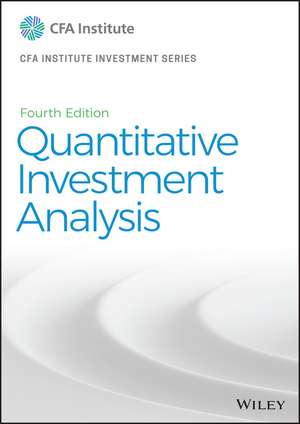
Quantitative Investment Analysis, Fourth Edition: CFA Institute Investment Series
Autor Cfa Instituteen Limba Engleză Hardback – 16 sep 2020
Structura acestei ediții este riguros organizată în jurul obiectivelor de învățare (Learning Outcome Statements), oferind un parcurs pedagogic care transformă conceptele statistice complexe în instrumente de lucru aplicabile. Quantitative Investment Analysis nu este doar un manual teoretic, ci un ghid metodologic care facilitează trecerea de la analiza de bază la tehnici avansate de modelare. Remarcăm efortul autorilor de a menține o consistență strictă a notațiilor matematice pe parcursul celor peste 900 de pagini, element esențial pentru un proces de studiu coerent. Această a patra ediție se distinge prin integrarea tehnologiilor moderne, extinzând aria de acoperire către algoritmii de Machine Learning și rolul Big Data în contextul investițional actual. Cititorul va parcurge etape critice, de la fundamentarea statistică la capitole de sinteză dedicate modelării factoriale, managementului riscului și simulărilor de tip backtesting. Pe linia practică a lucrării Investments de Michael McMillan, dar cu un focus mult mai pronunțat pe metodele cantitative și rigoarea matematică necesară testării strategiilor, volumul de față devine o referință autoritară pentru oricine activează în piețele financiare. Recomandăm acest volum pentru modul în care reușește să echilibreze teoria econometrică cu realitățile pieței. Spre deosebire de alte cursuri academice, abordarea CFA Institute pune accent pe aplicabilitate, oferind o multitudine de probleme practice, grafice și tabele care clarifică utilizarea metodelor cantitative în procesul de luare a deciziilor de investiții.



Preț: 658.86 lei
Preț vechi: 855.67 lei
-23%
Carte disponibilă
Livrare economică 11-25 noiembrie
Livrare express 27-31 octombrie pentru 81.48 lei
Specificații
ISBN-10: 1119743621
Pagini: 944
Dimensiuni: 192 x 257 x 52 mm
Greutate: 1.75 kg
Ediția:4. Auflage
Editura: John Wiley & Sons, Inc.
Colecția CFA Institute Investment Series
Seria CFA Institute Investment Series
Locul publicării:Hoboken, United States
V-ar putea interesa
-
 The Intelligent InvestorBenjamin Graham-20%Preț: 119.27 lei148.40 lei
 -
 -17%Preț: 598.20 lei720.47 lei
 -
 Frequently Asked Questions 2edPaul WilmottPreț: 351.13 lei
 -
 -19%Preț: 429.79 lei530.60 lei
 -
 Fixed Income Analysis, Fifth EditionCfa Institute-23%Preț: 656.91 lei853.12 lei
 -
 -23%Preț: 582.43 lei755.67 lei
 -
 Fundamentals of Investing, Global EditionLawrence GitmanPreț: 100.70 lei
 -
 The Truth About InvestingJonathan GuthriePreț: 122.10 lei
 -
 Investment Valuation, University EditionAswath Damodaran-19%Preț: 649.96 lei802.42 lei
 -
 The Elements of Quantitative InvestingGiuseppe A. Paleologo-8%Preț: 450.09 lei489.23 lei
 -
 The Only Three Questions That Still CountKen FisherPreț: 166.91 lei
 -
 Investing For Dummies, UK EditionDavid StevensonPreț: 157.74 lei
 -
 -23%Preț: 1470.36 lei1909.57 lei
 -
 -23%Preț: 1512.40 lei1964.15 lei
 -
 Friends That InvestSimran KaurPreț: 123.59 lei
 -
 Your Perfect PortfolioCullen RochePreț: 157.40 lei
 -
 CFA Program Curriculum 2020 Level I Volumes 1–6 Box SetCFA Institute-23%Preț: 1593.95 lei2070.06 lei
 -
 CFA Program Curriculum 2020 Level II Volumes 1–6 Box SetCFA Institute-11%Preț: 1559.16 lei1751.87 lei
 -
 -23%Preț: 1437.92 lei1867.43 lei
 -
 -25%Preț: 617.13 lei823.19 lei
De ce să citești această carte
Această carte este indispensabilă pentru analiștii financiari și investitorii care doresc să stăpânească instrumentele statistice moderne. Cititorul câștigă o înțelegere profundă a tehnicilor de Machine Learning și Big Data aplicate în finanțe. Este resursa ideală pentru cei care se pregătesc pentru examenul CFA sau pentru profesioniștii care au nevoie de un cadru riguros de analiză a riscului și testare a strategiilor de portofoliu.
Despre autor
CFA Institute este asociația globală a profesioniștilor în investiții care stabilește standardele pentru excelență tehnică și etică în industria financiară. Organizația administrează programele de certificare CFA (Chartered Financial Analyst) și CIPM la nivel mondial. Prin contribuțiile membrilor săi și ale experților din domeniu, institutul publică resurse educaționale de referință, precum seria CFA Institute Investment Series, care sintetizează cunoștințele colective ale practicienilor de top pentru a promova integritatea și competența în managementul investițiilor.
Notă biografică
Descriere
Cuprins
Acknowledgments xvii
About the CFA Institute Investment Series xix
Chapter 1 The Time Value of Money 1
Learning Outcomes 1
1. Introduction 1
2. Interest Rates: Interpretation 2
3. The Future Value of a Single Cash Flow 4
4. The Future Value of a Series of Cash Flows 13
5. The Present Value of a Single Cash Flow 16
6. The Present Value of a Series of Cash Flows 20
7. Solving for Rates, Number of Periods, or Size of Annuity Payments 27
8. Summary 38
Practice Problems 39
Chapter 2 Organizing, Visualizing, and Describing Data 45
Learning Outcomes 45
1. Introduction 45
2. Data Types 46
3. Data Summarization 54
4. Data Visualization 68
5. Measures of Central Tendency 85
6. Other Measures of Location: Quantiles 102
7. Measures of Dispersion 109
8. The Shape of the Distributions: Skewness 119
9. The Shape of the Distributions: Kurtosis 121
10. Correlation between Two Variables 125
11. Summary 132
Practice Problems 135
Chapter 3 Probability Concepts 147
Learning Outcomes 147
1. Introduction 148
2. Probability, Expected Value, and Variance 148
3. Portfolio Expected Return and Variance of Return 171
4. Topics in Probability 180
5. Summary 188
References 190
Practice Problem 190
Chapter 4 Common Probability Distributions 195
Learning Outcomes 195
1. Introduction to Common Probability Distributions 196
2. Discrete Random Variables 196
3. Continuous Random Variables 210
4. Introduction to Monte Carlo Simulation 228
5. Summary 231
References 233
Practice Problems 234
Chapter 5 Sampling and Estimation 241
Learning Outcomes 241
1. Introduction 242
2. Sampling 242
3. Distribution of the Sample Mean 248
4. Point and Interval Estimates of the Population Mean 251
5. More on Sampling 261
6. Summary 267
References 269
Practice Problems 270
Chapter 6 Hypothesis Testing 275
Learning Outcomes 275
1. Introduction 276
2. Hypothesis Testing 277
3. Hypothesis Tests Concerning the Mean 287
4. Hypothesis Tests Concerning Variance and Correlation 303
5. Other Issues: Nonparametric Inference 310
6. Summary 314
References 317
Practice Problems 317
Chapter 7 Introduction to Linear Regression 327
Learning Outcomes 327
1. Introduction 328
2. Linear Regression 328
3. Assumptions of the Linear Regression Model 332
4. The Standard Error of Estimate 335
5. The Coefficient of Determination 337
6. Hypothesis Testing 339
7. Analysis of Variance in a Regression with One Independent Variable 347
8. Prediction Intervals 350
9. Summary 353
References 354
Practice Problems 354
Chapter 8 Multiple Regression 365
Learning Outcomes 365
1. Introduction 366
2. Multiple Linear Regression 366
3. Using Dummy Variables in Regressions 381
4. Violations of Regression Assumptions 387
5. Model Specification and Errors in Specification 401
6. Models with Qualitative Dependent Variables 414
7. Summary 422
References 425
Practice Problems 426
Chapter 9 Time-Series Analysis 451
Learning Outcomes 451
1. Introduction to Time-Series Analysis 452
2. Challenges of Working with Time Series 454
3. Trend Models 454
4. Autoregressive (AR) Time-Series Models 464
5. Random Walks and Unit Roots 478
6. Moving-Average Time-Series Models 486
7. Seasonality in Time-Series Models 491
8. Autoregressive Moving-Average Models 496
9. Autoregressive Conditional Heteroskedasticity Models 497
10. Regressions with More than One Time Series 500
11. Other Issues in Time Series 504
12. Suggested Steps in Time-Series Forecasting 505
13. Summary 507
References 508
Practice Problems 509
Chapter 10 Machine Learning 527
Learning Outcomes 527
1. Introduction 527
2. Machine Learning and Investment Management 528
3. What is Machine Learning? 529
4. Overview of Evaluating ML Algorithm Performance 533
5. Supervised Machine Learning Algorithms 539
6. Unsupervised Machine Learning Algorithms 559
7. Neural Networks, Deep Learning Nets, and Reinforcement Learning 575
8. Choosing an Appropriate ML Algorithm 589
9. Summary 590
References 593
Practice Problems 593
Chapter 11 Big Data Projects 597
Learning Outcomes 597
1. Introduction 597
2. Big Data in Investment Management 598
3. Steps in Executing a Data Analysis Project: Financial Forecasting with Big Data 599
4. Data Preparation and Wrangling 603
5. Data Exploration Objectives and Methods 617
6. Model Training 629
7. Financial Forecasting Project: Classifying and Predicting Sentiment for Stocks 639
8. Summary 664
Practice Problems 665
Chapter 12 Using Multifactor Models 675
Learning Outcomes 675
1. Introduction 675
2. Multifactor Models and Modern Portfolio Theory 676
3. Arbitrage Pricing Theory 677
4. Multifactor Models: Types 683
5. Multifactor Models: Selected Applications 695
6. Summary 706
References 707
Practice Problems 708
Chapter 13 Measuring and Managing Market Risk 713
Learning Outcomes 713
1. Introduction 714
2. Understanding Value at Risk 714
3. Other Key Risk Measures-Sensitivity and Scenario Measures 735
4. Using Constraints in Market Risk Management 750
5. Applications of Risk Measures 755
6. Summary 764
References 766
Practice Problems 766
Chapter 14 Backtesting and Simulation 775
Learning Outcomes 775
1. Introduction 775
2. The Objectives of Backtesting 776
3. The Backtesting Process 776
4. Metrics and Visuals Used in Backtesting 792
5. Common Problems in Backtesting 801
6. Backtesting Factor Allocation Strategies 807
7. Comparing Methods of Modeling Randomness 813
8. Scenario Analysis 824
9. Historical Simulation versus Monte Carlo Simulation 828
10. Historical Simulation 830
11. Monte Carlo Simulation 835
12. Sensitivity Analysis 840
13. Summary 848
References 849
Practice Problems 849
Appendices 855
Glossary 865
About the Authors 883
About the CFA Program 885
Index 887