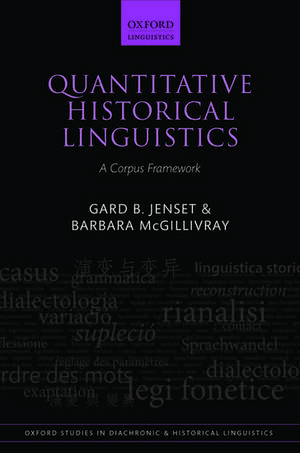
Quantitative Historical Linguistics: A Corpus Framework: Oxford Studies in Diachronic and Historical Linguistics, cartea 26
Autor Gard B. Jenset, Barbara McGillivrayen Limba Engleză Hardback – 5 oct 2017
Din seria Oxford Studies in Diachronic and Historical Linguistics
- 32%
 Preț: 635.46 lei
 - 19%
 Preț: 609.73 lei
 - 19%
 Preț: 705.84 lei
 - 32%
 Preț: 875.53 lei
 - 19%
 Preț: 703.43 lei
 - 23%
 Preț: 789.67 lei
 - 32%
 Preț: 696.59 lei
 - 31%
 Preț: 741.66 lei
 - 32%
 Preț: 664.85 lei
 - 31%
 Preț: 664.32 lei
 - 32%
 Preț: 658.65 lei
 - 11%
 Preț: 358.93 lei
 - 31%
 Preț: 959.41 lei
 - 31%
 Preț: 788.24 lei
 - 34%
 Preț: 948.32 lei
 - 31%
 Preț: 931.49 lei
 - 17%
 Preț: 334.32 lei
 - 33%
 Preț: 814.45 lei
 - 31%
 Preț: 820.75 lei
 - 30%
 Preț: 895.33 lei
 - 30%
 Preț: 898.35 lei
 - 31%
 Preț: 853.99 lei
 - 32%
 Preț: 991.57 lei
 - 30%
 Preț: 705.89 lei
 - 30%
 Preț: 966.16 lei
 - 31%
 Preț: 884.80 lei
 - 30%
 Preț: 899.77 lei
 - 30%
 Preț: 770.26 lei
 - 30%
 Preț: 813.33 lei
 - 34%
 Preț: 886.66 lei
 - 30%
 Preț: 951.13 lei
 - 30%
 Preț: 769.33 lei
 - 31%
 Preț: 1030.11 lei
 - 31%
 Preț: 825.63 lei
 - 31%
 Preț: 827.24 lei
 - 30%
 Preț: 696.69 lei
 - 31%
 Preț: 713.05 lei
 - 31%
 Preț: 692.74 lei
 - 30%
 Preț: 701.66 lei
 - 30%
 Preț: 734.32 lei
 - 30%
 Preț: 751.65 lei
 - 31%
 Preț: 634.30 lei
 - 31%
 Preț: 711.40 lei
 - 31%
 Preț: 810.28 lei
 - 29%
 Preț: 627.44 lei
 - 30%
 Preț: 810.09 lei
 - 32%
 Preț: 712.25 lei
Preț: 725.66 lei
Preț vechi: 1054.81 lei
-31%
Puncte Express: 1088
Carte tipărită la comandă
Livrare economică 10-16 decembrie
Livrare prin curier în România Termenul estimat este afișat lângă disponibilitate.
Transport gratuit pentru acest produs Plată online sau ramburs, în funcție de opțiunile comenzii.
Retur gratuit în 14 zile Comandă securizată și suport în română.
Specificații
ISBN-13: 9780198718178
ISBN-10: 0198718179
Pagini: 248
Dimensiuni: 173 x 242 x 20 mm
Greutate: 0.54 kg
Editura: OUP OXFORD
Colecția OUP Oxford
Seria Oxford Studies in Diachronic and Historical Linguistics
Locul publicării:Oxford, United Kingdom
ISBN-10: 0198718179
Pagini: 248
Dimensiuni: 173 x 242 x 20 mm
Greutate: 0.54 kg
Editura: OUP OXFORD
Colecția OUP Oxford
Seria Oxford Studies in Diachronic and Historical Linguistics
Locul publicării:Oxford, United Kingdom
Recenzii
Jenset and McGillivray's work is novel in applying this to historical linguistics, providing a step-by-step guide to the research process (Chapter 7) and case studies on historical linguistic phenomena. Overall, it is a clearly written, well-conceived guide to quantitative historical linguistics, combin-ing both theoretical background and practical instructions.
Corpus-driven quantitative approaches have huge potentials in historical linguistics, and this treatise on methodology provides a firm starting point for historical linguists to know and accept these approaches, in an informative and accessible manner. I believe scholars will greatly benefit from reading this book.
Corpus-driven quantitative approaches have huge potentials in historical linguistics, and this treatise on methodology provides a firm starting point for historical linguists to know and accept these approaches, in an informative and accessible manner. I believe scholars will greatly benefit from reading this book.
Notă biografică
Gard B. Jenset studied English, history, and computer science before earning his PhD in English linguistics, specializing in historical corpus linguistics, from the University of Bergen (2010). After working as an associate professor of English Linguistics at Bergen University College, he took up work on artificial intelligence, natural language processing, and computational linguistics in industry. He has published research in historical linguistics, corpus linguistics, and applied linguistics.Barbara McGillivray holds a degree in Mathematics and one in Classics from the University of Florence (Italy), and a Ph.D. in Computational Linguistics from the University of Pisa (2010). She has worked as a language technologist in the Dictionary division of Oxford University Press and as a data scientist in the Open Research Group of Springer Nature. She is currently a Research Fellow at the Alan Turing Institute/University of Cambridge. She has published in the fields of mathematics, corpus linguistics, computational linguistics, historical linguistics, and lexicography. Her monograph Methods in Latin Computational Linguistics was published by Brill in 2013.