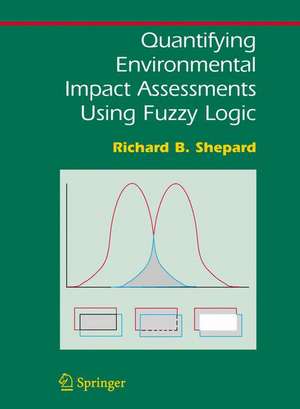
Quantifying Environmental Impact Assessments Using Fuzzy Logic
Autor Richard B Sheparden Limba Engleză Hardback – 23 iun 2005
First, issues related to current environmental impact assessment methods are discussed. Then the book discusses how lessons learned from computational intelligence can address these problems. It describes how a systematic, logical approach to environmental assessment can be applied to a variety of complex situations. Finally, the design and implementation of a more objective and powerful assessment is demonstrated through a worked example. Explanations of computational intelligence techniques and discussions of helpful software are intended to benefit those people actually preparing and using environmental assessments--in language that makes the process transparent and transferable to all types of systems.
Preț: 619.72 lei
Preț vechi: 729.08 lei
-15%
Puncte Express: 930
Preț estimativ în valută:
109.64€ • 129.27$ • 95.23£
109.64€ • 129.27$ • 95.23£
Carte tipărită la comandă
Livrare economică 23 martie-06 aprilie
Specificații
ISBN-13: 9780387243986
ISBN-10: 0387243984
Pagini: 264
Ilustrații: XXIV, 264 p. 42 illus.
Dimensiuni: 161 x 243 x 20 mm
Greutate: 0.53 kg
Ediția:2005 edition
Editura: Springer
Locul publicării:New York, NY, United States
ISBN-10: 0387243984
Pagini: 264
Ilustrații: XXIV, 264 p. 42 illus.
Dimensiuni: 161 x 243 x 20 mm
Greutate: 0.53 kg
Ediția:2005 edition
Editura: Springer
Locul publicării:New York, NY, United States
V-ar putea interesa
-
 Cradle to CradleMichael Braungart-21%Preț: 53.44 lei67.89 lei
 -
 The Vanishing Face of GaiaJames Lovelock-21%Preț: 58.60 lei74.55 lei
 -
 -18%Preț: 254.28 lei309.47 lei
 -
 Ecological Methods in Forest Pest ManagementDavid Wainhouse-37%Preț: 634.30 lei1006.02 lei
 -
 Symbiotic InteractionsA. E. Douglas-37%Preț: 281.20 lei446.35 lei
 -
 -12%Preț: 328.85 lei374.72 lei
 -
 A Rough Ride to the FutureJames LovelockPreț: 74.55 lei
 -
 COLDStreeverPreț: 119.13 lei
 -
 Oil and HoneyBill McKibbenPreț: 113.11 lei
 -
 -28%Preț: 83.93 lei116.38 lei
 -
 Scruton, R: Green PhilosophyRoger Scruton-19%Preț: 84.40 lei104.37 lei
 -
 WILD LAW SECOND EDITION SECO 2Cormac Cullinan-42%Preț: 112.41 lei193.16 lei
Public țintă
ResearchCuprins
The Traditional Approach.- General Principles.- Scoping.- Baseline Conditions.- Alternatives.- Impact Assessment.- Writing the Impact Statement.- The Modern Approach.- Moving to the New Paradigm.- to Fuzzy Sets and Logic.- Environmental Conditions.- Impact Inference and Assessment.- Multi-Objective, Multi-Criteria Decision-Making.- Application.- Scoping.- Baseline Environment.- Project Alternatives.- Results and Conclusions.
Notă biografică
Richard B. Shepard, Ph.D., is President of Applied Ecosystem Services, Inc.
Textul de pe ultima copertă
Environmental impact assessments are required for a wide range of projects throughout the world. These assessments have increasingly involved complex, political decision-making and incorporated values and beliefs of both stakeholders and interested parties. However, the results are often ineffective because values and beliefs are not easily quantifiable, and decisions are considered subjective. This analysis recognizes these problems and proposes practical methods based on fuzzy logic that will enable people preparing assessments to define terms and quantify opinions and input so that they are agreed upon by all involved parties. Fuzzy logic also quantifies the complex environmental, economic and social conditions that are present and are predicted by project alternatives. The author places special emphasis on the types of issues that frequently arise in NEPA environmental assessments and environmental impact statements and in similar regulations that are used in jurisdictions regionally and internationally. The new methods are intended to reduce the time and cost of assessments, while producing justifiable and legally defensible results.
First, issues related to current environmental impact assessment methods are discussed. Then the book discusses how lessons learned from computational intelligence can address these problems. It describes how a systematic, logical approach to environmental assessment can be applied to a variety of complex situations. Finally, the design and implementation of a more objective and powerful assessment is demonstrated through a worked example. Explanations of computational intelligence techniques and discussions of helpful software are intended to benefit those people actually preparing and using environmental assessments--in language that makes the process transparent and transferable to all types of systems.
First, issues related to current environmental impact assessment methods are discussed. Then the book discusses how lessons learned from computational intelligence can address these problems. It describes how a systematic, logical approach to environmental assessment can be applied to a variety of complex situations. Finally, the design and implementation of a more objective and powerful assessment is demonstrated through a worked example. Explanations of computational intelligence techniques and discussions of helpful software are intended to benefit those people actually preparing and using environmental assessments--in language that makes the process transparent and transferable to all types of systems.
Caracteristici
Discusses how lessons learned from computational science can address the current problems of environmental impact assessment Describes how a systematic, logical approach to environmental assessment can reduce the time and cost of assessments, while producing justifiable results A detailed case study designing and implementing a more objective and powerful method of assessment is demonstrated