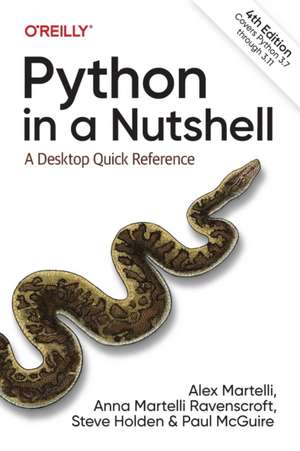
Python in a Nutshell: A Desktop Quick Reference
Autor Alex Martelli, Anna Ravenscroft, Paul McGuire, Steve Holdenen Limba Engleză Paperback – 24 ian 2023
Implementarea unor soluții software robuste și scalabile necesită o înțelegere profundă a mecanismelor interne ale limbajului, iar Python in a Nutshell oferă exact acest fundament tehnic. Cititorul va reuși să construiască arhitecturi de cod moderne, utilizând cele mai recente funcționalități din versiunea 3.10 și explorând în avanpremieră noutățile din 3.11. Ne-a atras atenția rigoarea cu care autorii, conduși de Alex Martelli, tratează subiecte esențiale precum adnotările de tip și reprezentarea obiectelor, elemente critice pentru mentenanța proiectelor de anvergură. Abordarea acestui volum diferă de Pragmatic Python Programming prin caracterul său de referință exhaustivă; în timp ce volumul lui Gabor Guta se concentrează pe concepte fundamentale și exemple practice punctuale, Python in a Nutshell este un instrument de consultare rapidă pentru programatorul profesionist care are nevoie de precizie tehnică imediată. De asemenea, față de Learning Python 5ed, care adoptă un stil tutorial de tip curs, lucrarea de față elimină redundanțele în favoarea unei structuri dense, ideale pentru cei care cunosc deja bazele și vor să stăpânească idiomurile specifice Python-ului modern. Putem afirma că această a patra ediție de la O'Reilly este indispensabilă pentru structurarea corectă a proiectelor și pentru procesele de debugging avansat. Volumul acoperă lacunele dintre teorie și execuție, oferind specificații clare despre modul în care Python gestionează datele, asigurând astfel o tranziție fluidă către un cod eficient și curat.
Preț: 450.46 lei
Preț vechi: 563.07 lei
-20%
Carte disponibilă
Livrare economică 07-21 noiembrie
Livrare express 24-30 octombrie pentru 78.12 lei
Specificații
ISBN-10: 1098113551
Pagini: 600
Dimensiuni: 153 x 228 x 38 mm
Greutate: 1 kg
Ediția:4. Auflage
Editura: O'Reilly
V-ar putea interesa
-
 Python DistilledDavid Beazley-20%Preț: 288.43 lei360.54 lei
 -
 Python Without FearBrian Overland-20%Preț: 219.31 lei274.14 lei
 -
 Programming PythonMark Lutz-20%Preț: 402.15 lei502.70 lei
 -
 -20%Preț: 316.22 lei395.27 lei
 -
 Python All-in-One For DummiesJohn C. Shovic-20%Preț: 235.56 lei294.46 lei
 -
 Python Programming LanguageRobin Nixon-20%Preț: 66.67 lei83.33 lei
 -
 -37%Preț: 186.21 lei295.59 lei
 -
 -36%Preț: 202.38 lei316.03 lei
 -
 -20%Preț: 272.59 lei340.75 lei
 -
 The Quick Python Book, Fourth EditionNaomi Ceder-20%Preț: 350.74 lei438.43 lei
 -
 -35%Preț: 258.35 lei396.35 lei
 -
 -34%Preț: 293.68 lei447.85 lei
 -
 -36%Preț: 236.32 lei367.47 lei
 -
 The Rust Programming Language, 3rd EditionCarol Nichols-20%Preț: 314.70 lei393.37 lei
 -
 -37%Preț: 186.29 lei295.65 lei
 -
 Python in Easy StepsMike Mcgrath-20%Preț: 74.68 lei93.35 lei
 -
 Python in Easy StepsMike Mcgrath-20%Preț: 82.04 lei102.55 lei
 -
 Advanced Guide to Python 3 ProgrammingJohn Hunt-20%Preț: 548.97 lei686.21 lei
De ce să citești această carte
Recomandăm această carte programatorilor care doresc o sursă de referință tehnică precisă pentru Python 3.10. Cititorul câștigă capacitatea de a scrie cod idiomatic și de a utiliza corect sistemul de tipuri al limbajului. Este un instrument practic pentru optimizarea fluxului de lucru, oferind răspunsuri rapide la probleme complexe de structură și debugging, fără a trece prin introduceri lungi pentru începători.
Despre autor
Alex Martelli este o figură proeminentă în comunitatea Python, având o carieră solidă începută cu opt ani de activitate în cadrul IBM Research. Expertiza sa tehnică s-a consolidat pe parcursul a 13 ani ca consultant software senior la think3 inc, unde a dezvoltat biblioteci complexe, protocoale de rețea și motoare GUI. Această experiență vastă în inginerie software se reflectă în precizia și pragmatismul cu care abordează limbajul Python în lucrările sale, fiind recunoscut pentru capacitatea de a explica mecanismele interne ale sistemelor de calcul.
Descriere
Python was recently ranked as today's most popular programming language on the TIOBE index, thanks to its broad applicability to design and prototyping to testing, deployment, and maintenance. With this updated fourth edition, you'll learn how to get the most out of Python, whether you're a professional programmer or someone who needs this language to solve problems in a particular field. Carefully curated by recognized experts in Python, this new edition focuses on version 3.10, bringing this seminal work on the Python language fully up to date on five version releases, including preview coverage of upcoming 3.11 features.
This handy guide will help you:Learn how Python represents data and program as objectsUnderstand the value and uses of type annotationsExamine which language features appeared in which recent versionsDiscover how to use modern Python idiomaticallyLearn ways to structure Python projects appropriatelyUnderstand how to debug Python code
Notă biografică
Alex Martelli has been programming for 40 years, mainly in Python for the recent half of that time. He wrote the first two editions of Python in a Nutshell, and co-authored the first two editions of the Python Cookbook and the third edition of Python in a Nutshell. He is a PSF Fellow and Core Committer, and won the 2002 Activators' Choice Award and the 2006 Frank Willison Memorial Award for contributions to the Python community. He is active on Stack Overflow and a frequent speaker at technical conferences. He's been living in Silicon Valley with his wife Anna for over 16 years, and working at Google throughout this time, currently as Senior Staff Engineer leading long tail tech support for Google Cloud.
Anna Martelli Ravenscroft is a PSF Fellow and winner of the 2013 Frank Willison Memorial Award for contributions to the Python community. She co-authored the second edition of the Python Cookbook and 3rd edition of Python in a Nutshell. She has been a technical reviewer for many Python books and is a regular speaker and track chair at technical conferences. Anna lives in Silicon Valley with her husband Alex, two dogs, one cat, and several chickens.
Passionate about programming and community, Steve Holden has worked with computers since 1967 and started using Python at version 1.4 in 1995. He has since written about Python, created instructor-led training, delivered it to an international audience built 40 hours of video training for reluctant Python users. An Emeritus Fellow of the Python Software Foundation, Steve served as a director of the Foundation for eight years and as its chairman for three; he created PyCon, the Python community's international conference series and was presented with the Simon Willison Award for services to the Python community. He lives in Hastings, England and works as Technical Architect for the UK Department for International Trade, where he is responsible for the systems that maintain and regulate the trading environment.
Paul McGuire has been programming for 40+ years, in languages ranging from FORTRAN to Pascal, PL/I, COBOL, Smalltalk, Java, C/C++/C#, and Tcl, settling on Python as his language-of-choice in 2001. He is the author and maintainer of the popular pyparsing module, as well as littletable and plusminus. Paul authored the O'Reilly Short Cut Getting Started with Pyparsing, and has written and edited articles for Python Magazine. He has also spoken at PyCon and at the Austin Python Users' Group, and is active on StackOverflow. Paul now lives in Austin, Texas with his wife and dog, and works for Indeed as a Site Reliability Engineer, helping people get jobs!