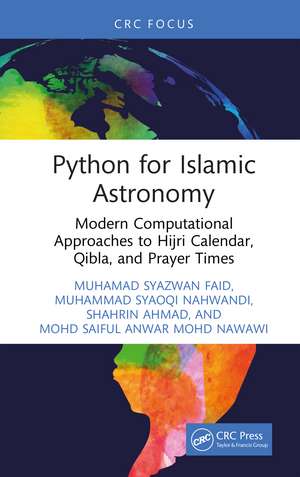
Python for Islamic Astronomy: Modern Computational Approaches to Hijri Calendar, Qibla, and Prayer Times
Autor Muhamad Syazwan Faid, Muhammad Syaoqi Nahwandi, Shahrin Ahmad, Mohd Saiful Anwar Mohd Nawawien Limba Engleză Hardback – 6 noi 2025
Key Features:
- The first book to provide practical guidance for using Python, supplemented by an interactive coding website, to solve real-world problems in the field of Islamic Astronomy.
- Uses the latest and most-trusted methods in Islamic Astronomy, ensuring all calculations are accurate and based on well-recognized references.
- Includes visualizations that help readers understand key topics like Qibla direction, prayer time zones, and lunar crescent visibility, making the content practical and user-friendly.
Preț: 452.13 lei
Preț vechi: 531.91 lei
-15%
Puncte Express: 678
Carte tipărită la comandă
Livrare economică 07-21 decembrie
Livrare prin curier în România Termenul estimat este afișat lângă disponibilitate.
Transport gratuit pentru acest produs Plată online sau ramburs, în funcție de opțiunile comenzii.
Retur gratuit în 14 zile Comandă securizată și suport în română.
Specificații
ISBN-13: 9781041082613
ISBN-10: 1041082614
Pagini: 208
Ilustrații: 42
Dimensiuni: 138 x 216 x 13 mm
Greutate: 0.38 kg
Ediția:1
Editura: CRC Press
Colecția CRC Press
ISBN-10: 1041082614
Pagini: 208
Ilustrații: 42
Dimensiuni: 138 x 216 x 13 mm
Greutate: 0.38 kg
Ediția:1
Editura: CRC Press
Colecția CRC Press
Public țintă
General, Postgraduate, Professional Reference, Undergraduate Advanced, and Undergraduate CoreCuprins
CHAPTER 1 APPLICATION OF ISLAMIC ASTRONOMY FOR MUSLIM
CHAPTER 2 WHY PYTHON MATTERS IN ISLAMIC ASTRONOMY
CHAPTER 3 IMPORTANCE OF ACCURACY OF CALCULATION
CHAPTER 4 SETTING UP PYTHON FOR ASTRONOMICAL CALCULATIONS
CHAPTER 5 QIBLAH CALCULATION USING PYTHON
CHAPTER 6 ISTIWA’ A’ZAM AND RASHDUL QIBLA
CHAPTER 7 PRAYER TIMES CALCULATION
CHAPTER 8 MOONSIGHTING OBSERVATION DATA COMPUTATION
CHAPTER 9 QIBLAH COMPASS VISUALIZATION
CHAPTER 10 SUN POSITION DURING PRAYER TIMES VISUALIZATION
CHAPTER 11 LUNAR CRESCENT OBSERVATION DATA VISUALISATION
CHAPTER 12 CONCLUSION
CHAPTER 2 WHY PYTHON MATTERS IN ISLAMIC ASTRONOMY
CHAPTER 3 IMPORTANCE OF ACCURACY OF CALCULATION
CHAPTER 4 SETTING UP PYTHON FOR ASTRONOMICAL CALCULATIONS
CHAPTER 5 QIBLAH CALCULATION USING PYTHON
CHAPTER 6 ISTIWA’ A’ZAM AND RASHDUL QIBLA
CHAPTER 7 PRAYER TIMES CALCULATION
CHAPTER 8 MOONSIGHTING OBSERVATION DATA COMPUTATION
CHAPTER 9 QIBLAH COMPASS VISUALIZATION
CHAPTER 10 SUN POSITION DURING PRAYER TIMES VISUALIZATION
CHAPTER 11 LUNAR CRESCENT OBSERVATION DATA VISUALISATION
CHAPTER 12 CONCLUSION
Notă biografică
Muhamad Syazwan Faid is a senior lecturer at the Department of Islamic Studies, Centre for General Studies and Co-Curricular, Universiti Tun Hussein Onn Malaysia (UTHM). His expertise lies at the intersection of Islamic Astronomy and computational sciences, where he integrates traditional Islamic astronomical practices with modern technological advancements.
Muhammad Syaoqi Nahwandi is a lecturer at UIN Syekh Nurjati Cirebon, where he specializes in Islamic Astronomy and its integration with modern scientific techniques. His academic focus includes lunar crescent visibility, prayer time calculations, and Hijri calendar determination.
Shahrin Ahmad is a renowned Malaysian astronomer and the founder of Falak Online, a platform dedicated to promoting Islamic Astronomy and public astronomy education. With extensive experience in observational astronomy, Shahrin is widely regarded as a leading figure in advancing understanding and application of Islamic astronomical practices.
Mohd Saiful Anwar Mohd Nawawi is an associate professor at the Department of Fiqh-Usul and Applied Sciences, Academy of Islamic Studies, University of Malaya (UM). A renowned scholar in Islamic Astronomy, he specializes in the development of methodologies for Hijri calendar determination, Qibla direction, and prayer time calculations.
Muhammad Syaoqi Nahwandi is a lecturer at UIN Syekh Nurjati Cirebon, where he specializes in Islamic Astronomy and its integration with modern scientific techniques. His academic focus includes lunar crescent visibility, prayer time calculations, and Hijri calendar determination.
Shahrin Ahmad is a renowned Malaysian astronomer and the founder of Falak Online, a platform dedicated to promoting Islamic Astronomy and public astronomy education. With extensive experience in observational astronomy, Shahrin is widely regarded as a leading figure in advancing understanding and application of Islamic astronomical practices.
Mohd Saiful Anwar Mohd Nawawi is an associate professor at the Department of Fiqh-Usul and Applied Sciences, Academy of Islamic Studies, University of Malaya (UM). A renowned scholar in Islamic Astronomy, he specializes in the development of methodologies for Hijri calendar determination, Qibla direction, and prayer time calculations.
Descriere
Python for Islamic Astronomy responds to the urgent need to improve calculation accuracy and data visualizations in the field of Islamic Astronomy. This field is becoming increasingly complex, leading to mistakes in determining the beginning of the Hijri month, Qibla directions and prayer times.