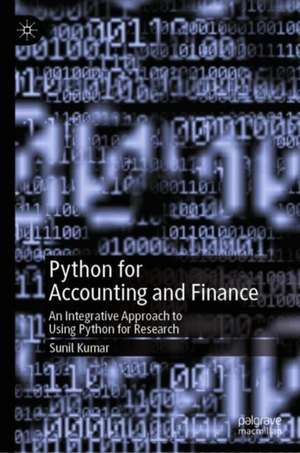
Python for Accounting and Finance
Autor Sunil Kumaren Limba Engleză Hardback – 27 iun 2024
The book uses case studies to illustrate how Python can enhance traditional research methods in accounting and finance, not only allowing the reader to gain a firm understanding of Pythonprogramming but also equipping them with the skills to apply Python to accounting, finance, and broader business research. Whether you are a PhD student, a professor, an industry professional, or a financial researcher, this book provides the key to unlocking the full potential of Python in research.
Preț: 623.56 lei
Preț vechi: 733.61 lei
-15%
Puncte Express: 935
Carte tipărită la comandă
Livrare economică 17-31 decembrie
Livrare prin curier în România Termenul estimat este afișat lângă disponibilitate.
Transport gratuit pentru acest produs Plată online sau ramburs, în funcție de opțiunile comenzii.
Retur gratuit în 14 zile Comandă securizată și suport în română.
Specificații
ISBN-13: 9783031546792
ISBN-10: 3031546792
Pagini: 524
Ilustrații: XVI, 508 p. 500 illus., 33 illus. in color.
Dimensiuni: 160 x 241 x 34 mm
Greutate: 0.91 kg
Ediția:2024
Editura: Springer
Locul publicării:Cham, Switzerland
ISBN-10: 3031546792
Pagini: 524
Ilustrații: XVI, 508 p. 500 illus., 33 illus. in color.
Dimensiuni: 160 x 241 x 34 mm
Greutate: 0.91 kg
Ediția:2024
Editura: Springer
Locul publicării:Cham, Switzerland
V-ar putea interesa
-
 Just Enough Data Science and Machine LearningMark LevenePreț: 329.91 lei
-
 -18%Preț: 744.18 lei907.54 lei
-
 -19%Preț: 495.00 lei611.12 lei
-
 Accounting and Finance for Non-Accounting StudentsEllie Franklin-13%Preț: 485.56 lei558.11 lei
-
 Streamlining Your Research Laboratory with PythonMark F Russo-19%Preț: 572.38 lei706.65 lei
-
 Python in Excel Step-by-StepDavid Langer-20%Preț: 295.33 lei369.16 lei
-
 Statistical Analysis with Python For DummiesJoseph SchmullerPreț: 237.16 lei
-
 Preț: 404.96 lei
-
 Python for Data Science: A Hands-On IntroductionYuli Vasiliev-20%Preț: 292.40 lei365.49 lei
-
 -36%Preț: 200.70 lei312.88 lei
-
 -34%Preț: 297.28 lei447.85 lei
-
 Python for Excel Users: Know Excel? You Can Learn PythonTracy Stephens-35%Preț: 241.34 lei368.95 lei
-
 PythonMartin Czygan-23%Preț: 644.95 lei837.61 lei
-
 Book of MoneyMonzoPreț: 86.15 lei
-
 Brilliant DataDiederick Thiel-10%Preț: 131.15 lei145.02 lei
-
 How to Make AI UsefulMagnus ReinerPreț: 78.62 lei
-
 Preț: 462.84 lei
-
 Business Analytics with R and PythonDavid L. Olson-20%Preț: 433.90 lei542.38 lei
-
 Multivariate Analysis and Machine Learning TechniquesSrikrishnan Sundararajan-20%Preț: 569.31 lei711.63 lei
Cuprins
Chapter 1: Introduction and Fundamentals.- Chapter 2: Data Acquisition and Cleaning.- Chapter 3: Exploratory Data Analysis and Visualization.- Chapter 4: Natural Language Processing and Text Analysis.- Chapter 5: Machine Learning and Predictive Analytics.- Chapter 6: Advanced Topics.
Notă biografică
Dr. Sunil Kumar is currently serving as an Associate Professor of Economics at the Faculty of Economics, South Asian University (SAU), New Delhi. He is also associated with Punjab School of Economics, Guru Nanak Dev University, Amritsar. He has more than 20 years of teaching experience in subjects related to Quantitative Methods, Macroeconomics, and Econometrics. His research interests include data envelopment analysis, stochastic frontier analysis, banking efficiency and industrial productivity. He has published more than three dozen research papers in journals of national and international repute including Economic Change and Restructuring, Macroeconomics and Finance in Emerging Market Economies, the American Journal of Accounting and Finance, International Journal of Productivity and Performance Management, International Review of Economics, Benchmarking, Global Business Review, etc. He also wrote a research book entitled, "Productivity and Factor Substitution: Theory and Analysis". His professional memberships include the Indian Society of Regional Science and Indian Economic Association.
Dr. Rachita Gulati is an Assistant Professor in Economics at Department of Humanities and Social Sciences, Indian Institute of Technology (IIT) Roorkee, Uttarakhand. Before joining IIT Roorkee, she was a core faculty of Indian Institute of Management (IIM) Kashipur, Uttarakhand. Her teaching interests include Applied Econometrics, Managerial Economics, and Quantitative Methods for Economists and her research interests include Efficiency and Productivity Analysis using Frontier Approaches and the Indian Banking Sector. Her research work focuses on financial economics in India and bears important policy implications for further reforms in the Indian banking sector. She has published research papers in journals of national and international repute. In 2008, she received the Best Paper Award from the Global Academy of Business andEconomics Research (GABER), USA.
Textul de pe ultima copertă
This book is a comprehensive guide to the application of Python in accounting, finance, and other business disciplines. This book is more than a Python tutorial; it is an integrative approach to using Python for practical research in these fields. The book begins with an introduction to Python and its key libraries. It then covers real-world applications of Python, covering data acquisition, cleaning, exploratory data analysis, visualization, and advanced topics like natural language processing, machine learning, predictive analytics, and deep learning. What sets this book apart is its unique blend of theoretical knowledge and real-world examples, supplemented with ready-to-use code. It doesn't stop at the syntax; it shows how to apply Python to tackle actual analytical problems.
The book uses case studies to illustrate how Python can enhance traditional research methods in accounting and finance, not only allowing the reader to gain a firm understanding of Python programming but also equipping them with the skills to apply Python to accounting, finance, and broader business research. Whether you are a PhD student, a professor, an industry professional, or a financial researcher, this book provides the key to unlocking the full potential of Python in research.
Sunil Kumar, Ph.D., C.P.A., currently serves as an assistant professor of Accounting at the Mario J. Gabelli School of Business, Roger Williams University, USA. He is a seasoned academic with a diversified research portfolio. His innovative research approach is deeply rooted in the application of technology, distinguishing him in the academic field of accounting and finance. His command over Python and other advanced computational tools allows him to integrate complex technological processes into his research, enabling a nuanced and comprehensive understanding of accounting and finance phenomena. He is currently involved in several projects that use machine learning and deep learning approaches for predictive modeling in financial contexts, further emphasizing his commitment to leveraging technology in research.