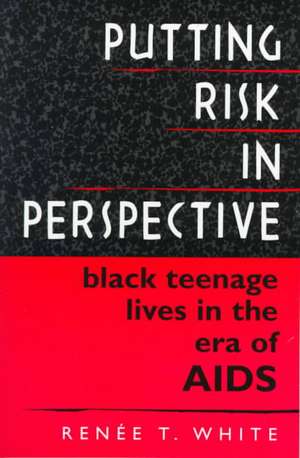
Putting Risk in Perspective: Black Teenage Lives in the Era of AIDS
Autor Renée T. Whiteen Limba Engleză Paperback – 23 dec 1998
Putting Risk in Perspective explores the many factors associated with HIV infection among young black women. HIV infection often occurs as a result of high risk behavior. Understanding what causes a young woman to take sexual and reproductive risks requires a consideration of the kinds of life issues she faces.
Drawing on ethnographic study and interviews, Renée T. White introduces to the reader many young women who are dealing with economic pressures, family relationships, dating and courtship, intimate relationship issues, and questions of sexual identity. These along with the mythology surrounding HIV and AIDS-and knowledge about contraception-influence whether or not a black teenager will engage in risky activity. This powerful book shows why the fight against AIDS must incorporate a commitment to improving the social and economic opportunities available to young black women.
Preț: 255.41 lei
Preț vechi: 334.15 lei
-24%
Puncte Express: 383
Carte tipărită la comandă
Livrare economică 28 noiembrie-12 decembrie
Livrare prin curier în România Termenul estimat este afișat lângă disponibilitate.
Transport gratuit de la 400.00 lei Plată online sau ramburs, în funcție de opțiunile comenzii.
Retur gratuit în 14 zile Comandă securizată și suport în română.
Specificații
ISBN-13: 9780847685875
ISBN-10: 084768587X
Pagini: 228
Dimensiuni: 148 x 226 x 14 mm
Greutate: 0.3 kg
Ediția:New.
Editura: Bloomsbury Publishing
Colecția Rowman & Littlefield
Locul publicării:New York, United States
ISBN-10: 084768587X
Pagini: 228
Dimensiuni: 148 x 226 x 14 mm
Greutate: 0.3 kg
Ediția:New.
Editura: Bloomsbury Publishing
Colecția Rowman & Littlefield
Locul publicării:New York, United States
Cuprins
Chapter 1 Introduction: To Be Young, Female, and Black
Chapter 2 Picturing the AIDS Epidemic
Chapter 3 In the City
Chapter 4 Talking to Girlfriends and Family
Chapter 5 Building Relationships: Love, Dating, and Romance
Chapter 6 Contraception: Safer Sex or Birth Control?
Chapter 7 Ultimate Risk: Perceptions of AIDS and HIV
Chapter 8 Just Say No?: Reflections on the Reality of AIDS
Chapter 9 Appendix 1: Description of the Study
Chapter 10 Appendix 2: HIV- and AIDS-Related Resources
Chapter 11 Notes
Chapter 12 References
Chapter 13 Index
Chapter 2 Picturing the AIDS Epidemic
Chapter 3 In the City
Chapter 4 Talking to Girlfriends and Family
Chapter 5 Building Relationships: Love, Dating, and Romance
Chapter 6 Contraception: Safer Sex or Birth Control?
Chapter 7 Ultimate Risk: Perceptions of AIDS and HIV
Chapter 8 Just Say No?: Reflections on the Reality of AIDS
Chapter 9 Appendix 1: Description of the Study
Chapter 10 Appendix 2: HIV- and AIDS-Related Resources
Chapter 11 Notes
Chapter 12 References
Chapter 13 Index
Recenzii
Renée White listened carefully to teenage women speaking about love, sex, motherhood, HIV disease and the future, keeping in sight the links between the women's personal behaviors and broader social contexts. Her meticulous analysis shows us that adolescents and health organisations may hold different views about what constitutes risky sexual behavior, why condoms are so seldom used, and why current health education fails to have an impact on the lives of young black women living in poverty. Dispensing with many popularly held assumptions about teenage sexual behavior, this book clears the path for more finely tuned and effective forms of health intervention and evaluation.
This book demonstrates why the fight against AIDS must include a responsibility to improve the social and economic opportunities available to young black women.
Putting Risk in Perspective is a powerful, thought-provoking book that examines one of the most challenging problems confronting young black female Americans today-their increasing risk of infection from HIV. White's book does succeed on many levels. First, it points to the importance of the relative meaning of the risk. Secondly, she bases her analyses largely on the assumption that racial identity and social class affect sexual and reproductive behavior. Third, her research provides compelling evidence that efforts to reduce poverty and inequality would immediately diminish the new cases of HIV infection among young women who are poor.
White's work goes beyond a mere identification of the issue of condom negotiation. She explores poverty, social class, parental relationships, friends and community role models as contributing factors in the development of sexual attidues and behaviors of Black adolescent females. It is a valuable tool as a reader for social work, nursing, education, psychology, medicine and other human services students.
Reports on results of an investigation of the sexual lives of 53 urban, female, African-American teenagers in the era of acquired immune deficiency syndrome (AIDS), drawing on ethnographic fieldwork conducted in the early 1990s in New Haven, CTTTTT
This book demonstrates why the fight against AIDS must include a responsibility to improve the social and economic opportunities available to young black women.
Putting Risk in Perspective is a powerful, thought-provoking book that examines one of the most challenging problems confronting young black female Americans today-their increasing risk of infection from HIV. White's book does succeed on many levels. First, it points to the importance of the relative meaning of the risk. Secondly, she bases her analyses largely on the assumption that racial identity and social class affect sexual and reproductive behavior. Third, her research provides compelling evidence that efforts to reduce poverty and inequality would immediately diminish the new cases of HIV infection among young women who are poor.
White's work goes beyond a mere identification of the issue of condom negotiation. She explores poverty, social class, parental relationships, friends and community role models as contributing factors in the development of sexual attidues and behaviors of Black adolescent females. It is a valuable tool as a reader for social work, nursing, education, psychology, medicine and other human services students.
Reports on results of an investigation of the sexual lives of 53 urban, female, African-American teenagers in the era of acquired immune deficiency syndrome (AIDS), drawing on ethnographic fieldwork conducted in the early 1990s in New Haven, CTTTTT