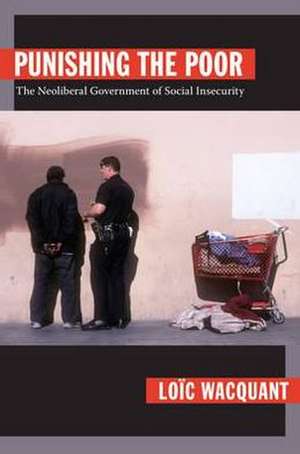
Punishing the Poor
Autor Loïc Wacquanten Limba Engleză Hardback – 22 mai 2009
În capitolul introductiv, Punishing the Poor poziționează Statele Unite ca un laborator viu pentru viitorul neoliberal, propunând o teză provocatoare: explozia populației carcerale nu este un răspuns la insecuritatea criminală, ci la insecuritatea socială generată de fragmentarea muncii salariale. Observăm cum Loïc Wacquant demontează mitul statului minimal, demonstrând că neoliberalismul presupune, de fapt, un stat penal hipertrofiat și intruziv. Autorul explorează modul în care elitele politice au orchestrat o „teatralizare a moralității”, transformând figuri marginale precum „mama asistată social” sau „delincventul de ghetou” în ținte ale oprobiului public pentru a compensa deficitul de legitimitate al guvernului. Structura volumului este riguros împărțită pentru a evidenția simbioza dintre asistența socială restrictivă și sistemul penal expansiv. În prima parte, este analizată „sărăcia statului social”, în timp ce partea a doua se concentrează pe „măreția statului penal”, culminând cu o analiză sociologică dură a închisorii ca ghetou surogat. Comparabil cu Criminal Justice and Neoliberalism de E. Bell în rigurozitatea cu care examinează rădăcinile politicilor punitive, volumul de față se distinge prin cadrul analitic unitar care tratează justiția penală și asistența socială ca două fețe ale aceleiași monede politice. Această lucrare rafinează temele explorate anterior de autor în The Invention of the 'Underclass', trecând de la demontarea terminologiilor sociologice la o critică sistemică a modului în care statul disciplinează precaritatea. Punishing the Poor nu este doar o analiză a criminalității, ci o radiografie a modului în care guvernarea neoliberală reconfigurează cetățenia democratică prin coerciție și supraveghere panoptică.
Preț: 767.91 lei
Preț vechi: 871.96 lei
-12%
Carte indisponibilă temporar
Specificații
ISBN-10: 0822344041
Pagini: 408
Dimensiuni: 159 x 241 x 32 mm
Greutate: 0.72 kg
Ediția:New.
Editura: Duke University Press
V-ar putea interesa
-
 May God Have Mercy: A True Story of Crime and PunishmentJohn C. TuckerPreț: 114.10 lei
 -
 Worse Than SlaveryDavid M. OshinskyPreț: 109.17 lei
 -
 Urban OutcastsLoic (University of California at Berkeley) WacquantPreț: 158.95 lei
 -
 ScrewedRonnie Thompson-26%Preț: 68.38 lei92.64 lei
 -
 Preț: 113.26 lei
 -
 Choosing MercyAntoinette BoscoPreț: 113.13 lei
De ce să citești această carte
Recomandăm această carte cercetătorilor în sociologie și politici publice care doresc să înțeleagă de ce statele moderne au trecut de la reabilitare la pedeapsă. Cititorul va câștiga o perspectivă critică asupra modului în care politicile economice influențează direct sistemul judiciar. Este o lectură esențială pentru a descifra mecanismele prin care sărăcia este gestionată administrativ prin intermediul codului penal, oferind argumente solide împotriva clișeelor despre „statul minimal” în era neoliberală.
Despre autor
Loïc Wacquant este profesor de sociologie la University of California, Berkeley, și cercetător la Centre de sociologie européenne din Paris. Discipol al lui Pierre Bourdieu, Wacquant și-a dedicat cariera studierii marginalității urbane, întemnițării în masă și politicilor de control social. Opera sa, care include titluri precum Bourdieu in the City și Prisons of Poverty, este recunoscută internațional pentru modul în care îmbină teoria critică cu cercetarea empirică extensivă, fiind unul dintre cei mai influenți sociologi contemporani în analiza relației dintre stat, clasă și rasă.
Descriere scurtă
Cuprins
Prologue: America as Living Laboratory for the Neoliberal Future xi
1. Social Insecurity and the Punitive Upsurge 1
Part I: Poverty of the Social State
2. The Criminalization of Poverty in the Post-Civil Rights Era 41
3. Welfare "Reform" as Poor Discipline and Statecraft 76
Part II: Grandeur of the Penal State
4. The Great Confinement of the Fin de Siècle 113
5. The Coming of Carceral "Big Government" 151
Part III.
6. The Prison as Surrogate Ghetto: Encaging the Black Subproletarians 195
7. Moralism and Punitive Panopticism: Hunting Down Sex Offenders 209
Part IV: European Declinations
8. The Scholarly Myths of the New Law-and-Order Reason 243
9. Carceral Aberration Comes to French 270
Theoretical Coda: A Sketch of the Neoliberal State 287
Acknowledgments 315
Endnotes 319
Index 367
Recenzii
Punishing the Poor is an incisive and unflinching indictment of neoliberal state restructuring and poverty (mis)management. It brilliantly exposes structural and symbolic consonances between workfare and prisonfare, and between emergent, transnational policy orthodoxies in social and penal policy. Loïc Wacquant delivers a trenchant, radical, and entirely compelling analysis.Jamie Peck, author of Workfare States
This masterful treatment of contemporary punishment policies relocates the entire field within the political sweep of the twentieth-century ascendance of economic neoliberalism and the evisceration of the welfare state. Loïc Wacquant skillfully weds materialist and symbolic approaches in the best tradition of Marx and radical criminology, on the one hand, and Durkheim and Bourdieu, on the other. This provocative book is the counter-manifesto to neoliberal penalty, a must-read for all students of criminal justice and citizenship.Bernard E. Harcourt, author of Against Prediction: Profiling, Policing, and Punishing in an Actuarial Age
Boldly conceived and carefully constructed the book details the grandeur of a penal state resourced by the plundering of the social one and dissects the attitudes that legitimate it in all its grandeur. Moreover, Wacquant not only chronicles the enthronement of the penal state in the US but also its imitative climb towards ascendancy in Western Europe...The cityscape he surveys is as ruptured and ill-lit as an urban earthquake, but his gaze is clear and steady...Urgent and timely, absorbing and alarming, Punishing the Poor should warn us that Britain's increasing dependence on our penal state and the accelerating erosion of our social state are one and the same thing, and may prove a disaster. TIMES HIGHER EDUCATION BOOK OF THE WEEK, Louise Hardwick, Times Higher Education, 6th August 2009
Punishing the Poor retains a certain power, reminding us of the hypermodern yet archaic world of prisons still in our midst bookforum.com, Sept 2009