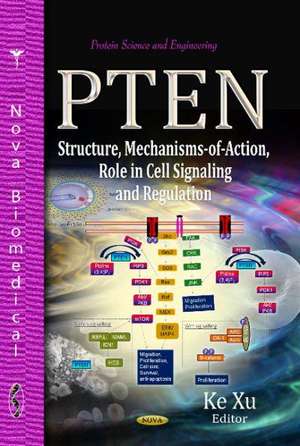
PTEN: Structure, Mechanisms-of-Action, Role in Cell Signaling & Regulation
Editat de Ke Xuen Limba Engleză Hardback – iul 2013
Preț: 1332.52 lei
Preț vechi: 1814.25 lei
-27%
Puncte Express: 1999
Carte disponibilă
Livrare economică 04-18 noiembrie
Livrare prin curier în România Termenul estimat este afișat lângă disponibilitate.
Transport gratuit pentru acest produs Plată online sau ramburs, în funcție de opțiunile comenzii.
Retur gratuit în 14 zile Comandă securizată și suport în română.
Specificații
ISBN-13: 9781628080490
ISBN-10: 1628080493
Pagini: 298
Dimensiuni: 180 x 260 x 21 mm
Greutate: 0.67 kg
Editura: Nova Science Publishers Inc
Colecția Nova Science Publishers, Inc (US)
Locul publicării:United States
ISBN-10: 1628080493
Pagini: 298
Dimensiuni: 180 x 260 x 21 mm
Greutate: 0.67 kg
Editura: Nova Science Publishers Inc
Colecția Nova Science Publishers, Inc (US)
Locul publicării:United States
V-ar putea interesa
-
 Protein Prenylation, Part BChristine Hrycyna-35%Preț: 710.22 lei1094.82 lei
 -
 Protein Structure and FunctionGregory Petsko-21%Preț: 513.29 lei652.10 lei
 -
 ProteinsDavid Whitford-19%Preț: 415.51 lei512.98 lei
 -
 -18%Preț: 2098.95 lei2559.70 lei
 -
 Protein Folding and Metal Ions: Mechanisms, Biology and DiseaseClaudio M. Gomes-18%Preț: 1513.19 lei1845.34 lei
 -
 Preț: 390.52 lei
 -
 ProteostasisRune Matthiesen-15%Preț: 681.15 lei801.35 lei
 -
 Protein ChromatographyDermot Walls-18%Preț: 742.80 lei905.86 lei
 -
 SH2 DomainsKazuya Machida-18%Preț: 1075.53 lei1311.63 lei
 -
 Protein CrystallographyAlexander Wlodawer-18%Preț: 1140.99 lei1391.45 lei
 -
 Tissue ProteomicsBrian Liu-15%Preț: 633.92 lei745.79 lei
 -
 New Developments in Proteomics ResearchGoro Fukushima-26%Preț: 1221.95 lei1662.46 lei
 -
 Proteomics: From Protein Sequence to FunctionDr Stephen Pennington-15%Preț: 516.15 lei607.24 lei
 -
 Peptide BionanomaterialsMohamed A. Elsawy-18%Preț: 1240.87 lei1513.25 lei
 -
 -18%Preț: 1173.98 lei1431.69 lei
 -
 Protein Folding KineticsBengt Nölting-18%Preț: 755.30 lei921.10 lei
 -
 Amino Acids and the Asymmetry of LifeUwe Meierhenrich-24%Preț: 764.16 lei1005.47 lei
 -
 MetabolomicsM. Tomita-15%Preț: 630.14 lei741.34 lei
 -
 The ABC Transporters of Human Physiology and DiseaseI Barry Holland-18%Preț: 980.11 lei1195.26 lei
 -
 The Protein Folding Problem and Its SolutionsArieh Ben-Naim-15%Preț: 677.80 lei797.41 lei
 -
 The Protein Folding Problem and Its SolutionsArieh Ben NaimPreț: 234.32 lei
 -
 -18%Preț: 1390.23 lei1695.40 lei
Cuprins
Preface; PTEN & Cell Signaling in Health & Disease; Post-translational Regulation of PTEN & its Implication in Cancer; Novel Developmental Pathway Regulation Mechanisms of PTEN expression: Implications for Human Disease; PTEN: A Molecule that Cancers Abuse to Overcome their Achilles Heels; Targeting the PTEN Tumor Suppressor as an Anti-Cancer Therapeutic Strategy; The Impact of PTEN Tumor Suppressor on Outcome in Lung & Breast Cancer Patients; PTEN Involvement in Eye Embryology & Pathology; Role of Post-translational Regulation of PTEN Activity in Cancer Cell Addiction to Heterozygous PTEN Mutations; Role of PTEN in Vascular Organization & Anomalies; PTEN on Angiogenesis & Ovarian Development: Experimental Data from a Primitive Vertebrate, Anguilla Japonica; Index.