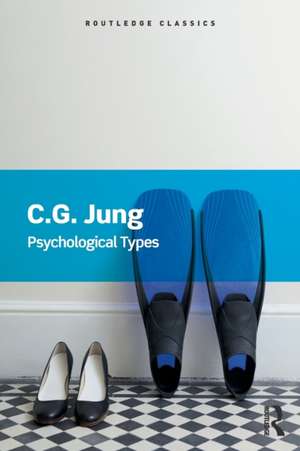
Psychological Types: Routledge Classics
Autor Carl Jungen Limba Engleză Paperback – 26 sep 2016
Psychological Types is one of Jung's most important and famous works. First published by Routledge in the early 1920s it appeared after Jung's so-called fallow period, during which he published little, and it is perhaps the first significant book to appear after his own confrontation with the unconscious. It is the book that introduced the world to the terms 'extravert' and 'introvert'. Though very much associated with the unconscious, in Psychological Types Jung shows himself to be a supreme theorist of the conscious. In putting forward his system of psychological types Jung provides a means for understanding ourselves and the world around us: our different patterns of behaviour, our relationships, marriage, national and international conflict, organizational functioning.
This Routledge Classics edition includes a new foreword by John Beebe."
Din seria Routledge Classics
-
 Preț: 159.10 lei
 - 21%
 Preț: 685.37 lei
 -
 Preț: 181.46 lei
 - 9%
 Preț: 1623.03 lei
 - 15%
 Preț: 962.48 lei
 -
 Preț: 192.23 lei
 - 19%
 Preț: 686.37 lei
 -
 Preț: 130.07 lei
 -
 Preț: 175.48 lei
 -
 Preț: 136.93 lei
 -
 Preț: 231.79 lei
 - 9%
 Preț: 808.31 lei
 - 5%
 Preț: 217.39 lei
 -
 Preț: 158.33 lei
 -
 Preț: 242.60 lei
 -
 Preț: 171.61 lei
 -
 Preț: 192.14 lei
 -
 Preț: 235.79 lei
 -
 Preț: 174.83 lei
 -
 Preț: 157.94 lei
 -
 Preț: 176.25 lei
 -
 Preț: 158.39 lei
 -
 Preț: 221.84 lei
 - 18%
 Preț: 857.65 lei
 - 18%
 Preț: 1038.92 lei
 -
 Preț: 177.24 lei
 -
 Preț: 137.18 lei
 -
 Preț: 137.77 lei
 -
 Preț: 174.15 lei
 -
 Preț: 175.25 lei
 -
 Preț: 192.11 lei
 - 12%
 Preț: 131.62 lei
 -
 Preț: 159.07 lei
 -
 Preț: 138.96 lei
 -
 Preț: 233.98 lei
 -
 Preț: 172.43 lei
 - 21%
 Preț: 686.65 lei
 -
 Preț: 137.87 lei
 -
 Preț: 191.35 lei
 -
 Preț: 154.81 lei
 -
 Preț: 243.25 lei
 -
 Preț: 173.52 lei
 -
 Preț: 170.65 lei
 -
 Preț: 175.55 lei
 -
 Preț: 174.29 lei
 -
 Preț: 137.96 lei
 -
 Preț: 159.20 lei
 -
 Preț: 128.66 lei
Preț: 236.11 lei
Carte disponibilă
Livrare economică 06-20 noiembrie
Livrare express 22-28 octombrie pentru 48.95 lei
Specificații
ISBN-10: 1138687421
Pagini: 568
Dimensiuni: 156 x 234 x 37 mm
Greutate: 0.79 kg
Ediția:1
Editura: Taylor & Francis
Colecția Routledge
Seria Routledge Classics
Locul publicării:Oxford, United Kingdom
V-ar putea interesa
-
 Selected WritingsAnna Freud-19%Preț: 87.27 lei107.63 lei
 -
 -18%Preț: 47.45 lei58.02 lei
 -
 Preț: 379.12 lei
 -
 Psychoanalytic Studies of the PersonalityW. R. D. FairbairnPreț: 380.83 lei
 -
 Essays on OthernessJean LaplanchePreț: 381.04 lei
 -
 Self-Harm: A Psychotherapeutic ApproachFiona GardnerPreț: 348.06 lei
 -
 Écrits: A SelectionJacques Lacan-5%Preț: 1104.99 lei1163.15 lei
 -
 Preț: 209.76 lei
 -
 Psychology of the UnconsciousC G JungPreț: 171.46 lei
 -
 The Triumph of ReligionJacques LacanPreț: 127.16 lei
 -
 On the Names-of-the-FatherJacques LacanPreț: 123.28 lei
 -
 The 5 Love LanguagesGary ChapmanPreț: 93.21 lei
 -
 Preț: 431.58 lei
 -
 Gifts Differing: Understanding Personality TypeIsabel Briggs MyersPreț: 109.27 lei
 -
 AnxietyJacques LacanPreț: 135.96 lei
 -
 -5%Preț: 337.70 lei355.47 lei
 -
 MoneyYuval Noah Harari-20%Preț: 33.53 lei42.10 lei
 -
 The Happiness HypothesisJonathan Haidt-25%Preț: 64.40 lei86.09 lei
 -
 The 48 Laws Of PowerRobert Greene-16%Preț: 123.64 lei147.79 lei
 -
 How To Read FreudJosh CohenPreț: 76.58 lei
 -
 HysteriaRichard Appignanesi-10%Preț: 97.67 lei108.64 lei
Public țintă
Postgraduate and UndergraduateCuprins
Introduction. 1. The Problem of Types in the History of Classical and Medieval Thought 2. Schiller's Ideas on the Type Problem 3. The Apollinium and Dionysian 4. the Type Problem in Human Character 5. The Type Problem in Poetry 6. The Type Problem in Psychopathology 7. The Type Problem in Aesthetics 8. The Type Problem in Modern Philosophy 9. The Type Problem in Biography 10. General Descriptions of the Types 11. Definitions Epilogue.
Notă biografică
Recenzii
"This volume is drastically serious, positive, didactic, classic and yet more than stimulating. It is energizing, liberating and recreative. The author shows an amazingly sympathetic and comprehensive knowledge of the introvert of the thinking type, and hardly less for his other types." New York Times
"…it has been an astounding phenomenon that a single person could develop such an important dynamic typology with such exhaustive inclusiveness between his 38th and 45th years of life. Jung not only saw the need and the problem but formulated and refined the theory to a point that stands the test of time." Wayne K. Detloff, Psychological Perspectives
"When I first found Bayne’s translation, in 1932, I felt that this was the most important book that I had ever read. Since then, I have found no reason to revise my opinion." Joseph B. Wheelwright, Journal of Analytical Psychology
Descriere
Psychological Types is one of Jung's most important and famous works. First published by Routledge in the early 1920s it appeared after Jung's so-called fallow period, during which he published little, and it is perhaps the first significant book to appear after his own confrontation with the unconscious. It is the book that introduced the world to the terms 'extravert' and 'introvert'. Though very much associated with the unconscious, in Psychological Types Jung shows himself to be a supreme theorist of the conscious. In putting forward his system of psychological types Jung provides a means for understanding ourselves and the world around us: our different patterns of behaviour, our relationships, marriage, national and international conflict, organizational functioning.
This Routledge Classics edition includes a new foreword by John Beebe."