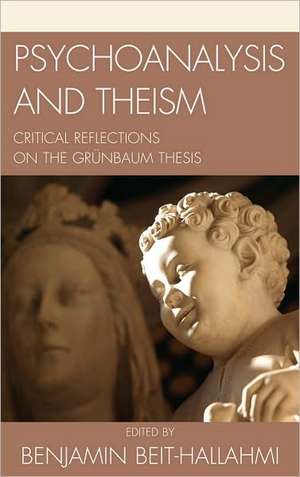
Psychoanalysis and Theism: Critical Reflections on the Grünbaum Thesis
Autor Benjamin Beit-Hallahmi Contribuţii de Michael P. Carroll, Adolf Grünbaum, PhD, Harriet Lutzky, Ralph W. Hood Jr., Jerry S. Piven, David Livingstone Smith, Carlo Strengeren Limba Engleză Hardback – 4 aug 2010
This remarkable essay is the stimulus for a symposium with nine senior scholars, coming from the fields of philosophy, psychology, sociology, and psychoanalysis, who present their critical reflections on how we should study religion, how we should treat Freud's ideas, and what the future directions in psychological research on concrete religious behavior should be. The contributors bring to this effort their varied fields of expertise, from analytical philosophy to experimental psychology. Of special interest are essays which deal with the Virgin Birth doctrine and its possible psychological sources and with the potential for future psychoanalytic studies of faith and ritual. Other essays focus on Freud's conscious and unconscious motivations for studying religion as well as the hidden biases and lacunae found in the social science literature on religious practices.
This volume adds a unique combination of critical and knowledgeable voices to the debate on Sigmund Freud's legacy.
Preț: 575.83 lei
Preț vechi: 863.36 lei
-33%
Puncte Express: 864
Carte tipărită la comandă
Livrare economică 28 noiembrie-12 decembrie
Livrare prin curier în România Termenul estimat este afișat lângă disponibilitate.
Transport gratuit pentru acest produs Plată online sau ramburs, în funcție de opțiunile comenzii.
Retur gratuit în 14 zile Comandă securizată și suport în română.
Specificații
ISBN-13: 9780765707222
ISBN-10: 0765707225
Pagini: 188
Dimensiuni: 162 x 241 x 19 mm
Greutate: 0.45 kg
Editura: Bloomsbury Publishing
Colecția Jason Aronson Inc
Locul publicării:New York, United States
ISBN-10: 0765707225
Pagini: 188
Dimensiuni: 162 x 241 x 19 mm
Greutate: 0.45 kg
Editura: Bloomsbury Publishing
Colecția Jason Aronson Inc
Locul publicării:New York, United States
Cuprins
Chapter 1 Preface
Part 2 Part I: Methods and Motives
Chapter 3 Chapter 1: Psychoanalysis and Theism
Chapter 4 Chapter 2: A Problem for Freud's Disjunctive Argument
Chapter 5 Chapter 3: The Psychoanalysis of Religion and the Dissolution of Epistemic Certitude
Chapter 6 Chapter 4: Psychoanalytic Theories of Religion and the "Catholic Problem"
Chapter 7 Chapter 5: Freud, Jewish Universalism, and the Critique of Religion
Part 8 Part II: Interpretation and Meaning
Chapter 9 Chapter 6: Interpreting Three Religious Constructs
Chapter 10 Chapter 7: Another Epistemic Evaluation of Freud's Oedipal Theory of Religion
Chapter 11 Chapter 8: Mapping the Imagination-Heroes, Gods, and the Oedipal Triumphs
Part 2 Part I: Methods and Motives
Chapter 3 Chapter 1: Psychoanalysis and Theism
Chapter 4 Chapter 2: A Problem for Freud's Disjunctive Argument
Chapter 5 Chapter 3: The Psychoanalysis of Religion and the Dissolution of Epistemic Certitude
Chapter 6 Chapter 4: Psychoanalytic Theories of Religion and the "Catholic Problem"
Chapter 7 Chapter 5: Freud, Jewish Universalism, and the Critique of Religion
Part 8 Part II: Interpretation and Meaning
Chapter 9 Chapter 6: Interpreting Three Religious Constructs
Chapter 10 Chapter 7: Another Epistemic Evaluation of Freud's Oedipal Theory of Religion
Chapter 11 Chapter 8: Mapping the Imagination-Heroes, Gods, and the Oedipal Triumphs
Recenzii
Adolf Grünbaum is an excellent philosopher of science. It is very good to have his critical assessment of the evidence for Freud's theory of religion reprinted here along with comments by scholars in several different fields. The authors examine Freud's and Grünbaum's arguments using resources drawn from philosophy, sociology, contemporary psychoanalysis, empirical psychology of religion, and the history of religions. The articles are all interesting, and they explore a range of topics including Freud's Jewish identity, Grünbaum's psychoanalytic account of virgin birth narratives, and contemporary serpent handlers. The volume contributes to current discussions of the relation of psychoanalysis and religion.
Benjamin Beit-Hallahmi's Psychoanalysis and Theism is a timely treasure. Seven essays responding to Adolf Grünbaum's "Psychoanalysis and Theism," with which the book begins, revive Freud's penetrating speculations about the meaning and psycho-dynamics of religion and carry them further. The authors explore the Oedipal angle of religion, the susceptibility of Catholicism to Freudian inquiry, the relationship of Jewish universalism to Freud's topic, the nature of the questions of illusion and delusion that Freud raised in regard to religious belief and behavior, and still more. Divided into two parts-Methods and Motives, and Interpretation and Meaning-the book offers the reader a brilliant set of essays that plumb and apply Freud's take on religion both appreciatively and critically.
This volume has been overdue. Asking what psychology has to say about religion, it does not loose itself in providing a host of facts and details. Rather, it dares to turn to the grand and incomparably influential theory psychoanalysis continues to be. Some of the best scholars worldwide engage in a multidisciplinary and critical discussion with eminent thinkers ranging from Freud to Grünbaum, resulting in a must read for anyone interested in the psychological study of religion.
Benjamin Beit-Hallahmi's Psychoanalysis and Theism is a timely treasure. Seven essays responding to Adolf Grünbaum's "Psychoanalysis and Theism," with which the book begins, revive Freud's penetrating speculations about the meaning and psycho-dynamics of religion and carry them further. The authors explore the Oedipal angle of religion, the susceptibility of Catholicism to Freudian inquiry, the relationship of Jewish universalism to Freud's topic, the nature of the questions of illusion and delusion that Freud raised in regard to religious belief and behavior, and still more. Divided into two parts-Methods and Motives, and Interpretation and Meaning-the book offers the reader a brilliant set of essays that plumb and apply Freud's take on religion both appreciatively and critically.
This volume has been overdue. Asking what psychology has to say about religion, it does not loose itself in providing a host of facts and details. Rather, it dares to turn to the grand and incomparably influential theory psychoanalysis continues to be. Some of the best scholars worldwide engage in a multidisciplinary and critical discussion with eminent thinkers ranging from Freud to Grünbaum, resulting in a must read for anyone interested in the psychological study of religion.