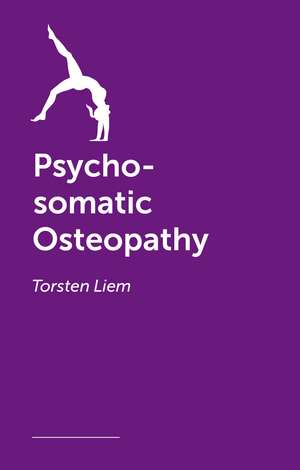
Psycho-somatic Osteopathy
Autor Torsten Liem Cuvânt înainte de William H. Devineen Limba Engleză Paperback – 18 feb 2027
Expert in Psycho-somatic Osteopathy and practising osteopath Torsten Liem covers not only the foundations of PSO but describes newly developed approaches and techniques, and how to use them to treat specific populations and conditions. These newly developed approaches include osteopathic heart-focused palpation (OHP), osteopathic bilateral stimulation (OBS), osteopathic emotional regulation technique (OER), multimodal bifocal integration (MBI) and osteopathic felt sense (OFS).
A detailed and practical guide to implementing PSO treatment structures and clinical procedures, this book is an invaluable resource for both new and experienced osteopaths aiming to develop their practice.
Preț: 1099.03 lei
Preț vechi: 1460.26 lei
-25% Precomandă
Puncte Express: 1649
Carte nepublicată încă
Livrare prin curier în România Precomanda se expediază când titlul devine disponibil.
Transport gratuit pentru acest produs Plată online sau ramburs, în funcție de opțiunile comenzii.
Retur gratuit în 14 zile Comandă securizată și suport în română.
Doresc să fiu notificat când acest titlu va fi disponibil:
Se trimite...
Specificații
ISBN-13: 9781399830485
ISBN-10: 1399830481
Pagini: 552
Ilustrații: 213 images
Dimensiuni: 189 x 246 mm
Editura: JESSICA KINGSLEY PUBLISHERS
Colecția Handspring Publishing
Locul publicării:London, United Kingdom
ISBN-10: 1399830481
Pagini: 552
Ilustrații: 213 images
Dimensiuni: 189 x 246 mm
Editura: JESSICA KINGSLEY PUBLISHERS
Colecția Handspring Publishing
Locul publicării:London, United Kingdom
V-ar putea interesa
-
 -26%Preț: 551.12 lei745.38 lei
 -
 -30%Preț: 504.81 lei719.21 lei
 -
 Preț: 409.53 lei
 -
 Somatic Exercises for DummiesKristin McgeePreț: 138.84 lei
 -
 HomeopathyEmma Van Hinsbergh-5%Preț: 61.43 lei64.66 lei
 -
 Healing HandbookTara WardPreț: 96.29 lei
 -
 ExposureWim Hof-5%Preț: 235.96 lei248.38 lei
 -
 Too Tired to FightErin Mitchell-19%Preț: 98.78 lei121.87 lei
 -
 Safe and SoundStephen W. Porges-5%Preț: 116.23 lei122.34 lei
 -
 It Didn't Start With You WorkbookMark WolynnPreț: 121.05 lei
 -
 Shockingly Useful Book, AEmiliya Ilieva BelchevaPreț: 125.42 lei
 -
 Somatic Techniques for Massage TherapistsGabriel Posner-24%Preț: 262.22 lei346.19 lei
 -
 Change Your Brain, Change Your PainDaniel Amen-27%Preț: 140.04 lei191.42 lei
 -
 Energetic Kinesiology: Principles and PracticeTania McGowan-24%Preț: 416.07 lei545.18 lei
 -
 Fascia in the Osteopathic FieldTorsten Liem-24%Preț: 625.66 lei825.16 lei
 -
 -27%Preț: 208.97 lei287.78 lei
 -
 -28%Preț: 533.12 lei743.66 lei
 -
 Facial Diagnosis for Everyone: A WorkbookDavid CardPreț: 140.28 lei
 -
 Foundations of Osteopathic Medicine: Philosophy, Science, Clinical Applications, and ResearchKurt P. Heinking DO, FAAO, CS-19%Preț: 1051.97 lei1295.77 lei
 -
 Nst Spinal Integration (P)Michael Nixon-Livy-5%Preț: 419.32 lei441.39 lei
Recenzii
Torsten Liem presents an original clinical framework integrating the dynamic interactions of soma, physiology, experience, and context into osteopathic practice. His thoughtful approach enriches clinical reasoning and provides valuable clinical perspectives for understanding and treating complex patient presentations.
Torsten Liem, together with contributions from other leading lights in osteopathic philosophy, education and research, has made a decisive step forward in osteopathy-integrating neurophysiology, immunology, and patient interaction within a practical, palpatory model. It challenges us to think wider, engage deeper, and recognise co-regulation as central to effective treatment. This is an ambitious, thought-provoking, and ultimately important contribution that will certainly influence the future direction of osteopathy.
Torsten Liem once again demonstrates his remarkable ability to integrate diverse perspectives into a coherent clinical framework. By venturing into the still largely uncharted territory at the interface between osteopathy, neuroscience, psychology, and manual therapy, this book represents an important pioneering contribution. It offers fresh perspectives and a rich source of inspiration for osteopaths interested in the interplay between body, mind, and therapeutic touch.
This is an ambitious attempt to formalize something many experienced osteopaths do intuitively - reading a patient's emotional and biographical context alongside their tissue findings - into a teachable clinical framework.
Its real strength is scope: it pulls together attachment theory, polyvagal/stress physiology, and osteopathic principle in one place, and the case-study material and staged treatment structure should be genuinely useful for clinicians wanting a repeatable process rather than vague holism.
Torsten Liem, together with contributions from other leading lights in osteopathic philosophy, education and research, has made a decisive step forward in osteopathy-integrating neurophysiology, immunology, and patient interaction within a practical, palpatory model. It challenges us to think wider, engage deeper, and recognise co-regulation as central to effective treatment. This is an ambitious, thought-provoking, and ultimately important contribution that will certainly influence the future direction of osteopathy.
Torsten Liem once again demonstrates his remarkable ability to integrate diverse perspectives into a coherent clinical framework. By venturing into the still largely uncharted territory at the interface between osteopathy, neuroscience, psychology, and manual therapy, this book represents an important pioneering contribution. It offers fresh perspectives and a rich source of inspiration for osteopaths interested in the interplay between body, mind, and therapeutic touch.
This is an ambitious attempt to formalize something many experienced osteopaths do intuitively - reading a patient's emotional and biographical context alongside their tissue findings - into a teachable clinical framework.
Its real strength is scope: it pulls together attachment theory, polyvagal/stress physiology, and osteopathic principle in one place, and the case-study material and staged treatment structure should be genuinely useful for clinicians wanting a repeatable process rather than vague holism.