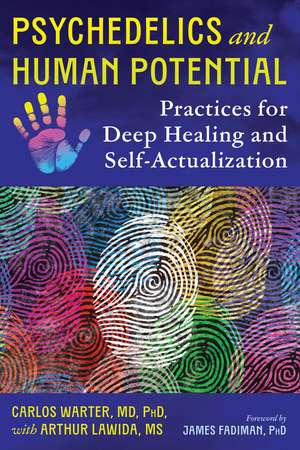
Psychedelics and Human Potential: Practices for Deep Healing and Self-Actualization
Autor Carlos Warter Cu Arthur Lawida Cuvânt înainte de James Fadiman Ph.D.en Limba Engleză Paperback – 2 iul 2026
• Includes a brief history of the ancient roots of psychedelics, their rediscovery by the counterculture, and their contemporary use in treating trauma and mental illness
• Offers the “Human Promise” program blending spiritual and philosophical tools and practices with psychedelics for self-actualization
• Explores today’s regulatory environment, the role of AI, and the influence of the Information Age on psychedelic culture
Despite an unsettled legal landscape, the promise and potential of psychedelics continue to be at the forefront of thinking and research in the United States and around the world. What medicinal and therapeutic properties do the substances of MDMA, psilocybin, LSD, ibogaine, ayahuasca, and ketamine possess, and how can they help us to grow as individuals and as a culture?
Dr. Carlos Warter, with input from mental health counselor Arthur Lawida, explores these questions to offer a guide to psychedelics that blends history, contemporary context, and tools and practices to help readers realize self-actualization. Warter considers the history of psychedelics from North American peyote rituals to the counterculture of the 1960s and the psychedelic renaissance, exploring how the public perception of psychedelics has changed with an increasing acceptance of their therapeutic value.
Moving toward the Human Promise of enlightenment, this book explains how psychedelics can be used in a transpersonal context for sustainable growth and self-discovery. It suggests tools and practices that can round out a program of self-development, including Pilates, Feldenkrais work, neurofeedback systems, and virtual reality. Readers will also learn how AI and information technology are changing the psychedelic and human-development landscape to help with deep healing and spiritual awakening.
Preț: 102.73 lei
Preț vechi: 137.22 lei
-25%
Puncte Express: 154
Carte disponibilă
Livrare economică 13-25 noiembrie
Livrare express 28 octombrie-03 noiembrie pentru 55.53 lei
Livrare prin curier în România Termenul estimat este afișat lângă disponibilitate.
Transport gratuit de la 400.00 lei Plată online sau ramburs, în funcție de opțiunile comenzii.
Retur gratuit în 14 zile Comandă securizată și suport în română.
Specificații
ISBN-13: 9798888503461
Pagini: 192
Ilustrații: 1 b&w illustration
Dimensiuni: 152 x 229 x 13 mm
Greutate: 0.24 kg
Editura: Inner Traditions/Bear & Company
Colecția Park Street Press
Pagini: 192
Ilustrații: 1 b&w illustration
Dimensiuni: 152 x 229 x 13 mm
Greutate: 0.24 kg
Editura: Inner Traditions/Bear & Company
Colecția Park Street Press
Notă biografică
Carlos Warter, MD, PhD, has been a pioneer in spiritual regenerative psychiatry, integrative medicine, and psychedelic therapy since the 1970s. The author of more than 24 books, he is a practicing physician and founder of the World Health Foundation for Development and Peace. His work is now called the Human Promise and is delivered in series of retreats over a three-year curriculum. He lives in Southern California.
Arthur Lawida, MS, is a mental health counselor, executive business coach, and 30-year student of Dr. Warter applying his techniques. He lives near San Diego, California.
Arthur Lawida, MS, is a mental health counselor, executive business coach, and 30-year student of Dr. Warter applying his techniques. He lives near San Diego, California.
Extras
1
What Is the Human Promise?
The Eidos of Entelechia
What do I mean by the Human Promise? The Human Promise is not a static goal or endpoint; it is continuous and ongoing. Its path is inner work, and it requires a conscious directed effort toward growth and realization. The Human Promise is a fulfillment—and a transcendence—of our human potential.
Human evolution isn’t a straight path—it’s a series of steady steps punctuated by exponential leaps forward or decisions that lead to stagnation. Sometimes we inch ahead through effort and understanding. Other times, everything changes all at once, like a light switching on in a dark room. This book is about one of those leaps, what I call the Human Promise.
I coined the term Human Promise, and it’s central to everything we explore here. It’s about a transformation, transmutation and transcendence, one that could redefine not only how we understand the universe but who we are as human beings.
To help you imagine it, picture this: Right now in Southern California, monarch butterflies are beginning their migration. You probably remember from school that these butterflies begin life as caterpillars—creatures that live low to the ground, eating leaves and crawling through the dirt. Their entire existence revolves around survival as a caterpillar. There’s no sign they’re destined for anything beyond that.
But something extraordinary happens. They undergo metamorphosis, transforming into butterflies—creatures of color, light, and flight, capable of traveling thousands of miles. That caterpillar had no way of knowing what it was becoming. Its potential was to be a better caterpillar. But its promise was to become something utterly different.
That’s what I intend to mean by the Human Promise. The actual work toward it will be presented as the Human Promise Program, a course offered by the World Health Foundation for Development and Peace. I started this foundation during the International Year of Peace of the United Nations, and we later received the Messenger of Peace Award in the 1980s. As a species, our potential is to become stronger from within, kinder, wiser, more loving versions of ourselves. But our promise goes beyond that—it’s to become something radically new. Not just better humans, but beings that exist in a completely new way, with a new consciousness we can’t yet imagine. With the advent of powerful AI, we must be careful to learn to find our essence instead of believing we are an algorithm that provides utilitarian information in this new era and religion of datism.
This book shares ideas, practices, and tools that help us shed the layers of conditioning, history, and false identity that keep us locked into the familiar. I call this path the realization of the Human Promise (HP). Many of these practices—meditation, mindfulness, conscious company, breathwork, rituals, even psychedelics—have helped people grow for thousands of years. But if any of them could fully unlock this transformation, we’d already be there. These tools matter, but they’re only part of the preparation for the leap. The embodiment of the teaching is fundamental to be able to transmit it for the time needed to present a set of experiences that the location of its nonlocal identity matters.
Consider physics as an example. For centuries, Newtonian physics helped us understand and interpret the world—it was a massive breakthrough in its time. But then came quantum mechanics, which changed everything. It wasn’t a refinement of the old—it was a completely new paradigm that opened doors we didn’t even know existed. The laws of Newton still worked, when contextualizing reality at that exact level, but quantum theory showed us a deeper and different explanation of that nature of what we call reality.
The Human Promise is like that. It’s not about becoming slightly better—it’s about entering a new paradigm. A new way of being. And just like quantum physics, it might arrive through insight, not effort. A shift that redefines what it even means to be human.
This book invites you to hold this idea in your thoughts, in your heart, in your quiet moments. Sit with the possibility of a transformation that isn’t just about progress, but about transcendence. It may sound bold—but I believe it’s not only possible . . . it’s our destiny.
And isn’t that a more exciting future than simply becoming a slightly better version of ourselves?
The Human Promise is the tendency toward enlightenment. It is not just about personal fulfillment or success but involves a deeper, conscious, more altruistic, compassionate, and inclusive engagement with the world, others, and the messages of the cosmos. Collectively, it suggests that humanity can evolve toward greater harmony, understanding, and cooperation, achieving heights of civilization previously unimagined. By tapping into and actualizing our individual potential, we partake in a shared journey toward a more aware, caring, and interconnected global community, fulfilling the grand Human Promise of individual and collective progress and well-being. The Human Promise is like a curve that remains asymptotic to an ideal line of events and never touches, which I refer to as a “tendency.”
We live in an exciting novel time, full of possibilities. Technological innovation is accelerating at an ever-increasing rate, yet our inner development has seemingly not kept pace with external progress. Human beings still create a tremendous amount of unnecessary suffering for themselves, the planet, and other species.
In my introduction, I mentioned the role of psychedelics within the traditional medical model. From a technology perspective, we would call this the break/fix model. Psychedelics can help us fix problems in our consciousness that we have intentionally or unintentionally created.
While they can be powerful medicines to help alleviate suffering, this only scratches the surface of their ultimate potential. While some mental illnesses are heritable, all of them carry a genetic component and many of them are created by humans acting in ways that create suffering for ourselves and others around us. War, sexual assault, wo/men trafficking, negative parenting, and a misunderstanding of the purpose of life can all create suffering that could then be sometimes alleviated or cured by traditional or psychedelic medicines.
However valuable these medicines are, spending so much effort to cure conditions that we create is not the purpose of human life. It seems circular.
There is the possibility that instead of spending trillions in resources to fix problems that we create, we can go inward to address the root problem of why we do this to ourselves and learn how to stop. We can then apply our vast resources to the positive exploration of the Human Promise.
An Overview of Entelechia,
the Realization of Fullest Potential
The eidos (meaning “idea” or “essence”) of the Human Promise represents a profound exploration of our possibilities, both individually and as a species. It encompasses the idea that ALL persons harbor unique capacities, developmental expansion, and virtues that, when fully realized, contribute to the collective advancement of the individual and all of humanity.
The Human Promise is rooted in the philosophical term entelechy, derived from Aristotle’s ancient Greek term entelechia, which signifies the ongoing realization of something’s fullest potential. This principle suggests that both individuals and groups are engaged in a continuous journey toward achieving their utmost capabilities, a process that evolves and reveals practical implications over time.
Aristotle’s works (particularly Metaphysics and On the Soul) frequently discuss the interplay between potentiality and actuality across various domains, including physiology, metaphysics, and ethics. Potentiality is the inherent capability of something to evolve into a more complete state. It is often categorized into two types: a strong potentiality, which emerges from a natural tendency and unfolds almost inevitably under the right conditions, and a weak potentiality, which is transient and occurs sporadically by chance. Actuality, on the other hand, is the manifestation of potential through action or change, rather than remaining in a passive state. Aristotle introduced two terms to describe this actualization process: energia, which is the basic state of being actively engaged, and entelechia, a more advanced form of energia that achieves the ultimate potential or purpose of an entity.
This dynamic of actualization underscores that achieving one’s ultimate potential is not a static endpoint or a final destination but a state of continual engagement and effort. The work of fulfilling the Human Promise is ongoing and integral to what I term inner work. Inner work is the conscious awareness and focused action directed toward realizing one’s own entelechy. It isn’t just about having the right conditions but involves a constant, directed effort toward growth and realization.
Thus, the Human Promise suggests a transformative process where the potential is not just a static quality but is dynamically realized through continuous effort. This echoes the mythical philosopher’s stone, believed to turn base metals into gold and grant immortality, symbolizing the profound and transformative and evolutionary power of achieving one’s full potential through persistent and dedicated effort.
What Is the Human Promise?
The Eidos of Entelechia
What do I mean by the Human Promise? The Human Promise is not a static goal or endpoint; it is continuous and ongoing. Its path is inner work, and it requires a conscious directed effort toward growth and realization. The Human Promise is a fulfillment—and a transcendence—of our human potential.
Human evolution isn’t a straight path—it’s a series of steady steps punctuated by exponential leaps forward or decisions that lead to stagnation. Sometimes we inch ahead through effort and understanding. Other times, everything changes all at once, like a light switching on in a dark room. This book is about one of those leaps, what I call the Human Promise.
I coined the term Human Promise, and it’s central to everything we explore here. It’s about a transformation, transmutation and transcendence, one that could redefine not only how we understand the universe but who we are as human beings.
To help you imagine it, picture this: Right now in Southern California, monarch butterflies are beginning their migration. You probably remember from school that these butterflies begin life as caterpillars—creatures that live low to the ground, eating leaves and crawling through the dirt. Their entire existence revolves around survival as a caterpillar. There’s no sign they’re destined for anything beyond that.
But something extraordinary happens. They undergo metamorphosis, transforming into butterflies—creatures of color, light, and flight, capable of traveling thousands of miles. That caterpillar had no way of knowing what it was becoming. Its potential was to be a better caterpillar. But its promise was to become something utterly different.
That’s what I intend to mean by the Human Promise. The actual work toward it will be presented as the Human Promise Program, a course offered by the World Health Foundation for Development and Peace. I started this foundation during the International Year of Peace of the United Nations, and we later received the Messenger of Peace Award in the 1980s. As a species, our potential is to become stronger from within, kinder, wiser, more loving versions of ourselves. But our promise goes beyond that—it’s to become something radically new. Not just better humans, but beings that exist in a completely new way, with a new consciousness we can’t yet imagine. With the advent of powerful AI, we must be careful to learn to find our essence instead of believing we are an algorithm that provides utilitarian information in this new era and religion of datism.
This book shares ideas, practices, and tools that help us shed the layers of conditioning, history, and false identity that keep us locked into the familiar. I call this path the realization of the Human Promise (HP). Many of these practices—meditation, mindfulness, conscious company, breathwork, rituals, even psychedelics—have helped people grow for thousands of years. But if any of them could fully unlock this transformation, we’d already be there. These tools matter, but they’re only part of the preparation for the leap. The embodiment of the teaching is fundamental to be able to transmit it for the time needed to present a set of experiences that the location of its nonlocal identity matters.
Consider physics as an example. For centuries, Newtonian physics helped us understand and interpret the world—it was a massive breakthrough in its time. But then came quantum mechanics, which changed everything. It wasn’t a refinement of the old—it was a completely new paradigm that opened doors we didn’t even know existed. The laws of Newton still worked, when contextualizing reality at that exact level, but quantum theory showed us a deeper and different explanation of that nature of what we call reality.
The Human Promise is like that. It’s not about becoming slightly better—it’s about entering a new paradigm. A new way of being. And just like quantum physics, it might arrive through insight, not effort. A shift that redefines what it even means to be human.
This book invites you to hold this idea in your thoughts, in your heart, in your quiet moments. Sit with the possibility of a transformation that isn’t just about progress, but about transcendence. It may sound bold—but I believe it’s not only possible . . . it’s our destiny.
And isn’t that a more exciting future than simply becoming a slightly better version of ourselves?
The Human Promise is the tendency toward enlightenment. It is not just about personal fulfillment or success but involves a deeper, conscious, more altruistic, compassionate, and inclusive engagement with the world, others, and the messages of the cosmos. Collectively, it suggests that humanity can evolve toward greater harmony, understanding, and cooperation, achieving heights of civilization previously unimagined. By tapping into and actualizing our individual potential, we partake in a shared journey toward a more aware, caring, and interconnected global community, fulfilling the grand Human Promise of individual and collective progress and well-being. The Human Promise is like a curve that remains asymptotic to an ideal line of events and never touches, which I refer to as a “tendency.”
We live in an exciting novel time, full of possibilities. Technological innovation is accelerating at an ever-increasing rate, yet our inner development has seemingly not kept pace with external progress. Human beings still create a tremendous amount of unnecessary suffering for themselves, the planet, and other species.
In my introduction, I mentioned the role of psychedelics within the traditional medical model. From a technology perspective, we would call this the break/fix model. Psychedelics can help us fix problems in our consciousness that we have intentionally or unintentionally created.
While they can be powerful medicines to help alleviate suffering, this only scratches the surface of their ultimate potential. While some mental illnesses are heritable, all of them carry a genetic component and many of them are created by humans acting in ways that create suffering for ourselves and others around us. War, sexual assault, wo/men trafficking, negative parenting, and a misunderstanding of the purpose of life can all create suffering that could then be sometimes alleviated or cured by traditional or psychedelic medicines.
However valuable these medicines are, spending so much effort to cure conditions that we create is not the purpose of human life. It seems circular.
There is the possibility that instead of spending trillions in resources to fix problems that we create, we can go inward to address the root problem of why we do this to ourselves and learn how to stop. We can then apply our vast resources to the positive exploration of the Human Promise.
An Overview of Entelechia,
the Realization of Fullest Potential
The eidos (meaning “idea” or “essence”) of the Human Promise represents a profound exploration of our possibilities, both individually and as a species. It encompasses the idea that ALL persons harbor unique capacities, developmental expansion, and virtues that, when fully realized, contribute to the collective advancement of the individual and all of humanity.
The Human Promise is rooted in the philosophical term entelechy, derived from Aristotle’s ancient Greek term entelechia, which signifies the ongoing realization of something’s fullest potential. This principle suggests that both individuals and groups are engaged in a continuous journey toward achieving their utmost capabilities, a process that evolves and reveals practical implications over time.
Aristotle’s works (particularly Metaphysics and On the Soul) frequently discuss the interplay between potentiality and actuality across various domains, including physiology, metaphysics, and ethics. Potentiality is the inherent capability of something to evolve into a more complete state. It is often categorized into two types: a strong potentiality, which emerges from a natural tendency and unfolds almost inevitably under the right conditions, and a weak potentiality, which is transient and occurs sporadically by chance. Actuality, on the other hand, is the manifestation of potential through action or change, rather than remaining in a passive state. Aristotle introduced two terms to describe this actualization process: energia, which is the basic state of being actively engaged, and entelechia, a more advanced form of energia that achieves the ultimate potential or purpose of an entity.
This dynamic of actualization underscores that achieving one’s ultimate potential is not a static endpoint or a final destination but a state of continual engagement and effort. The work of fulfilling the Human Promise is ongoing and integral to what I term inner work. Inner work is the conscious awareness and focused action directed toward realizing one’s own entelechy. It isn’t just about having the right conditions but involves a constant, directed effort toward growth and realization.
Thus, the Human Promise suggests a transformative process where the potential is not just a static quality but is dynamically realized through continuous effort. This echoes the mythical philosopher’s stone, believed to turn base metals into gold and grant immortality, symbolizing the profound and transformative and evolutionary power of achieving one’s full potential through persistent and dedicated effort.
Cuprins
Foreword by James Fadiman, PhD
Acknowledgments
Preface: The Why and How of This Book
Introduction: The Road Map to
the Human Promise
PART 1
AWAKENING WITH PSYCHEDELICS
1 What Is the Human Promise?
The Eidos of Entelechia
2 Cross-Cultural Uses of Psychedelics
as Sacraments
From Kykeon of the Eleusinian Mysteries to
Peyote in Navajo Country
3 The Psychedelic Experience
Journeys on Notable Entheogens
4 Spiritual and Philosophical Resources
for Inner Exploration
Direct Experience of Higher States
of Consciousness
5 Personal Sovereignty and the Pyramid
of Healing
We Are Unique Beings Yet One Consciousness
PART 2
PSYCHEDELICS IN PSYCHOLOGY
6 Recent History of Psychedelics
Counterculture to Mainstream Medicine
7 Psychological Therapies
Remembering the Essential Nature of the Mind
8 Nontraditional Therapies
On the Pathway to Fulfillment
9 Understanding Psychedelics and the Brain
Neuroplasticity, the Frontal Lobe, and Tech Devices
10 Body-Centered Therapies
Personal Transformation Through Movement,
Body Awareness, and Physical Fitness
11 Treating Trauma and Mental Illness
with Psychedelic Therapy
Depression, Anxiety, PTSD, and Addiction
PART 3
THE FUTURE OF PSYCHEDELIC USE
IN CONTEMPORARY SOCIETY
12 Ethical and Safety Considerations
Maintaining Equilibrium while Reaching Catharsis
13 The Legal and Regulatory Landscape
Navigating Treatment Protocols with
a Changing Government
14 Artificial Intelligence and the Information Age
Balancing the Possibilities with the Risks
Conclusion: Embracing Universal Human Values
References
Index
About the Authors
Acknowledgments
Preface: The Why and How of This Book
Introduction: The Road Map to
the Human Promise
PART 1
AWAKENING WITH PSYCHEDELICS
1 What Is the Human Promise?
The Eidos of Entelechia
2 Cross-Cultural Uses of Psychedelics
as Sacraments
From Kykeon of the Eleusinian Mysteries to
Peyote in Navajo Country
3 The Psychedelic Experience
Journeys on Notable Entheogens
4 Spiritual and Philosophical Resources
for Inner Exploration
Direct Experience of Higher States
of Consciousness
5 Personal Sovereignty and the Pyramid
of Healing
We Are Unique Beings Yet One Consciousness
PART 2
PSYCHEDELICS IN PSYCHOLOGY
6 Recent History of Psychedelics
Counterculture to Mainstream Medicine
7 Psychological Therapies
Remembering the Essential Nature of the Mind
8 Nontraditional Therapies
On the Pathway to Fulfillment
9 Understanding Psychedelics and the Brain
Neuroplasticity, the Frontal Lobe, and Tech Devices
10 Body-Centered Therapies
Personal Transformation Through Movement,
Body Awareness, and Physical Fitness
11 Treating Trauma and Mental Illness
with Psychedelic Therapy
Depression, Anxiety, PTSD, and Addiction
PART 3
THE FUTURE OF PSYCHEDELIC USE
IN CONTEMPORARY SOCIETY
12 Ethical and Safety Considerations
Maintaining Equilibrium while Reaching Catharsis
13 The Legal and Regulatory Landscape
Navigating Treatment Protocols with
a Changing Government
14 Artificial Intelligence and the Information Age
Balancing the Possibilities with the Risks
Conclusion: Embracing Universal Human Values
References
Index
About the Authors
Recenzii
“Dr. Carlos Warter and Arthur Lawida have produced a tour de force that elegantly synthesizes the renaissance in psychedelic medicine with rigorous scholarship and clinical sophistication. Their Human Promise program represents a paradigm shift in how we conceptualize human potential—moving beyond conventional therapeutic models to embrace what the data increasingly supports: that psychedelics, properly integrated, may be psychiatry’s most promising frontier. This book brilliantly navigates the intersection of neuroscience, consciousness studies, and emerging technologies with the intellectual rigor our field demands and the visionary thinking that readers and our patients deserve.”
“Psychedelics and Human Potential is a masterful synthesis of more than fifty years of Dr. Carlos Warter’s pioneering work in the field of consciousness and psychedelics. With deep insight, Dr. Warter explores how these substances can catalyze both personal healing and the fulfillment of the Human Promise. This book is essential reading for anyone serious about integrating psychedelics into a journey of growth, transformation, and the realization of our highest potential.”
“Carlos Warter is a true ‘psychedelic elder’ who shares in this book a wealth of wisdom gained over a lifetime investigating these powerful, mystical medicines.”
“Psychedelics and Human Potential is a masterful synthesis of more than fifty years of Dr. Carlos Warter’s pioneering work in the field of consciousness and psychedelics. With deep insight, Dr. Warter explores how these substances can catalyze both personal healing and the fulfillment of the Human Promise. This book is essential reading for anyone serious about integrating psychedelics into a journey of growth, transformation, and the realization of our highest potential.”
“Carlos Warter is a true ‘psychedelic elder’ who shares in this book a wealth of wisdom gained over a lifetime investigating these powerful, mystical medicines.”
Descriere
A guide to psychedelically facilitated personal growth and self-discovery