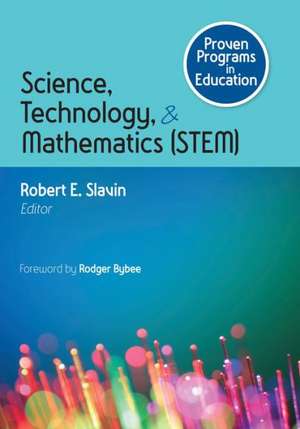
Proven Programs in Education: Science, Technology, and Mathematics (STEM)
Editat de Robert Slavinen Limba Engleză Paperback – 21 iul 2014
- Proven Programs in Literacy
- Proven Programs in STEM
- Proven Programs in Social Emotional Development
- Proven Programs in Classroom Management and Assessment
Preț: 220.30 lei
Puncte Express: 330
Carte tipărită la comandă
Livrare economică 28 decembrie 26 - 11 ianuarie 27
Livrare prin curier în România Termenul estimat este afișat lângă disponibilitate.
Transport gratuit de la 400.00 lei Plată online sau ramburs, în funcție de opțiunile comenzii.
Retur gratuit în 14 zile Comandă securizată și suport în română.
Specificații
ISBN-13: 9781483351216
ISBN-10: 1483351211
Pagini: 136
Ilustrații: illustrations
Dimensiuni: 178 x 254 x 9 mm
Greutate: 0.29 kg
Ediția:1
Editura: SAGE Publications
Colecția Corwin
Locul publicării:Thousand Oaks, United States
ISBN-10: 1483351211
Pagini: 136
Ilustrații: illustrations
Dimensiuni: 178 x 254 x 9 mm
Greutate: 0.29 kg
Ediția:1
Editura: SAGE Publications
Colecția Corwin
Locul publicării:Thousand Oaks, United States
V-ar putea interesa
-
 Teaching Languages to Young LearnersLynne Cameron-8%Preț: 384.73 lei418.18 lei
-
 Children's MathematicsElizabeth Carruthers-15%Preț: 622.11 lei731.90 lei
-
 The Primary Drama HandbookPatrice BaldwinPreț: 406.47 lei
-
 -8%Preț: 407.13 lei442.52 lei
-
 PhonicsMaureen Lewis-8%Preț: 418.95 lei455.38 lei
-
 Mathematical Understanding 5-11Anne CockburnPreț: 416.51 lei
Recenzii
“Overall,
this
book
does
an
excellent
job
of
putting
current
research
into
an
accessible
format
for
anyone
interested
in
learning
about
the
latest
ideas
for
improving
education
practice
and
supporting
student
learning
and
development.”
Cuprins
Foreword
-
Rodger
Bybee
Introduction
Preface - Robert Slavin
About the Editor
Chapter 1. What Works in Teaching Math - Robert Slavin
Chapter 2. The Importance of the Early Years - Douglas Clements and Julie Sarama
Chapter 3. Building Mathematics Skills - Chris Kyriacou
Chapter 4. Which Instructional Methods Are Most Effective for Mathematics? - James Hiebert and Douglas Grouws
Chapter 5. Understanding Mathematics Learning - Celia Hoyles
Chapter 6. Depth of Knowledge for Mathematics - Norman Lott Webb
Chapter 7. Supporting Sensemaking: Thinking Mathematically - Megan Franke
Chapter 8. Effectively Using Technology in Education - Steven Ross and Deborah Lowther
Chapter 9. Embedded Multimedia: Trailing Edge Technology Cuts a New Path - Bette Chambers
Chapter 10. Interactive Whiteboards and Classroom Interactions - Neil Mercer
Chapter 11. Whiteboards Are for Learning - Omar Lopez
Chapter 12. The Role of Technology in Science Assessments - Jody Clarke-Midura
Chapter 13. Digital Storytelling: Reinventing How Learners Communicate - Lynne Schrum and Barbara Levin
Chapter 14. Blended Education for Elementary and Secondary Students - Cathy Cavanaugh
Chapter 15. Online Social Networking for Learning - Christine Greenhow
Chapter 16. Transforming Education, One-to-One - Leslie Wilson
Chapter 17. Using Technology for Active Differentiation - Maureen Haldane and Rebecca Smith
Chapter 18. Professional Development: The Key to Integrating Technology - Deborah Lowther and Steven Ross
Chapter 19. Using Cooperative Learning to Engage Students in Science - Allen Thurston
Chapter 20. Teaching Practices That Matter in Middle School Science - Christopher Harris and Ronald Marx
Chapter 21. How Science Teachers Use Research Evidence - Mary Ratcliffe
Chapter 22. Linking Textbooks to Science Learning - Jo Ellen Roseman
Chapter 23. Diversity and Equity in Science Education - Okhee Lee
Chapter 24. Learning to See Scientifically - Wolff-Michael Roth
Chapter 25. Ideas About Designing Science Programs - Brenda Gustafson and Dougal MacDonald
Chapter 26. Evidence-Based Policy Making: Theory Into Practice - Sir John Holman
Index
Descriere
Collection
of
practical
articles
on
best
practices
in
STEM
education
by
the
premier
researchers
and
authors
in
the
US
and
UK.