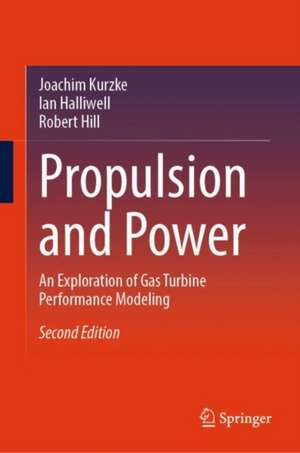
Propulsion and Power
Autor Joachim Kurzke, Ian Halliwell, Robert Hillen Limba Engleză Hardback – 16 apr 2025
Clear distinctions are made between design and off-design models, the keys to success being the recognition of the importance of scaling and validating compressor and turbine maps. This topic is discussed in more detail than in other sources. New descriptions of turbomachinery basics are offered, and it is shown how velocity diagrams can capture the quality of a compressor or turbine stage and the effects of changes. Non-dimensional performance is explained in an unusual way, without referring to higher mathematics. The influence of inlet flow distortion and heat transfer on engine operability during transient operation is also characterized.
This second edition contains new material about engine starting and windmilling, supported by how to extend existing compressor and turbine maps down to speeds as low as 1%. Unique material on map interpretation is included. The design and operation of hybrid propulsion systems are also addressed.
Not only a valuable engineering textbook but also a good read!
Preț: 1361.44 lei
Preț vechi: 1768.10 lei
-23%
Puncte Express: 2042
Carte tipărită la comandă
Livrare economică 23-29 decembrie
Livrare prin curier în România Termenul estimat este afișat lângă disponibilitate.
Transport gratuit pentru acest produs Plată online sau ramburs, în funcție de opțiunile comenzii.
Retur gratuit în 14 zile Comandă securizată și suport în română.
Specificații
ISBN-13: 9783031650253
ISBN-10: 3031650255
Pagini: 936
Ilustrații: X, 890 p.
Dimensiuni: 160 x 241 x 52 mm
Greutate: 1.67 kg
Ediția:Second Edition 2025
Editura: Springer
Locul publicării:Cham, Switzerland
ISBN-10: 3031650255
Pagini: 936
Ilustrații: X, 890 p.
Dimensiuni: 160 x 241 x 52 mm
Greutate: 1.67 kg
Ediția:Second Edition 2025
Editura: Springer
Locul publicării:Cham, Switzerland
Cuprins
Simulation tasks: New engine design.- Engine families.- Modeling an engine.- Engine model examples.- Model-based performance analysis.- Inlet flow distortion.- Transient performance simulation.- Preliminary design:- Compressor.- Turbines.- Mechanical design.- Off-design: Component performance.- Understanding off-design behavior.- Basics: Gas properties and standard atmosphere.- Spreadsheet calculations.- Non-dimensional performance.- Reynolds number corrections.- Efficiency of a cooled turinbe.- Secondary air system.- Mathematics.- Optimization.- Monte Carlo simulations.- Appendix.
Notă biografică
Joachim Kurzke spent his engineering life dealing with gas turbine performance, first at the Technical University of Munich, Institute for Flight Propulsion.
1976 Kurzke joined the performance department of the company which is now MTU Aero Engines and stayed there for 28 years. He worked on a multitude of different engine projects, designed the engine performance program MOPS for MTU, and applied it to the everyday problems in the performance department.
MOPS is due to the modular design very flexible and can be adapted easily to new requirements, however, it's use requires significant training in gas turbine performance. This observation resulted in the development of the performance program GasTurb(TM). This software concentrates on the user interface, without neglecting any detail which is required for professional gas turbine performance work. After more than 20 years in the public domain, GasTurb(TM) is well known and acknowledged all over the world.
Kurzke has published numerous papers dealing with gas turbine performance, and was a member of several RTO (former AGARD) working groups, as well as the SAE E33 committee "Thrust in Flight". He is still a member of the ASME/IGTI Aircraft Engine and Education Committees.
Ian Halliwell obtained his B.Sc. in Aeronautical Engineering and M.Sc. in Aerodynamics from Imperial College, London, followed by a Ph.D. in Experimental Gas Dynamics from the University of Southampton. His professional career began in 1975 at Rolls-Royce, Derby in Turbine Aerodynamics Research. He then crossed the Atlantic to work for Pratt and Whitney Canada in Mississauga and subsequently GE in Cincinnati, where he moved into the preliminary design of complete engine systems and spent a few years on the High Speed Civil Transport program. During that period, he also began teaching in GE after-hours education.
While continuingto model complete engine systems, his teaching activities continued after moving to the small business world, as a contractor at the NASA Glenn Research Center and expanded through involvement with AIAA and ASME/IGTI. He chaired the AIAA Air Breathing Propulsion and Gas Turbine Engine Technical Committees and is still an active member of AIAA. He is also a member of the ASME/IGTI Aircraft Engine and Education Committees. His connection to students and university faculty was enhanced during the 14 years he organized the AIAA International Engine Design Competition for undergraduate teams. He met Joachim Kurzke while presenting a tutorial on Preliminary Engine Design at ASME TurboExpo in 2001 and the seeds were sown for this book a few years later.
His current special interests are in new engine architectures, involving vaneless counter-rotation and exoskeletal architectures for compressors and turbines - both axial and radial. The past 10 years or so, back in aerodynamics, involved the development and application of new design tools.
Textul de pe ultima copertă
This book is for students, teachers, and practicing engineers and describes an industrial approach to gas turbine engine simulation, mainly for aircraft propulsion. The principles of performance model creation are covered, and the viability and accuracy of model-based performance analyses are demonstrated by their application to real-world examples, where measured data are scarce.
Clear distinctions are made between design and off-design models, the keys to success being the recognition of the importance of scaling and validating compressor and turbine maps. This topic is discussed in more detail than in other sources. New descriptions of turbomachinery basics are offered, and it is shown how velocity diagrams can capture the quality of a compressor or turbine stage and the effects of changes. Non-dimensional performance is explained in an unusual way, without referring to higher mathematics. The influence of inlet flow distortion and heat transfer on engine operability during transient operation is also characterized.
This second edition contains new material about engine starting and windmilling, supported by how to extend existing compressor and turbine maps down to speeds as low as 1%. Unique material on map interpretation is included. The design and operation of hybrid propulsion systems are also addressed.
Not only a valuable engineering textbook but also a good read!
Caracteristici
Guide for solving real world problems with modern computer software Good text for teaching gas turbine design and performance Solutions of overall system simulation problems