Cantitate/Preț
Produs

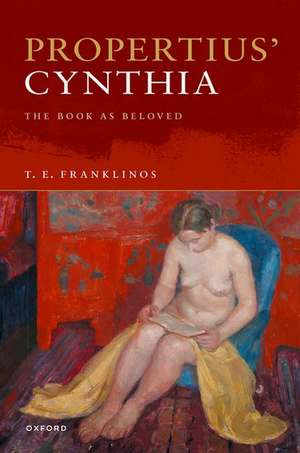
Propertius’ Cynthia: The Book as Beloved

Autor T. E. Franklinos
en Limba Engleză Hardback – 28 noi 2024

Studiile clasice recente au evoluat semnificativ de la analiza textuală tradițională către o înțelegere profundă a modului în care autorii antici își construiesc identitatea literară prin intermediul metaforei. Reținem în acest sens lucrarea Propertius’ Cynthia, în care T. E. Franklinos propune o lectură inovatoare a Cărților 3 și 4, argumentând că figura Cynthiei nu este doar o muză, ci întruparea însăși a poeziei lui Propertius. Subliniem modul în care autorul demonstrează că discursul amoros repetitiv, specific elegiei, este de fapt un instrument metapoetic: eșecul relației de a progresa reflectă limitările și transformările genului literar.

Această lucrare acoperă aceeași arie tematică precum volumul Cynthia de S. J. Heyworth, dar cu o abordare mult mai axată pe structura narativă și pe intertextualitate decât pe critica textuală pură. În timp ce edițiile clasice îngrijite de W. A. Camps, precum Elegies Bk 3 sau Propertius: Elegies Book 4, se concentrează pe clarificarea limbajului și a dificultăților de manuscris pentru studenți, Franklinos avansează o teză teoretică solidă despre modul în care fragmentarea și repetiția lexicală modelează înțelegerea cititorului asupra discursului amator.

În contextul operei sale, această monografie completează preocupările autorului pentru istoria literaturii latine, vizibile și în Sicco Polenton, Lives of the Famous Latin Authors. Dacă în lucrarea despre Polenton acesta explora biografiile autorilor antici prin prisma umaniștilor, aici analizează mecanismul intern prin care Propertius își fragmentează propria experiență pentru a crea un corpus elegiac polivalent. Este o analiză densă, esențială pentru înțelegerea tranziției de la elegia subiectivă la experimentele generice radicale din finalul operei propertiene.

Citește tot Restrânge

Preț: 61365 lei

Preț vechi: 92071 lei
-33%

Puncte Express: 920

Carte disponibilă

Livrare economică 07-13 mai
Livrare express 21-25 aprilie pentru 17474 lei


Specificații

ISBN-13: 9780198940234
ISBN-10: 0198940238
Pagini: 256
Dimensiuni: 163 x 240 x 22 mm
Greutate: 0.55 kg
Editura: OUP OXFORD
Colecția OUP Oxford
Locul publicării:Oxford, United Kingdom

De ce să citești această carte

Recomandăm această lucrare cercetătorilor și studenților avansați în filologie clasică. Cititorul câștigă o perspectivă nouă asupra modului în care textul poetic devine un obiect al dorinței, depășind interpretările biografice limitate. Este o resursă valoroasă pentru cei care doresc să înțeleagă cum metafora „iubitei ca text” fundamentează întreaga structură a elegiei latine augustane.


Despre autor

T. E. Franklinos este un cercetător specializat în literatură latină, cu un interes marcat pentru poezia elegiacă și transmiterea textelor clasice. Expertiza sa se extinde de la perioada augustană până la receptarea clasicilor în perioada Renașterii, fapt demonstrat de lucrarea sa asupra lui Sicco Polenton. În volumul de față, publicat la OUP Oxford, Franklinos îmbină rigoarea filologică cu teoria literară modernă pentru a reevalua unul dintre cei mai complecși poeți ai Romei antice. Contribuțiile sale sunt recunoscute pentru modul în care reușesc să aducă noi nuanțe unor texte disputate de secole în mediul academic.


Descriere

Propertius' Cynthia considers Propertius' metapoetic and intra- and intertextual habits and their relationship with the repetitious amatory discourse that he fashions for himself with his beloved, Cynthia. Where scholarship tends to treat as separate the metaliterary and the amatory aspects of Propertius' poetry, this volume - focussed on Books 3 and 4 - argues that his discussion of his own poetry and of his relationship to it as an author-figure - his metapoetic commentary - is closely married to, and can be clearly mapped onto, his account of his relationship with Cynthia, especially in Books 1-3. Moreover, it demonstrates that the amorous discourse the elegist fashions is constituted of a poetics of repetitiousness that is apt for the articulation of an elegiac relationship that, by its nature, cannot progress. The encounters between Propertius and Cynthia are repetitive, and the poet mirrors these in his recollection of lexical and thematic aspects of earlier poems in later ones. Each poem provides a fragmentary glance at Propertius' relationship and, through repetitions with variation, the elegist shapes his readers' understanding of his amatory discourse. Furthermore, it is argued that, since his beloved is the embodiment of his poetry, Propertius' account of his changing relationship with her allows him to articulate the transformations of his elegiac corpus; this becomes most significant as the close of Book 3 appears to end their relationship and he begins a radical experimentation with the generic bounds of elegy that is expanded in Book 4, where the polyvalent Vertumnus embodies the poet's work.

Notă biografică

Tristan Franklinos teaches at the University of Oxford, where he completed his graduate study following his first degree at St Andrews. After holding a British Academy Postdoctoral Fellowship and Junior Research Fellowship at Trinity College, Oxford, he was appointed to a Lectorship in the Faculty of Classics at Oxford, is a Fellow of Wolfson College, and a Lecturer at Oriel College; he has also held an Alexander-von-Humboldt-Stiftung Fellowship at Ludwig-Maximilians-Universität, Munich. His work focusses on the Latin literatures of Antiquity and the Middle Ages and their transmission; he has primarily written on the Roman elegists, pseudepigrapha, and medieval Latin texts.