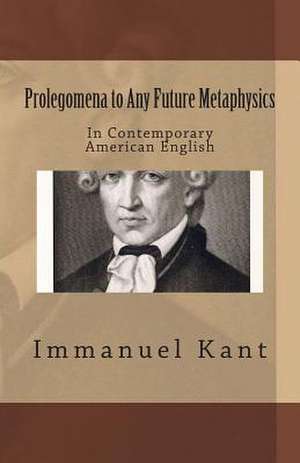
Prolegomena to Any Future Metaphysics
Autor Immanuel Kant Editat de Marciano Guerrero Traducere de Marymarc Translationsen Limba Engleză Paperback
Preț: 69.57 lei
Puncte Express: 104
Carte indisponibilă temporar
Doresc să fiu notificat când acest titlu va fi disponibil:
Se trimite...
Specificații
ISBN-13: 9781495451560
ISBN-10: 1495451569
Pagini: 246
Dimensiuni: 140 x 216 x 13 mm
Greutate: 0.29 kg
Editura: CREATESPACE
ISBN-10: 1495451569
Pagini: 246
Dimensiuni: 140 x 216 x 13 mm
Greutate: 0.29 kg
Editura: CREATESPACE
V-ar putea interesa
-
 An Answer to the Question: 'What Is Enlightenment?'Immanuel Kant-20%Preț: 45.43 lei56.65 lei
 -
 LabyrinthsJorge Luis Borges-25%Preț: 59.27 lei78.99 lei
 -
 The Oxford Book of MoneyKevin Jackson-29%Preț: 669.59 lei949.57 lei
 -
 An Anthology of Greek ProseD. A. Russell-29%Preț: 536.59 lei752.14 lei
 -
 Brief Interviews With Hideous MenDavid Foster Wallace-26%Preț: 58.74 lei79.32 lei
 -
 That Mighty Sculptor, TimeMarguerite YourcenarPreț: 115.57 lei
 -
 The Last EmpireGore VidalPreț: 130.00 lei
 -
 The Moral Law: Groundwork of the Metaphysics of MoralsImmanuel KantPreț: 137.77 lei
 -
 Preț: 212.63 lei
 -
 Critique of the Power of JudgmentImmanuel KantPreț: 317.82 lei
 -
 Practical PhilosophyImmanuel KantPreț: 402.80 lei
 -
 -22%Preț: 98.53 lei126.85 lei
 -
 Preț: 299.77 lei
 -
 On LookingLia PurpuraPreț: 104.97 lei
 -
 Kritik der reinen VernunftImmanuel KantPreț: 97.04 lei
Descriere
Descriere de la o altă ediție sau format:
The Prolegomena to Any Future Metaphysics serves dual purposes. It is an ideal entry point to Immanuel Kant’s broader thought and to his longer, more complex works. And it is also in itself an impressive and argumentatively powerful study of the methods and limits of metaphysics. Kant boldly declares to any reader aiming to construct a system of metaphysics: “You must satisfy the demands I make here, either by adopting my solution, or by thoroughly refuting it, and substituting another. To evade it is impossible.”
This edition of the Prolegomena is uniquely suited to readers approaching Kant for the first time. It includes a modernized translation along with copious interspersed notes designed to aid understanding of what Kant is saying. These explanatory notes, prompts, and explanations offer a gentle guiding hand, clarifying the book’s concepts and resolving common misunderstandings without forcing any one interpretation of the text. Reflective questions are also provided to encourage critical evaluation of Kant’s arguments.
The Prolegomena to Any Future Metaphysics serves dual purposes. It is an ideal entry point to Immanuel Kant’s broader thought and to his longer, more complex works. And it is also in itself an impressive and argumentatively powerful study of the methods and limits of metaphysics. Kant boldly declares to any reader aiming to construct a system of metaphysics: “You must satisfy the demands I make here, either by adopting my solution, or by thoroughly refuting it, and substituting another. To evade it is impossible.”
This edition of the Prolegomena is uniquely suited to readers approaching Kant for the first time. It includes a modernized translation along with copious interspersed notes designed to aid understanding of what Kant is saying. These explanatory notes, prompts, and explanations offer a gentle guiding hand, clarifying the book’s concepts and resolving common misunderstandings without forcing any one interpretation of the text. Reflective questions are also provided to encourage critical evaluation of Kant’s arguments.
Recenzii
The Prolegomena to Any Future Metaphysics serves dual purposes. It is an ideal entry point to Immanuel Kant’s broader thought and to his longer, more complex works. And it is also in itself an impressive and argumentatively powerful study of the methods and limits of metaphysics. Kant boldly declares to any reader aiming to construct a system of metaphysics: “You must satisfy the demands I make here, either by adopting my solution, or by thoroughly refuting it, and substituting another. To evade it is impossible.”
This edition of the Prolegomena is uniquely suited to readers approaching Kant for the first time. It includes a modernized translation along with copious interspersed notes designed to aid understanding of what Kant is saying. These explanatory notes, prompts, and explanations offer a gentle guiding hand, clarifying the book’s concepts and resolving common misunderstandings without forcing any one interpretation of the text. Reflective questions are also provided to encourage critical evaluation of Kant’s arguments.
“This is a great new edition of one of Kant’s most important works! It ushers the Prolegomena into the twenty-first century in ways that will appeal to students and scholars alike. The in-text editorial commentary and expanded footnotes clarify and illuminate the text’s key concepts and arguments. The revised prose greatly enhances the reader’s understanding, making Kant’s thought all the more accessible and intelligible. Martin has gifted us with an invaluable teaching tool.” — Michael P. Berman, Brock University
“This edition will serve admirably as an accessible teaching text for students new to Kant’s writing. Helpful editorial insertions in the text serve to clarify key terms, elucidate arguments, and provide background about previous philosophers Kant is responding to. The ‘Questions for Consideration’ placed at the ends of sections invite students in to philosophize more and more deeply about what they are reading. The Prolegomena is a text that can challenge even the most earnest philosophy student, and this edition welcomes them in a friendly and good-humored way without over-simplifying.” — Jane Dryden, Mount Allison University
This edition of the Prolegomena is uniquely suited to readers approaching Kant for the first time. It includes a modernized translation along with copious interspersed notes designed to aid understanding of what Kant is saying. These explanatory notes, prompts, and explanations offer a gentle guiding hand, clarifying the book’s concepts and resolving common misunderstandings without forcing any one interpretation of the text. Reflective questions are also provided to encourage critical evaluation of Kant’s arguments.
“This is a great new edition of one of Kant’s most important works! It ushers the Prolegomena into the twenty-first century in ways that will appeal to students and scholars alike. The in-text editorial commentary and expanded footnotes clarify and illuminate the text’s key concepts and arguments. The revised prose greatly enhances the reader’s understanding, making Kant’s thought all the more accessible and intelligible. Martin has gifted us with an invaluable teaching tool.” — Michael P. Berman, Brock University
“This edition will serve admirably as an accessible teaching text for students new to Kant’s writing. Helpful editorial insertions in the text serve to clarify key terms, elucidate arguments, and provide background about previous philosophers Kant is responding to. The ‘Questions for Consideration’ placed at the ends of sections invite students in to philosophize more and more deeply about what they are reading. The Prolegomena is a text that can challenge even the most earnest philosophy student, and this edition welcomes them in a friendly and good-humored way without over-simplifying.” — Jane Dryden, Mount Allison University
Cuprins
- Part 1: Introductory Material
- Editors Introduction
- Advice on Further Reading
- Overview of the Prolegomena
- Analysis of the Prolegomena
- Note on Texts and Translations
- Notes to Part I
- Part 2: Prolegomena to Any Future Metaphysics
- Preface
- Preamble: Of What is Peculiar to All Metaphysical Cognition
- General Question of the Prolegomena: Is Metaphysics Possible at All?
- General Question: How is Cognition from Pure Reason Possible?
- Editors Notes to Prolegomena, Preface and Preamble
- First Part of the Main Transcendental Question: How is Pure Mathematics Possible?
- Editors Notes to Prolegomena, First PartSecond Part of the Main Transcendental Question: How is Pure Natural Science Possible?
- Editors Notes to Prolegomena, Second PartThird Part of the Main Transcendental Question: How is Metaphysics in General Possible?
- Editors Notes to Prolegomena, Third PartSolution to the General Question of the Prolegomena: How is Metaphysics as Science Possible?
- Appendix: Of What Can Be Done to Make Metaphysics as Science Actual
- Editors Notes to Prolegomena, Solution and Appendix
- Part 3: Supplementary Texts
- The Göttingen Review of the Critique of Pure Reason
- Editors Notes to the Göttingen Review
- The Garve Review of the Critique of Pure Reason
- Editors Notes to the Garve Review
- Part 4: Reference Material
- Glossary, Bibliography, Chronology, Index of Names, Index of Terms
Notă biografică
Immanuel Kant ( 22 April 1724 - 12 February 1804) was an influential German philosopher[23] in the Age of Enlightenment. In his doctrine of transcendental idealism, he argued that space, time, and causation are mere sensibilities; "things-in-themselves" exist, but their nature is unknowable.[24][25] In his view, the mind shapes and structures experience, with all human experience sharing certain structural features. In one of his major works, the Critique of Pure Reason (1781; second edition 1787),[26] he drew a parallel to the Copernican revolution in his proposition that worldly objects can be intuited a priori ('beforehand'), and that intuition is therefore independent from objective reality.[b] Kant believed that reason is also the source of morality, and that aesthetics arise from a faculty of disinterested judgment. Kant's views continue to have a major influence on contemporary philosophy, especially the fields of epistemology, ethics, political theory, and post-modern aesthetics. He attempted to explain the relationship between reason and human experience and to move beyond the failures of traditional philosophy and metaphysics. He wanted to put an end to what he saw as an era of futile and speculative theories of human experience, while resisting the skepticism of thinkers such as David Hume. He regarded himself as showing the way past the impasse between rationalists and empiricists,[28] and is widely held to have synthesized both traditions in his thought.[29] Kant was an exponent of the idea that perpetual peace could be secured through universal democracy and international cooperation. He believed that this would be the eventual outcome of universal history, although it is not rationally planned.[30] The nature of Kant's religious ideas continues to be the subject of philosophical dispute, with viewpoints ranging from the impression that he was an initial advocate of atheism who at some point developed an ontological argument for God, to more critical treatments epitomized by Schopenhauer, who criticized the imperative form of Kantian ethics as "theological morals" and the "Mosaic Decalogue in disguise",[31] and Nietzsche, who claimed that Kant had "theologian blood"[32] and was merely a sophisticated apologist for traditional Christian faith