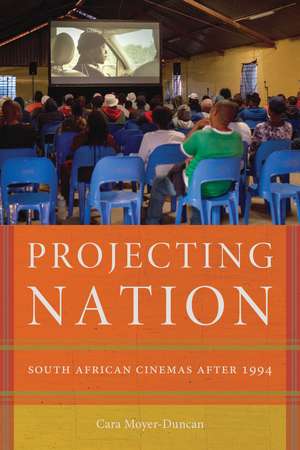
Projecting Nation: South African Cinemas after 1994: African Humanities and the Arts
Autor Cara Moyer-Duncanen Limba Engleză Paperback – iul 2020


Preț: 417.69 lei
Puncte Express: 627
Preț estimativ în valută:
73.92€ • 86.39$ • 64.18£
73.92€ • 86.39$ • 64.18£
Carte indisponibilă temporar
Doresc să fiu notificat când acest titlu va fi disponibil:
Se trimite...
Preluare comenzi: 021 569.72.76
Specificații
ISBN-13: 9781611863635
ISBN-10: 1611863635
Pagini: 298
Ilustrații: 26
Dimensiuni: 152 x 229 x 20 mm
Greutate: 0.48 kg
Ediția:1
Editura: Michigan State University Press
Colecția Michigan State University Press
Seria African Humanities and the Arts
ISBN-10: 1611863635
Pagini: 298
Ilustrații: 26
Dimensiuni: 152 x 229 x 20 mm
Greutate: 0.48 kg
Ediția:1
Editura: Michigan State University Press
Colecția Michigan State University Press
Seria African Humanities and the Arts
Notă biografică
CARA MOYER-DUNCAN is an Assistant Professor of Africana Studies in the Institute for Liberal Arts and Interdisciplinary Studies at Emerson College.
Cuprins
Contents
Acknowledgments
Introduction. Audience, Race, Globalization, and South African Cinemas after 1994
Chapter 1. An Industry Not Yet Transformed: The State, the Private Sector, and the Ecology of South African Cinema after 1994
Chapter 2. Projecting South Africa for Global Consumption: Myths, Stereotypes, and Feel-Good Stories
Chapter 3. Independent Filmmaking after 1994: New Directions, No Audiences
Chapter 4. “Oh Schuks!” Is This the New South African Cinema? Genre, Stars, Stereotypes, and Popular Appeal
Chapter 5. Following the Market: The Refragmentation of the Local Film Industry
Conclusion
Notes
Filmography
Bibliography
Index
Recenzii
“The history of South African film is well documented, especially during the period of political transition. Less well examined is the contemporary post-millennial era, on which Moyer-Duncan’s book offers a very useful analytical frame to underpin study of those cinema themes that followed liberation after 1994.”
—KEYAN G. TOMASELLI, Distinguished Professor of Communication Studies, University of Johannesburg, and Professor Emeritus and Fellow,
University of KwaZulu-Natal
—KEYAN G. TOMASELLI, Distinguished Professor of Communication Studies, University of Johannesburg, and Professor Emeritus and Fellow,
University of KwaZulu-Natal
Descriere
In 1994, not long after South Africa made its historic transition to multiracial democracy, the nation’s first black-majority government determined that film had the potential to promote social cohesion, stimulate economic development, and create jobs. In 1999, the new National Film and Video Foundation was charged with fostering a vibrant, socially engaged, and self-sufficient film industry. What are the results of this effort to create a truly national cinematic enterprise? Projecting Nation: South African Cinemas after 1994 answers that question by examining the ways in which national and transnational forces have shaped the representation of race and nation in feature-length narrative fiction films.