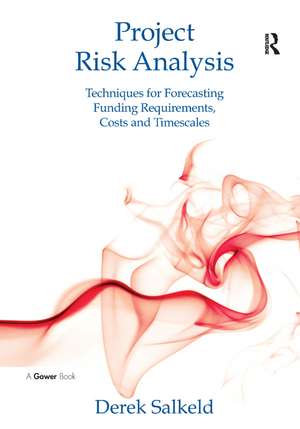
Project Risk Analysis: Techniques for Forecasting Funding Requirements, Costs and Timescales
Autor Derek Salkelden Limba Engleză Hardback – 19 mar 2013
Preț: 1316.39 lei
Preț vechi: 1605.36 lei
-18%
Puncte Express: 1975
Carte disponibilă
Livrare economică 10-24 noiembrie
Livrare prin curier în România Termenul estimat este afișat lângă disponibilitate.
Transport gratuit pentru acest produs Plată online sau ramburs, în funcție de opțiunile comenzii.
Retur gratuit în 14 zile Comandă securizată și suport în română.
Specificații
ISBN-13: 9780566091865
ISBN-10: 0566091860
Pagini: 310
Dimensiuni: 174 x 246 x 24 mm
Greutate: 0.82 kg
Ediția:New.
Editura: Taylor & Francis
Colecția Routledge
Locul publicării:Oxford, United Kingdom
ISBN-10: 0566091860
Pagini: 310
Dimensiuni: 174 x 246 x 24 mm
Greutate: 0.82 kg
Ediția:New.
Editura: Taylor & Francis
Colecția Routledge
Locul publicării:Oxford, United Kingdom
V-ar putea interesa
-
 Material Markets: How Economic Agents are ConstructedDonald MacKenzie-31%Preț: 594.79 lei862.94 lei
 -
 Credit Rating Agencies on the Watch List: Analysis of European RegulationRaquel García Alcubilla-31%Preț: 948.64 lei1378.94 lei
 -
 Creating Value from Mergers and AcquisitionsSudi Sudarsanam-9%Preț: 609.23 lei669.49 lei
 -
 The RainforestVictor W. HwangPreț: 132.70 lei
 -
 Discounting, LIBOR, CVA and FundingC. KenyonPreț: 512.10 lei
 -
 The International Banking SystemFelix I. Lessambo-15%Preț: 615.71 lei724.36 lei
 -
 Preț: 411.16 lei
Notă biografică
Derek Salkeld has been a risk analyst and risk manager for 20 years. He trained as a geophysicist and led a signal processing systems design team for a UK military systems manufacturer. He has extensive experience of multi-disciplinary engineering projects covering a wide range of assets including: the assessment of Network Rail's IT investment programme; the development of an asset investment model of waste water treatment systems owned by the Water Service of Northern Ireland and the business case for the London Cross Rail system. He was risk manager on both the recently opened London cable car and the East London Line projects. He is currently advisor to London Underground Limited on its stations capital works programme and to Genesis Power on its Tekapo hydro electric projects in New Zealand. He is a doctoral research student at the University of Exeter researching risk management methods.
Cuprins
1: Introduction; 1: The Case for Risk Analysis; 2: Risk Modelling Primitives; 3: Risk Modelling Examples: Cost Context; 4: Risk Modelling Examples: Time; 5: Using Risk Analysis to Inform the Allocation of Risk Ownership; 6: Using Risk Analysis to Derive the Risk Management Strategy; 7: A Risk Analysis Process; Conclusion
Recenzii
’The book provides a multitude of aids to help with determining risks, identifying costs, and how the risks affect the schedule. These aids include examples, areas to address and checklists... it stresses the importance of tying risks to people through assignment of ownership and risks to the project budget through allocation of contingences.... The project management and risk management professions may get a better reputation because of projects getting completed at a higher rate and on time and within budget.’ PM World Journal, September 2013 ’Derek Salkeld’s book is about understanding the uncertainty inherent in projects, which leads to the inability to predict timescales and costs precisely at the beginning of a project. In an industry where even large companies are wedded to single-valued estimating techniques, against which they may enter fixed-price contracts with penalties for lateness, (or judge the performance of the project delivery staff), the content of this book provides valuable material to help manage expectations, obligations, and funding.’ Camel Blog (Arras People), January 2015
Descriere
Projects overspend and overrun. Business cases perform less well than expected. Managers tighten their grip and initiate more procedure. But little changes and the scenario repeats, and it has done so for decades. Losing other peoples' money and goodwill is almost an innate characteristic of projects. This may be a norm but it need not be the natural state of affairs. In Project Risk Analysis, Derek Salkeld shows how easily assimilated techniques developed out of formal risk analysis methods can be used to increase the chances of projects being delivered to the oft quoted objective of on time and to budget, to quality and to popular acceptance. These techniques need to be understood by managers so that they can foresee the benefits of directing their teams to carry them out, and so they can inform their clients about the potential consequences of the investments they wish to make and how the project team plan to assure these.