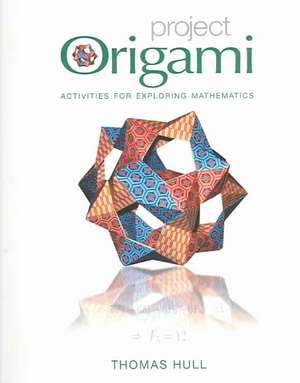
Project Origami
Autor Thomas Hullen Limba Engleză Paperback – 15 mar 2006
Structura volumului Project Origami este concepută pentru a transforma matematica dintr-o disciplină pur teoretică într-una tactilă și experimentală. Thomas Hull organizează materialul sub formă de activități practice care transcend geometria clasică, explorând fundamentele algebrei abstracte, topologiei și analizei matematice. Considerăm că forța acestui volum rezidă în metodologia sa riguroasă: fiecare exercițiu de pliere a hârtiei este utilizat pentru a vizualiza concepte complexe, de la modele matriciale pentru îndoituri până la studiul curburii Gaussiane. Abordarea nu este una pur recreativă, ci una didactică, oferind demonstrații matematice solide prin intermediul unităților PHiZZ sau al construcției de Bucky Balls.
Putem afirma că Project Origami acționează ca o punte între intuiția spațială și rigoarea algebrică. Cititorii familiarizați cu Origametry, tot de Thomas Hull, vor aprecia modul în care acest volum trece de la teoria pură la aplicabilitatea imediată în sala de curs. Dacă Origametry servește drept referință teoretică completă, Project Origami este instrumentul de lucru practic, oferind fișe descărcabile online care facilitează implementarea lecțiilor. Comparativ cu Origamics de Kazuo Haga, care se concentrează predilect pe geometrie prin explorare experimentală, lucrarea de față extinde spectrul tematic către ecuații cubice și structuri discrete, fiind mult mai ancorată în curriculumul universitar și de liceu avansat. Ritmul este unul ghidat, cu instrucțiuni clare care încurajează formularea de întrebări și descoperirea activă a soluțiilor.
Preț: 223.05 lei
Preț vechi: 260.11 lei
-14%
Carte tipărită la comandă
Livrare economică 10-16 decembrie
Specificații
ISBN-10: 1568812582
Pagini: 272
Dimensiuni: 203 x 254 x 19 mm
Greutate: 0.66 kg
Editura: TAYLOR & FRANCIS LTD
V-ar putea interesa
De ce să citești această carte
Recomandăm această carte profesorilor de matematică și studenților care doresc să exploreze conexiunile neașteptate dintre arta plierii hârtiei și algebra abstractă sau topologie. Cititorul câștigă o metodă interactivă de a preda și înțelege concepte dificile, beneficiind de resurse digitale gata de utilizat. Este instrumentul ideal pentru a revitaliza cercurile de matematică prin proiecte concrete, precum rezolvarea ecuațiilor cubice prin origami.
Descriere scurtă
Recenzii
—Mathematical Reviews, February 2008
Is it possible to use origami in the higher level mathematics classroom? An affirmative answer is given by Thomas Hull’s book Project Origami: Activities for Exploring Mathematics. Based on Hull’s extensive experience of combining origami and mathematics teaching over the last fifteen years, it aims to help the teacher bring origami into the mathematics classroom, at the high school, college, and university level.
—Helena Verrill, AMS Notices, May 2007
Thomas Hull … is one of the country’s foremost researchers in origami mathematics—a subject making the slow transition from the ghetto of recreational math, where Sudoku and Rubik’s Cube dwell, to the rarified air of legitimate research topic … The fun part is watching the mash-up of intellectual analysis and paper creativity … but what really drives him, he says, is understanding what’s happening underneath each figure.
—David Brooks, Nashuatelegraph.com, May 2007
In his efforts to collect everything that he could find linking origami and math (and in his own research efforts), Hull has discovered not only the obvious links between origami and geometry but also intriguing intersections of origami with other fields of mathematics, such as algebra, number theory, and combinatorics.
—Ivars Peterson, Science News, June 2006
Overall, this book is an excellent resource for mathematics educators who would like to include some hands-on experimentation in their teaching.
—Steven Frankel, MAA Reviews, July 2006
This is probably the most comprehensive study of mathematical paperfolding produced in book form to date. … Along with theorems and formulas, there are copious notes for instructors, making the book more a teachers’ manual than a recreational pursuit. Even so it will reward a study even by those wishing solely to produce decorative forms.
—John Cunliffe, ELFA and British Origami Society
This book shows you how and explains how! … The book is neatly presented and is designed to work as a sourcebook for teachers wishing to use origami in the classroom, but is easily accessible to anyone.
—Dennis Walker, British Origami Society
Thomas Hull has written a truly wonderful book … Project Origami is full of surprises and depth. Hull is passionate about his work and it shines through in this text … Concrete connections to curriculum (upper high-school levels, undergraduate levels) are made clear, highlighting the relevance and importance of this material to mathematics education. Every teacher should take a hold of this book … Hull shares the joy of doing and exploring real mathematics and provides a route that all can pursue.
—James Tanton