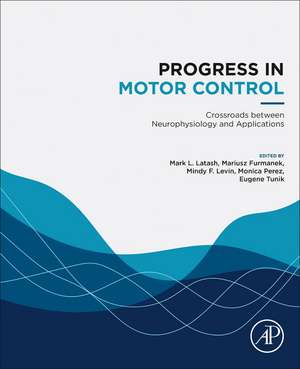
Progress in Motor Control: Crossroads between Neurophysiology and Applications
Editat de Mark L. Latash, Mariusz P. Furmanek, Mindy F. Levin, Monica A. Perez, Eugene Tuniken Limba Engleză Paperback – sep 2026
Divided into five comprehensive parts, the book covers theoretical advances, neurophysiological mechanisms, motor learning, neural plasticity, and motor disorders, including essential topics like neural population dynamics and the dual role of vestibulospinal reflexes. Final sections highlight practical strategies for improving recovery outcomes following neurological events.
- Combines theories from multiple disciplines for an integrated view of motor control
- Examines environmental factors and contextual influences on motor performance and learning
- Highlights clinical case studies demonstrating real-world applications in rehabilitation
- Discusses the impact of emerging technologies, such as non-invasive brain stimulation, on motor disorders
- Provides practical insights for clinicians on tailoring interventions based on the latest research
Preț: 1067.42 lei
Preț vechi: 1123.60 lei
-5% Nou
Puncte Express: 1601
Carte disponibilă
Livrare economică 30 octombrie-13 noiembrie
Livrare prin curier în România Termenul estimat este afișat lângă disponibilitate.
Transport gratuit pentru acest produs Plată online sau ramburs, în funcție de opțiunile comenzii.
Retur gratuit în 14 zile Comandă securizată și suport în română.
Specificații
ISBN-13: 9780443450686
ISBN-10: 0443450684
Pagini: 356
Dimensiuni: 216 x 276 mm
Greutate: 0.93 kg
Editura: ELSEVIER SCIENCE
ISBN-10: 0443450684
Pagini: 356
Dimensiuni: 216 x 276 mm
Greutate: 0.93 kg
Editura: ELSEVIER SCIENCE
Cuprins
Part I: Theoretical Advances in Motor Control
1. Origins of processes within the uncontrolled manifold
2. Cognitive psychology of human motor planning
3. What a “task” means and why it matters: Bernstein’s ideas meet perception and attention research
4. A perspective on effort and its role in motor learning
5. Progress in scientific thinking about the equilibrium-point hypothesis during half a century
6. Determinants of the force-length characteristic of muscle and implications for limb mechanics
Part II: Advances in Understanding Neurophysiological Mechanisms
7. Relative contributions of different descending pathways to driving motoneurons and generating muscle contractions
8. Investigation of human reach to grasp using non-invasive brain stimulation
9. The dual roles of vestibulospinal reflexes: excitatory and inhibitory influences on limb muscle activity
10. Locomotor coordination and dynamic visual acuity
Part III: Motor Learning and Neural Plasticity
11. Exploration for learning new coordinative structures
12. Heksor: The CNS substrate of a skilled behavior
13. Targeting sensorimotor networks with noninvasive brain stimulation
14. Body mapping in infancy: Implications for goal-directed movements
15. New perspectives on cortical and subcortical mechanisms for visuomotor adaptation and their clinical implications
Part IV: Motor Disorders
16. The lens matters: Walking recovery after pediatric spinal cord injury
17. Mediolateral Foot Trajectory Stabilization During Walking in Young Adults, Older Adults, and People with Stroke
18. Mechanisms of Impaired Motor Control in Essential Tremor
19. The Association of Cognitive and Motor Performance in Parkinson's Disease: Understanding the Role of the Cerebellum and Related Circuitry
Part V: Recovery of the Motor Function
20. How Astrocytes Utilize L-Lactate to Promote Exercise-Enhanced Neuroplasticity in Parkinson’s disease
21. Translation of motor control principles to functional movement improvement after stroke
22. It’s Time to Move Forward: Translating Motor Control Principles into Neurorehabilitation
23. From muscle function to neural drive to plasticity – guiding neural plasticity to improve soleus activation and function
1. Origins of processes within the uncontrolled manifold
2. Cognitive psychology of human motor planning
3. What a “task” means and why it matters: Bernstein’s ideas meet perception and attention research
4. A perspective on effort and its role in motor learning
5. Progress in scientific thinking about the equilibrium-point hypothesis during half a century
6. Determinants of the force-length characteristic of muscle and implications for limb mechanics
Part II: Advances in Understanding Neurophysiological Mechanisms
7. Relative contributions of different descending pathways to driving motoneurons and generating muscle contractions
8. Investigation of human reach to grasp using non-invasive brain stimulation
9. The dual roles of vestibulospinal reflexes: excitatory and inhibitory influences on limb muscle activity
10. Locomotor coordination and dynamic visual acuity
Part III: Motor Learning and Neural Plasticity
11. Exploration for learning new coordinative structures
12. Heksor: The CNS substrate of a skilled behavior
13. Targeting sensorimotor networks with noninvasive brain stimulation
14. Body mapping in infancy: Implications for goal-directed movements
15. New perspectives on cortical and subcortical mechanisms for visuomotor adaptation and their clinical implications
Part IV: Motor Disorders
16. The lens matters: Walking recovery after pediatric spinal cord injury
17. Mediolateral Foot Trajectory Stabilization During Walking in Young Adults, Older Adults, and People with Stroke
18. Mechanisms of Impaired Motor Control in Essential Tremor
19. The Association of Cognitive and Motor Performance in Parkinson's Disease: Understanding the Role of the Cerebellum and Related Circuitry
Part V: Recovery of the Motor Function
20. How Astrocytes Utilize L-Lactate to Promote Exercise-Enhanced Neuroplasticity in Parkinson’s disease
21. Translation of motor control principles to functional movement improvement after stroke
22. It’s Time to Move Forward: Translating Motor Control Principles into Neurorehabilitation
23. From muscle function to neural drive to plasticity – guiding neural plasticity to improve soleus activation and function