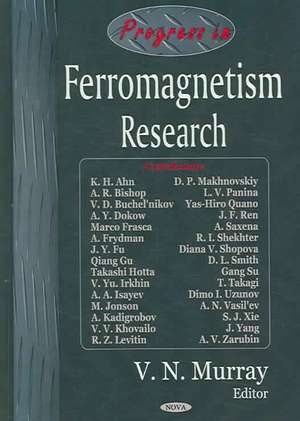
Progress in Ferromagnetism Research
Editat de V N Murrayen Limba Engleză Hardback – 6 iun 2005
Preț: 1450.08 lei
Preț vechi: 1970.63 lei
-26%
Puncte Express: 2175
Carte disponibilă
Livrare economică 07-21 noiembrie
Livrare prin curier în România Termenul estimat este afișat lângă disponibilitate.
Transport gratuit pentru acest produs Plată online sau ramburs, în funcție de opțiunile comenzii.
Retur gratuit în 14 zile Comandă securizată și suport în română.
Specificații
ISBN-13: 9781594543357
ISBN-10: 1594543356
Pagini: 356
Ilustrații: May 2006
Dimensiuni: 260 x 180 x 29 mm
Greutate: 0.99 kg
Editura: Nova Science Publishers Inc
Colecția Nova Science Publishers, Inc (US)
Locul publicării:United States
ISBN-10: 1594543356
Pagini: 356
Ilustrații: May 2006
Dimensiuni: 260 x 180 x 29 mm
Greutate: 0.99 kg
Editura: Nova Science Publishers Inc
Colecția Nova Science Publishers, Inc (US)
Locul publicării:United States
V-ar putea interesa
-
 A Treatise on Electricity and Magnetism: Volume 2James Clerk Maxwell-28%Preț: 379.30 lei523.59 lei
 -
 Electromagnetic TheoryA. Kovetz-31%Preț: 564.59 lei817.48 lei
 -
 Principles of DielectricsB. K. P. Scaife-33%Preț: 744.13 lei1102.60 lei
 -
 The Physics of Vibrations and Waves 6eH. John Pain-19%Preț: 441.24 lei544.73 lei
 -
 Electromagnetism 2eI. S. GrantPreț: 415.87 lei
 -
 MagnetismCraik-9%Preț: 844.72 lei928.27 lei
 -
 -27%Preț: 973.73 lei1333.86 lei
 -
 Electromagnetic Theory, Volume 3Oliver HeavisidePreț: 180.41 lei
 -
 -27%Preț: 1330.90 lei1813.16 lei
 -
 -14%Preț: 938.58 lei1091.37 lei
 -
 THEORY OF MAGNETISMDiep Hung-The-15%Preț: 525.84 lei618.64 lei
Cuprins
Fully Polarised States and Decoherence; Ferromagnetism in Undoped Manganites; Difference Equations for Correlation Functions and Form Factors of the Eight-Vertex/XYZ Model; Basic Properties of Spin Injection and Transport in Ferromagnetic/Polymer Systems; Theory of Spintronic Transport in Magnetic Tunnel Junctions; Ferromagnetic Phase Transition in Spinor Bose Gases; Giant Oscillations of the Density of States and the Conductance in a Ferromagnetic Conductor Coupled to two Superconductors; The Effect of Geometry on the Magneto-Transport Properties of Insulating Granular Ferromagnets; Many-Particle Effects in Half-Metallic Ferromagnets; Phases and Phase Transitions in Spin-Triplet Ferromagnetic Superconductors; Field and Stress -Tuneable Microwave Composite Materials Based on Ferromagnetic Wires; Phase Diagram and Magnetic Properties of Ferromagnetic Shape Memory Alloys; Spin Polarised States in Nuclear Matter with Skyrme Effective Interaction.