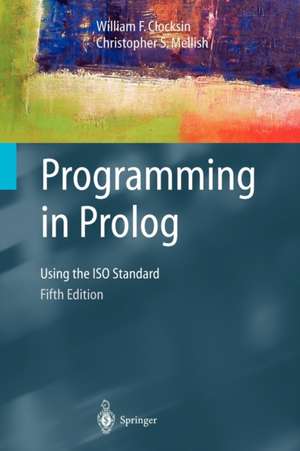
Programming in Prolog: Using the ISO Standard
Autor William F. Clocksin, Christopher S. Mellishen Limba Engleză Paperback – 25 iul 2003
Suntem de părere că longevitatea unui text tehnic este cel mai bun indicator al calității sale, iar lucrarea semnată de William F. Clocksin și Christopher S. Mellish reprezintă un caz rar în literatura de specialitate. Publicată inițial în 1981, aceasta a fost prima resursă didactică dedicată limbajului Prolog, menținându-și statutul de text fundamental prin rigoare și claritate. Autorii aduc o vastă experiență practică în ecosistemul calculului logic; de pildă, în lucrarea sa Computational Modelling of Robot Personhood and Relationality, Clocksin explorează frontierele inteligenței artificiale, o temă care își are rădăcinile tehnice chiar în conceptele de programare logică prezentate aici.
Ca și Max Bramer în Logic Programming with Prolog, autorii distilează experiența reală în principii acționabile, oferind o tranziție lină de la paradigma imperativă la cea declarativă. Structura cărții este una progresivă, de tip tutorial. Primele capitole familiarizează cititorul cu sintaxa, faptele și regulile, pentru ca ulterior să abordeze structuri de date avansate, precum arborii și listele, și tehnici esențiale precum backtracking-ul și utilizarea operatorului „cut”.
Această a cincea ediție este esențială deoarece aliniază limbajul la standardul ISO, eliminând informațiile despre sistemele Prolog depășite. Abordarea este una practică și tehnică, punând accent pe modul în care Prolog servește drept bază pentru sistemele moderne de Inteligență Artificială. În comparație cu alte titluri precum PROLOG for Computer Science de Christopher Dawe, care se concentrează pe studii de caz lingvistice, volumul de față rămâne o resursă de inginerie software generalistă, ideală pentru cei care doresc să stăpânească fundamentele logice ale programării.
Preț: 457.74 lei
Preț vechi: 572.18 lei
-20%
Carte tipărită la comandă
Livrare economică 09-23 iunie
Specificații
ISBN-10: 3540006788
Pagini: 316
Ilustrații: XIV, 300 p. 1 illus.
Dimensiuni: 155 x 235 x 17 mm
Greutate: 0.45 kg
Ediția:5th ed. 2003
Editura: Springer Berlin, Heidelberg
Colecția Springer
Locul publicării:Berlin, Heidelberg, Germany
V-ar putea interesa
-
 C Programming LanguageDennis Ritchie-20%Preț: 375.05 lei468.81 lei
 -
 Thinking in JavaBruce Eckel-20%Preț: 390.83 lei488.54 lei
 -
 Smalltalk Best Practice PatternsKent Beck-20%Preț: 405.59 lei506.99 lei
 -
 Structure and Interpretation of Computer ProgramsGerald Jay Sussman-20%Preț: 493.81 lei617.26 lei
 -
 The Little ProverCarl Eastlund-20%Preț: 299.42 lei374.28 lei
 -
 The Reasoned SchemerDaniel P. Friedman-26%Preț: 243.29 lei330.27 lei
 -
 The Seasoned SchemerDaniel P. Friedman-31%Preț: 287.82 lei414.90 lei
 -
 Prolog Programming for Artificial IntelligenceIvan Bratko-20%Preț: 586.35 lei732.93 lei
 -
 Programming Language PragmaticsMichael Scott-41%Preț: 456.61 lei770.02 lei
 -
 C ProgrammingK N King-20%Preț: 446.86 lei558.59 lei
 -
 Common Lisp: A Gentle Introduction to Symbolic ComputationDavid S. Touretzky-50%Preț: 170.41 lei343.42 lei
 -
 Programming PythonMark Lutz-20%Preț: 390.07 lei487.58 lei
 -
 CompilersAlfred V. Aho-20%Preț: 643.20 lei804.01 lei
 -
 C++ How to Program, Global EditionPaul Deitel-20%Preț: 507.25 lei634.05 lei
 -
 Artificial Intelligence: A Guide to Intelligent SystemsMichael Negnevitsky-20%Preț: 509.36 lei636.70 lei
 -
 Coding for Dummies, All New EditionPaul McFedries-20%Preț: 111.94 lei139.93 lei
 -
 Modern C, Third EditionJens Gustedt-20%Preț: 330.17 lei412.71 lei
 -
 -36%Preț: 274.73 lei426.89 lei
 -
 System Programming in Linux: A Hands-On IntroductionStewart Weiss-36%Preț: 450.23 lei704.27 lei
Public țintă
ResearchDe ce să citești această carte
Recomandăm această carte cercetătorilor și programatorilor care doresc să înțeleagă programarea logică direct de la sursa care a definit domeniul. Fiind actualizată la standardul ISO, lucrarea oferă un fundament tehnic solid pentru dezvoltarea aplicațiilor de inteligență artificială. Cititorul câștigă o metodologie clară de rezolvare a problemelor complexe prin logică, beneficiind de un stil didactic rafinat de-a lungul a cinci ediții succesive.
Cuprins
Recenzii
"This is the fifth and the most recent edition of a legendary book … . It was probably the first introductory Prolog book and it is still the most gentle introduction to Prolog for everyone, including non-computer scientists. … the book is as great as ever as an introductory text for Prolog. When a newbie asks for an introduction to Prolog, the best advice is still Clocksin & Mellish." (Bart Demoen, TLP-Theory and Practice of Logic Programming, Vol. 5 (3), 2005)
Textul de pe ultima copertă
Prolog has continued to attract a great deal of interest in the computer science community, and has turned out to be the basis for an important new generation of programming languages and systems for Artificial Intelligence. Since the previous edition of Programming in Prolog, the language has been standardised by the International Organization for Standardization (ISO) and this book has been updated accordingly. The authors have also introduced some new material, clarified some explanations, corrected a number of minor errors, and removed appendices about Prolog systems that are now obsolete.