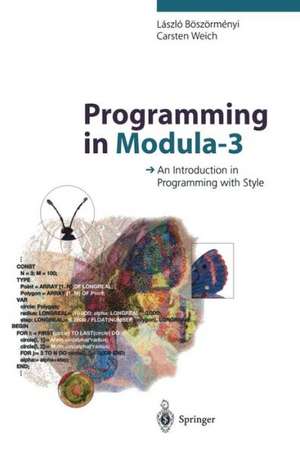
Programming in Modula-3: An Introduction in Programming with Style
Autor Laszlo Böszörmenyi Cuvânt înainte de J. Weizenbaum Traducere de R. Bach Autor Carsten Weichen Limba Engleză Paperback – 15 sep 2011
Preț: 334.18 lei
Preț vechi: 417.72 lei
-20%
Puncte Express: 501
Carte tipărită la comandă
Livrare economică 26 noiembrie-10 decembrie
Livrare prin curier în România Termenul estimat este afișat lângă disponibilitate.
Transport gratuit de la 400.00 lei Plată online sau ramburs, în funcție de opțiunile comenzii.
Retur gratuit în 14 zile Comandă securizată și suport în română.
Specificații
ISBN-13: 9783642646140
ISBN-10: 364264614X
Pagini: 600
Ilustrații: XXII, 571 p.
Dimensiuni: 155 x 235 x 32 mm
Greutate: 0.83 kg
Ediția:Softcover reprint of the original 1st ed. 1996
Editura: Springer Berlin, Heidelberg
Colecția Springer
Locul publicării:Berlin, Heidelberg, Germany
ISBN-10: 364264614X
Pagini: 600
Ilustrații: XXII, 571 p.
Dimensiuni: 155 x 235 x 32 mm
Greutate: 0.83 kg
Ediția:Softcover reprint of the original 1st ed. 1996
Editura: Springer Berlin, Heidelberg
Colecția Springer
Locul publicării:Berlin, Heidelberg, Germany
V-ar putea interesa
-
 Colonial TransformationsR. BachPreț: 390.56 lei
 -
 -20%Preț: 563.29 lei704.12 lei
 -
 -27%Preț: 676.09 lei926.15 lei
 -
 Software Modeling and DesignHassan Gomaa-20%Preț: 665.25 lei831.56 lei
 -
 KanbanDavid J. Anderson-20%Preț: 264.20 lei330.25 lei
 -
 The Human Side of AgileGil BrozaPreț: 271.68 lei
 -
 Software EngineeringRuneson-20%Preț: 471.15 lei588.94 lei
 -
 Professional GitBrent Laster-20%Preț: 256.78 lei320.97 lei
 -
 Automatic Program DevelopmentOlivier Danvy-20%Preț: 674.50 lei843.12 lei
 -
 Preț: 401.71 lei
 -
 Python AlgorithmsMagnus Lie Hetland-20%Preț: 468.00 lei584.99 lei
 -
 The Definitive Guide to HTML5 WebSocketVanessa Wang-20%Preț: 372.28 lei465.36 lei
 -
 Head First AgileAndrew Stellman-20%Preț: 343.20 lei429.00 lei
 -
 Continuous Delivery with Visual Studio ALM 2015Mathias Olausson-20%Preț: 299.70 lei374.63 lei
 -
 Design It! : Pragmatic ProgrammersMicahel Keeling-20%Preț: 257.50 lei321.87 lei
 -
 Mastering ServiceNow - Second EditionMartin Wood-20%Preț: 368.74 lei460.93 lei
 -
 -20%Preț: 329.25 lei411.55 lei
 -
 Introduction to Programming with Modula-2Günther Blaschek-20%Preț: 333.53 lei416.92 lei
 -
 HemodilutionJ. Koscielny-5%Preț: 355.21 lei373.90 lei
 -
 Computer Aided VerificationAlan J. Hu-20%Preț: 637.63 lei797.04 lei
 -
 Software Engineering Education in the Modern AgePaola Inverardi-20%Preț: 330.98 lei413.72 lei
 -
 Model Checking SoftwareDragan Bošnački-20%Preț: 335.02 lei418.78 lei
 -
 Static AnalysisHanne Riis Nielson-20%Preț: 345.05 lei431.32 lei
 -
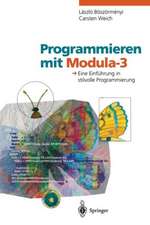 Programmieren mit Modula-3: Eine Einführung in stilvolle ProgrammierungLaszlo Böszörmenyi-20%Preț: 306.83 lei383.53 lei
Public țintă
ResearchCuprins
1 What is programming?.- 1.1 An informal introduction.- 1.2 The von Neumann Computer.- 1.3 Rigid thought structures.- 1.4 Programming in the small.- 1.5 Levels of programming.- 1.6 Programming and Computer science.- 2 Metalanguages.- 2.1 Definition of formal languages.- 2.2 Digits and numbers.- 2.3 Names.- 2.4 Arithmetic expressions.- 2.5 Extension for Modula-3 syntax.- 3 The structure of programs.- 3.1 Structuring.- 3.2 Language environment.- 3.3 The statics and dynamics of a program.- 3.4 Structure of Modula-3 programs.- 4 Predefined data types.- 4.1 Integers.- 4.2 Logical type.- 4.3 Characters.- 4.4 Texts.- 4.5 Floating-point numbers.- 5 Statements.- 5.1 The assignment.- 5.2 Structured Statements.- 5.3 Sequence.- 5.4 Branches.- 5.5 Loops.- 6 User-defined simple types.- 6.1 Enumeration.- 6.2 Subranges.- 7 Expressions and declarations.- 7.1 Expressions.- 7.2 Declarations.- 7.3 Equivalence of types.- 7.4 Subtypes.- 7.5 Assignment compatibility.- 7.6 Expression compatibility.- 8 Composite static types.- 8.1 Arrays.- 8.2 Records.- 8.3 Sets.- 8.4 Comparison of arrays, records and sets.- 8.5 Packed data types.- 9 Structuring algorithms.- 9.1 Block structure.- 9.2 Procedures and functions.- 9.3 Modes of parameter passing.- 9.4 Identifying the procedures.- 9.5 Name, type and default value of a parameter.- 9.6 Eval statement.- 9.7 Procedure types.- 10 Modules.- 10.1 Structure.- 10.2 Using modules.- 10.3 An example with graphic elements.- 10.4 Modularization.- 11 Dynamic data structures.- 11.1 Dynamism in static data structures.- 11.2 Dynamic data in Modula-3.- 11.3 Subtypes.- 11.4 Abstract and encapsulated data types.- 11.5 Dynamic structures.- 12 Recursion.- 12.1 Recursive algorithms.- 12.2 Recursive data structures.- 13 Objects.- 13.1 Object-oriented modeling.- 13.2 Object-oriented programming.- 13.3 Object types in Modula-3.- 13.4 Encapsulation of object types.- 14 Persistent data structures.- 14.1 Files.- 14.2 Files in Modula-3.- 14.3 Persistent variables.- 15 Exception handling.- 15.1 Exceptions in a program.- 15.2 Exception handling in Modula-3.- 15.3 Delaying exception handling.- 15.4 Strategies for exception handling.- 16 Parallel programming.- 16.1 Motivation for parallelism.- 16.2 Parallel programs.- 16.3 Threads in Modula-3.- 16.4 Shared variables.- 16.5 Message passing.- A small database.- B Language Definition.- C Library interfaces.- D Modula-3 language environments.
Textul de pe ultima copertă
The difficulty of programming lies in the need to bring our ideas into a form that can be processed by a machine. This book shows how to write and understand even complex programs by applying proper structures and good style. It uses the programming language Modula-3, which relies on and extends the well-known concepts of Pascal and Modula-2. The steps needed to become an expert programmer are based first of all on the elegant type concept of Modula-3. The programming style supported by this concept leads the reader step-by-step toward coping with complex data structures and algorithms. Such new and exciting subjects as object-oriented and parallel programming are touched upon. The book requires no prior programming experience.