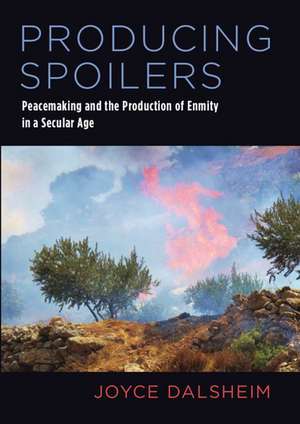
Producing Spoilers: Peacemaking and the Production of Enmity in a Secular Age
Autor Joyce Dalsheimen Limba Engleză Hardback – 21 aug 2014
Evoluția studiilor de rezolvare a conflictelor a trecut de la simpla mediere a violenței la o analiză critică a structurilor care permit perpetuarea ostilității. În Producing Spoilers, descoperim o perspectivă provocatoare care inversează logica tradițională a diplomației: „perturbatorii” păcii (spoilers) — adesea identificați în grupări precum Hamas sau coloniștii radicali — nu sunt doar obstacole externe, ci produse inerente ale sistemului statului-națiune și ale modului în care înțelegem istoria în era seculară. Observăm cum eforturile de pacificare, departe de a fi neutre, pot funcționa ca mecanisme de generare a dușmăniei prin însăși structura lor narativă.
Această lucrare completează perspectiva oferită de Spoiling and Coping with Spoilers – Israeli–Arab Negotiations de Galia Golan. În timp ce Golan și Sher se concentrează pe analiza grupurilor care perturbă procesele de negociere prin mijloace violente sau politice pentru a găsi soluții de gestionare a acestora, Joyce Dalsheim merge mai adânc în rădăcinile ontologice ale problemei. Ea demonstrează că însăși ideea de „anacronism” atribuită religioșilor îi împiedică pe activiști și teoreticieni să vadă posibilități creative de coexistență. Cartea se situează în continuarea preocupărilor autoarei din Unsettling Gaza și Israel Has a Jewish Problem, unde a investigat modul în care identitatea națională este construită prin lupte interne asupra semnificației de a fi evreu în statul modern. Tonul este unul academic riguros, ancorat în experiența de teren, refuzând soluțiile teritoriale simpliste în favoarea unei regândiri a comunității și a schimbului cultural în afara binarismului naționalist.
Preț: 256.33 lei
Carte tipărită la comandă
Livrare economică 10-15 iulie
Specificații
ISBN-10: 0199944423
Pagini: 256
Dimensiuni: 211 x 142 x 25 mm
Greutate: 0.39 kg
Editura: Oxford University Press
Colecția OUP USA
Locul publicării:New York, United States
V-ar putea interesa
-
 -22%Preț: 335.20 lei428.40 lei
 -
 A Failure of TreatmentGilbert Lewis-26%Preț: 311.89 lei421.20 lei
 -
 -19%Preț: 451.76 lei557.73 lei
 -
 -22%Preț: 632.68 lei811.63 lei
 -
 The Mormon Quest for Glory: The Religious World of the Latter-Day SaintsMelvyn HammarbergPreț: 348.11 lei
 -
 -14%Preț: 699.61 lei813.50 lei
 -
 -8%Preț: 328.28 lei356.27 lei
 -
 Preț: 249.84 lei
 -
 Preț: 291.19 lei
 -
 Preț: 196.64 lei
 -
 Preț: 391.87 lei
 -
 Ferry Tales: Mobility, Place, and Time on Canada's West CoastPhillip VanniniPreț: 397.04 lei
 -
 The Empire of DeathPaul Koudounaris-17%Preț: 264.44 lei318.80 lei
 -
 Genesis of Symbolic ThoughtAlan BarnardPreț: 207.48 lei
 -
 Measuring Wellbeing: Towards Sustainability?Karen ScottPreț: 402.16 lei
De ce să citești această carte
Pentru cercetătorii în științe politice și studenții la relații internaționale, această carte oferă un cadru teoretic nou pentru a înțelege de ce procesele de pace stagnează. Cititorul câștigă o perspectivă critică asupra modului în care limbajul reconcilierii poate, paradoxal, să întărească barierele dintre inamici. Este o lectură esențială pentru cei care doresc să depășească analizele convenționale despre conflictul din Orientul Mijlociu.
Despre autor
Joyce Dalsheim este o antropoloagă culturală specializată în studiul conflictelor și al identității naționale, cu un interes deosebit pentru spațiul israeliano-palestinian. Opera sa explorează frecvent intersecția dintre religie, secularism și politica statului modern. Printre lucrările sale de referință se numără Unsettling Gaza, unde analizează conflictele interne ce alimentează violența regională, și Ethnographic Encounters in Israel – Poetics and Ethics of Fieldwork, o explorare a societății israeliene prin prisma experienței de teren. Expertiza sa combină rigoarea academică cu o perspectivă critică asupra modului în care sunt construite categoriile sociale și politice.
Descriere
Recenzii
Joyce Dalsheim's book is a timely contribution to a deeper understanding of the various and contradictory narratives of Israelis and Palestinians. These are voices and views of great importance for any hoped-for peace, and yet they have been given hardly any voice by the dominant political frameworks of peace processes. Here you will find the sensitive eyes and ears of a cultural anthropologist who provides a much more nuanced reading of all the parties to the conflict. The deeper empathic understanding of these parties and their worldviews is the only hope for short term and long term solutions that involve the least amount of violence and the greatest hope for a realistic path of justice and fairness to all communities affected by this century-old conflict.
This book simultaneously engages and challenges the current fashion for the reification of the enemy à la Carl Schmitt. With a moving synthesis of ethnography and theory, Dalsheim studies the site where the enemy effect is produced, in part through the very rhetoric of conflict resolution. The radical message of her work is that in a true search for peace, no onenot even the most inconvenientmay be left behind.
Nation, narration, recognition these are among the complicated terms that oscillate, rather than mediate, between war and peace. They reach deep into entrenched certainties and familiar divisions. In Israel/Palestine, Dalsheim reminds us, they endure as alibis of failure. Casting and recasting them out of the troubling margins of the so-called conflict (spoilers, settlers, peacemakers, conversation stoppers, and repugnant others), this book seeks nothing less than to move the very ground of our moral imagination.