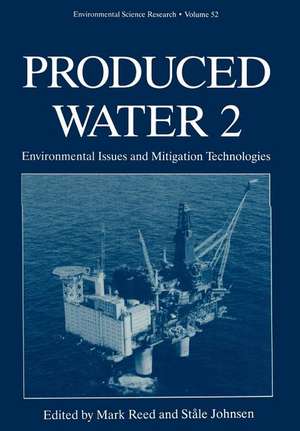
Produced Water 2: Environmental Science Research, cartea 52
Editat de Stale Johnsen, Mark Reeden Limba Engleză Paperback – 17 sep 2011
Din seria Environmental Science Research
-
 Preț: 402.69 lei
 -
 Preț: 389.88 lei
 -
 Preț: 372.15 lei
 -
 Preț: 379.88 lei
 -
 Preț: 388.20 lei
 -
 Preț: 383.59 lei
 -
 Preț: 389.65 lei
 -
 Preț: 382.49 lei
 -
 Preț: 395.05 lei
 -
 Preț: 395.25 lei
 -
 Preț: 379.38 lei
 - 15%
 Preț: 630.91 lei
 - 18%
 Preț: 1209.13 lei
 - 5%
 Preț: 372.85 lei
 -
 Preț: 394.31 lei
 -
 Preț: 399.50 lei
 -
 Preț: 409.85 lei
 -
 Preț: 438.47 lei
 -
 Preț: 379.31 lei
 -
 Preț: 390.61 lei
 -
 Preț: 407.15 lei
 -
 Preț: 393.57 lei
 -
 Preț: 416.85 lei
 -
 Preț: 384.33 lei
 -
 Preț: 379.38 lei
 -
 Preț: 380.82 lei
 - 5%
 Preț: 1140.76 lei
 - 5%
 Preț: 1056.18 lei
 -
 Preț: 380.15 lei
 - 5%
 Preț: 364.56 lei
 -
 Preț: 383.16 lei
 -
 Preț: 384.28 lei
 - 5%
 Preț: 692.51 lei
 -
 Preț: 488.77 lei
 - 18%
 Preț: 1892.81 lei
 -
 Preț: 384.33 lei
 - 18%
 Preț: 982.28 lei
 - 15%
 Preț: 677.61 lei
 - 18%
 Preț: 980.74 lei
 -
 Preț: 377.49 lei
 - 18%
 Preț: 981.25 lei
 -
 Preț: 386.66 lei
 - 18%
 Preț: 1270.03 lei
 - 15%
 Preț: 656.55 lei
 - 15%
 Preț: 645.99 lei
Preț: 661.87 lei
Preț vechi: 778.67 lei
-15%
Puncte Express: 993
Carte tipărită la comandă
Livrare economică 23 noiembrie-07 decembrie
Livrare prin curier în România Termenul estimat este afișat lângă disponibilitate.
Transport gratuit pentru acest produs Plată online sau ramburs, în funcție de opțiunile comenzii.
Retur gratuit în 14 zile Comandă securizată și suport în română.
Specificații
ISBN-13: 9781461380252
ISBN-10: 1461380251
Pagini: 552
Ilustrații: 549 p.
Dimensiuni: 170 x 244 x 30 mm
Greutate: 0.94 kg
Ediția:Softcover reprint of the original 1st edition 1996
Editura: Springer Us
Colecția Environmental Science Research
Seria Environmental Science Research
Locul publicării:New York, NY, United States
ISBN-10: 1461380251
Pagini: 552
Ilustrații: 549 p.
Dimensiuni: 170 x 244 x 30 mm
Greutate: 0.94 kg
Ediția:Softcover reprint of the original 1st edition 1996
Editura: Springer Us
Colecția Environmental Science Research
Seria Environmental Science Research
Locul publicării:New York, NY, United States
V-ar putea interesa
-
 Tundra-Taiga BiologyRobert M. M. Crawford-22%Preț: 533.37 lei687.57 lei
 -
 Antarctic LakesJohanna Laybourn-Parry-21%Preț: 447.92 lei567.98 lei
 -
 Wildlife Ecology, Conservation, and Management 3eAnthony R. E. SinclairPreț: 461.19 lei
 -
 PaleoecologyDavid J. Bottjer-23%Preț: 456.45 lei592.80 lei
 -
 Aquaculture EcosystemsSaleem Mustafa-9%Preț: 1280.80 lei1407.47 lei
 -
 Preț: 438.63 lei
 -
 Ecological Challenges and Conservation ConundrumsJohn A. Wiens-8%Preț: 550.45 lei598.31 lei
 -
 Natural SystemsMarkus Eichhorn-23%Preț: 443.81 lei576.38 lei
 -
 Freshwater AlgaeDavid C. Sigee-19%Preț: 590.56 lei729.09 lei
 -
 Introduction to Population EcologyLarry L. RockwoodPreț: 475.26 lei
 -
 Ecology of North AmericaBrian R. Chapman-11%Preț: 574.00 lei644.94 lei
 -
 Tools for Oceanography and Ecosystemic ModelingAndre Monaco-9%Preț: 991.63 lei1089.70 lei
 -
 EdenTim Smit-20%Preț: 84.93 lei105.95 lei
Public țintă
ResearchCuprins
Section I. Legislative and Management Issues.- 1. Session Summary.- 2. Regulation of Produced Water on the Norwegian Continental Shelf.- 3. Discharges of Produced Water to the North Sea: Effects in the Water Column.- 4. Regulation of Produced Water by the U.S. Environmental Protection Agency.- Section II. Chemistry and Toxicity Issues.- 5. Session Summary.- 6. Estimating the Acute Toxicity of Produced Waters to Marine Organisms Using Predictive Toxicity Models.- 7. A Comparison between the Toxicity of Produced Oil and Gas Condensate Using a New Sediment Bioassay for Deposited Oil.- 8. Produced Water Composition, Toxicity, and Fate: A Review of Recent BP North Sea Studies.- 9. Field Evaluation of Toxic Effects and Dispersion of Produced Water Discharges from North Sea Oil Platforms: Implications for Monitoring Acute Impacts in the Environment.- 10. Sub-Lethal Effects of Oil-Produced Water on the Early Life Stages of Turbot.- 11. Exposure of Cod Larvae (Gadus morhua L) to Phenols in Produced Water during the Critical Period of First Feeding.- Section III. Environmental Effects.- 12. Session Summary.- 13. Ecotoxicological Risk of Produced Water Discharged from Oil Production Platforms in the Statfjord and Gullfaks Field.- 14. The N-Octanol/Water Partition Coefficient: A Critical Parameter in Environmental Risk Assessment of Offshore E&P Chemicals.- 15. Effects of the Water Soluble Fraction of Crude Oil on Marine Fish Larvae and Crustaceans.- 16. Aromatic Hydrocarbons in Produced Water: Bioaccumulation and Trophic Transfer in Marine Food Webs.- 17. Delineation of Benthic Impact and Recovery at Two Produced Water Discharge Sites in Inshore Louisiana.- 18. The Effects of Produced Water on Hydrocarbon Levels and on P4501A Monooxygenase Activity in Fish Larvae in the Northern North Sea.- Section IV. Dispersion Models.- 19. Session Summary.- 20. Dispersion Modeling Perspectives on the Environmental Fate of Produced Water Discharges.- 21. Development and Appraisal of a Particle Tracking Model for the Dispersion of Produced Water Discharged from an Oil Production Platform in the North Sea.- 22. A Buoyant Jet/Plume Model for Subsea Releases.- 23. An Intercomparison between Field Measurements and Three Different Calculation Models for Estimates of Dilution Factors.- Section V. Environmental Modelling.- 24. Session Summary.- 25. Environmental Effects of Discharge and Reinjection of Produced Water.- 26. The Role of the Supplier of Production Chemicals in Managing the Environmental Impact of Produced Water in Offshore Oil and Gas Production.- 27. An Introduction to the CHARM Model.- 28. The Charm Model Used in Environmental Risk Management of Produced Water on Ula.- 29. PROVANN: A Model System for Assessing Potential Chronic Effects of Produced Water.- Section VI. U.S. DOE: Gulf of Mexico Studies.- 30. Session Summary.- 31. U.S. Department of Energy Sponsored Study — Environmental and Economic Assessment of Discharges from Gulf of Mexico Region Oil and Gas Operations: An Overview.- 32. Assessing the Potential for Enhanced Bioaccumulation of Heavy Metals from Produced Water Discharges to the Gulf of Mexico.- 33. An Ecological Risk Assessment for Polycyclic Aromatic Hydrocarbons in Produced Water Discharges to the Western Gulf of Mexico.- 34. Naturally Occurring Radioactive Materials Associated with Offshore Produced Water Discharges in the Gulf of Mexico.- 35. Distribution of Finfish Caught Near Oilfield Structures along Coastal Louisiana and Texas.- 36. Risk Assessment for Produced Water Discharges to Open Bays in Louisiana.- Section VII.Technology for Mitigation.- 37. Session Summary.- 38. Air Stripping Combined with FID Detection for Oil-in-Water Analysis.- 39. Dissolved Component Removal from Oilfield Waters.- 40. Report on the Start-up of a Unique Hydrocyclone-Based System for Treating Produced Water.- 41. Produced Water Reinjection (PWRI): Experiences from the Ula Field.- 42. Down Hole Separation (DHS) Technology.- 43. Evaluation of NF/UF Membrane Treatment in De-Oiling Produced Water in-Situ at a Heavy-Oil Production Facility in Western Canada.- 44. Agip and the Environment: Disposal of Produced Water from Gas Fields Exploitation in the Adriatic Sea.- 45. Biological Treatment Process for Removing Petroleum Hydrocarbons from Oilfield Produced Waters.- 46. Pretreatment of Oil Field and Mine Waste Waters for Reverse Osmosis.- 47. Comparison of Injectivity Prediction Models to Estimate Ula Field Injector Performance for Produced Water Reinjection.