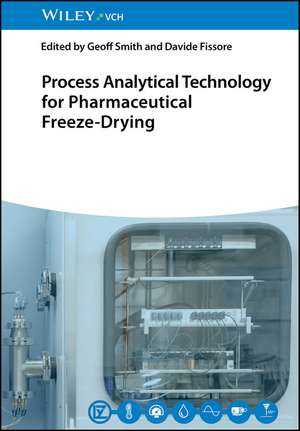
Process Analytical Technology for Pharmaceutical Freeze-Drying
Editat de Geoff Smith, Davide Fissoreen Limba Engleză Hardback – 16 sep 2026
Process Analytical Technology for Pharmaceutical Freeze-Drying provides a comprehensive and forward-looking overview of monitoring and control strategies for one of the pharmaceutical industry's most technically demanding manufacturing processes. Combining scientific fundamentals with industrial case studies, the book examines both established and emerging technologies used to improve process understanding, optimise cycle design, and ensure consistent product quality.
Coverage includes the measurement and interpretation of critical process variables such as temperature and pressure, wireless sensing technologies, pressure-rise methods (MTM, PRA, DPE), tunable diode laser absorption spectroscopy (TDLAS), near-infrared (NIR) and Raman spectroscopy, infrared thermal imaging, and advanced data analysis approaches. Dedicated chapters also explore through-vial impedance spectroscopy (TVIS) as a non-invasive technology for real-time monitoring of product temperature, ice mass, sublimation behaviour, and phase transitions.
The book further discusses innovations in continuous and alternative freeze-drying platforms, controlled nucleation technologies, multiplexed PAT systems, and the growing role of artificial intelligence and model-based control strategies in pharmaceutical manufacturing.
Sample topics explored in Process Analytical Technology for Pharmaceutical Freeze-Drying include:
- Temperature and pressure measurement technologies and their application to freeze-drying process monitoring and control
- Wireless sensing approaches for real-time monitoring of pharmaceutical freeze-drying
- Pressure-rise and sublimation-flow methods for determination of product temperature, sublimation rate, and heat and mass transfer parameters
- Spectroscopic, impedance-based, and thermal imaging techniques for advanced process analysis and optimisation
- Emerging freeze-drying technologies, continuous manufacturing approaches, and AI-enabled process control strategies
Preț: 841.38 lei
Preț vechi: 924.60 lei
-9% Nou
Puncte Express: 1262
Carte tipărită la comandă
Livrare economică 28 noiembrie-12 decembrie
Livrare express 24-30 octombrie pentru 215.37 lei
Livrare prin curier în România Termenul estimat este afișat lângă disponibilitate.
Transport gratuit pentru acest produs Plată online sau ramburs, în funcție de opțiunile comenzii.
Retur gratuit în 14 zile Comandă securizată și suport în română.
Specificații
ISBN-13: 9783527354658
ISBN-10: 3527354654
Pagini: 496
Dimensiuni: 171 x 248 x 32 mm
Greutate: 1.09 kg
Editura: Wiley-VCH GmbH
ISBN-10: 3527354654
Pagini: 496
Dimensiuni: 171 x 248 x 32 mm
Greutate: 1.09 kg
Editura: Wiley-VCH GmbH
Notă biografică
Geoff Smith is Professor of Pharmaceutical Process Analytical Technology in the Leicester School of Pharmacy at De Montfort University (UK). His research group focuses on pharmaceutical applications for impedance/dielectric spectroscopy. He is responsible for the development of through-vial impedance spectroscopy (TVIS) as a PAT tool for monitoring phase behaviour (ice formation and eutectics), ice interface temperatures, primary drying rates, and end points. More recently, this research has extended to the multiplexing of other PAT systems alongside the TVIS technology, with the addition of near-infrared and Raman spectroscopy. He is author or co-author of 45 papers in international peer reviewed journals, 2 book chapters, 2 patents, and >100 podium and posters presentations at international conferences.
Davide Fissore is Full Professor at Politecnico di Torino (Italy). His research activity is mainly focused on process modelling and optimisation, and on the design and validation of model-based tools for process monitoring and control. One of the topics of this research is the freeze-drying of pharmaceuticals and foodstuffs. In particular, he has proposed various devices to monitor and optimise in-line (using a control system) or offline (using the design space of the product) the freeze-drying process for a given product. Davide Fissore is author or co-author of about 115 papers appeared in international peer reviewed journals, 20 book chapters, and 95 papers appeared on proceedings international conferences. He is also member of the International Society for Lyophilization and Freeze-Drying and member of the Editorial Advisory Board of the Journal of Pharmaceutical Sciences.
Davide Fissore is Full Professor at Politecnico di Torino (Italy). His research activity is mainly focused on process modelling and optimisation, and on the design and validation of model-based tools for process monitoring and control. One of the topics of this research is the freeze-drying of pharmaceuticals and foodstuffs. In particular, he has proposed various devices to monitor and optimise in-line (using a control system) or offline (using the design space of the product) the freeze-drying process for a given product. Davide Fissore is author or co-author of about 115 papers appeared in international peer reviewed journals, 20 book chapters, and 95 papers appeared on proceedings international conferences. He is also member of the International Society for Lyophilization and Freeze-Drying and member of the Editorial Advisory Board of the Journal of Pharmaceutical Sciences.
Cuprins
1. Freeze-drying of parenteral drug products - An Introduction
2. Standard PAT instrumentation: Temperature sensors
3. Standard PAT instrumentation: Pressure gauges and vapour pressure sensors
4. Wireless sensor networks for lyophilization
5. Monitoring methods based on the measure of the sublimation flow: Pressure Rise Test and other direct technologies
6. Spectroscopic-based PAT in freeze-drying
7. An introduction to Through-Vial Impedance Spectroscopy (TVIS)
8. An application for Through-Vial Impedance Spectroscopy (TVIS) in modelling of the ice sublimation process
9. Freeze-drying monitoring and control using thermal imaging
10. Multiplexing PAT for qualitative ice sublimation monitoring in primary drying
11. Emerging technologies in pharmaceutical freeze-drying
12. Innovations in control of freezing in pharmaceutical processes
2. Standard PAT instrumentation: Temperature sensors
3. Standard PAT instrumentation: Pressure gauges and vapour pressure sensors
4. Wireless sensor networks for lyophilization
5. Monitoring methods based on the measure of the sublimation flow: Pressure Rise Test and other direct technologies
6. Spectroscopic-based PAT in freeze-drying
7. An introduction to Through-Vial Impedance Spectroscopy (TVIS)
8. An application for Through-Vial Impedance Spectroscopy (TVIS) in modelling of the ice sublimation process
9. Freeze-drying monitoring and control using thermal imaging
10. Multiplexing PAT for qualitative ice sublimation monitoring in primary drying
11. Emerging technologies in pharmaceutical freeze-drying
12. Innovations in control of freezing in pharmaceutical processes