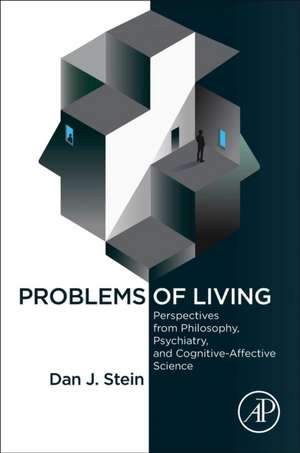
Problems of Living: Perspectives from Philosophy, Psychiatry, and Cognitive-Affective Science
Autor Dan J. Steinen Limba Engleză Paperback – 14 mai 2021
Remarcăm o lacună persistentă în literatura academică între rigoarea clinică a psihiatriei și interogațiile fundamentale ale filozofiei despre natura condiției umane. Volumul Problems of Living, semnat de Dan J. Stein, completează acest spațiu printr-o sinteză riguroasă între metafizică, epistemologie și datele empirice ale neuroștiinței. Suntem de părere că noutatea acestui titlu constă în capacitatea sa de a depăși dihotomiile clasice — minte versus corp, rațiune versus pasiune — propunând un cadru conceptual în care mintea este văzută ca fiind întrupată în creier și înrădăcinată în contextul social.
Structura cărții este organizată tematic, debutând cu o analiză a metaforelor despre creier și evoluând spre capitole dedicate binelui și răului, adevărului și, în final, sensului vieții. Această progresie indică o acoperire exhaustivă a „problemelor vieții”, nu doar ca simptome clinice, ci ca experiențe umane fundamentale. Problems of Living reprezintă o alternativă la The Bloomsbury Companion to Philosophy of Psychiatry pentru cursurile de filozofia psihiatriei sau neuroetică, cu avantajul unei abordări integrate care folosește știința cognitiv-afectivă pentru a regândi dilemele etice, nu doar pentru a descrie disciplina.
În contextul operei autorului, această lucrare marchează o trecere de la textele tehnice și diagnostice, precum Obsessive-Compulsive and Related Disorders sau Understanding Psychopathology, către o explorare filosofică de anvergură. Dacă lucrările anterioare se concentrau pe taxonomii DSM-5 și tratamente specifice, volumul de față chestionează însăși natura fericirii și a suferinței. Stilul este precis și academic, evitând speculațiile nefondate în favoarea unei analize bazate pe realismul critic.
Preț: 760.04 lei
Preț vechi: 996.86 lei
-24%
Carte tipărită la comandă
Livrare economică 26 noiembrie-10 decembrie
Specificații
ISBN-10: 0323902391
Pagini: 326
Dimensiuni: 152 x 229 x 20 mm
Greutate: 0.44 kg
Editura: ELSEVIER SCIENCE
V-ar putea interesa
-
 -30%Preț: 708.01 lei1016.65 lei
 -
 Neural Networks and PsychopathologyDan J. M. D. Stein-11%Preț: 549.11 lei616.97 lei
 -
 -23%Preț: 731.26 lei949.68 lei
 -
 Mental Disorders Around the WorldKate M. Scott-5%Preț: 1141.01 lei1201.06 lei
 -
 Philosophy of PsychopharmacologyDan J. M. D. Stein-5%Preț: 317.53 lei334.24 lei
 -
 Heterogeneity in AsthmaAllan R. Brasier-18%Preț: 916.07 lei1117.16 lei
 -
 3D Imaging Technologies in AtherosclerosisRikin Trivedi-5%Preț: 714.10 lei751.68 lei
 -
 The Multiple Therapeutic Targets of A20Christiane Ferran-18%Preț: 908.46 lei1107.87 lei
 -
 Anxiety Disorders and GenderDan J. Stein-5%Preț: 734.82 lei773.49 lei
 -
 Neurotransmitter Interactions and Cognitive FunctionMieczyslaw Pokorski-5%Preț: 677.91 lei713.59 lei
 -
 Pulmonary FunctionMieczyslaw Pokorski-20%Preț: 594.87 lei743.59 lei
 -
 Membrane Potential Imaging in the Nervous System and HeartMarco Canepari-24%Preț: 923.08 lei1214.57 lei
 -
 -5%Preț: 678.11 lei713.80 lei
De ce să citești această carte
Recomandăm această carte studenților și profesioniștilor din neuroștiințe, psihiatrie și filozofie care caută o fundamentare teoretică dincolo de manualele clinice. Cititorul câștigă o perspectivă multidisciplinară asupra modului în care biologia creierului influențează valorile morale și căutarea sensului. Este un instrument esențial pentru a înțelege cum datele științifice pot informa, fără a înlocui, dezbaterile etice despre ce înseamnă o viață bună.
Despre autor
Dan J. Stein este director de cercetare în cadrul Departamentului de Psihiatrie al Universității Stellenbosch din Africa de Sud. Cu o carieră prolifică dedicată înțelegerii mecanismelor psihopatologiei, Stein s-a remarcat prin lucrări de referință în domeniul tulburărilor de anxietate și al spectrului obsesiv-compulsiv. Expertiza sa vastă, care include contribuții la manuale editate de American Psychiatric Association, îi permite să abordeze intersecția dintre științele creierului și filozofie cu o rigoare metodologică rară, transformându-l într-o voce autoritară în psihiatria biologică contemporană.
Descriere scurtă
- Draws on the strongest aspects of polar positions in philosophy and psychiatry to help resolve important perennial debates in these fields
- Explores continuities between early philosophical work and current cognitive-affective sciences, including neuroscience and psychology
- Employs findings from modern cognitive-affective science to rethink key long-standing debates in philosophy and psychiatry
- Builds on work showing how mind is embodied in the brain, and embedded in society, to provide an integrated conceptual framework
- Assesses both the insights and the limitations of cognitive-affective science for addressing the big questions and hard problems of living
Cuprins
2. Brain–minds: What’s the best metaphor?
3. Reason and passion
4. The pleasures of life
5. Pain and suffering
6. The good and the bad
7. How can we know what is true, then?
8. The meaning of life
9. Conclusion: Metaphors of life
Recenzii
"Dan Stein's new books is an engaging and courageous piece of writing that raises fundamental questions about the nature of mind and brain. It examines how to live a fulfilling life and be contented, despite the paradox of, on the one hand feeling our lives are central to the world, and on the other, that we are just one of many species… Stein investigates the mechanisms that underlie reason and passion, from a philosophical and psychiatric perspective. There are key implications for psychiatric and psychological practice, public mental health and societal flourishing. His primary source material is rich, and he communicates a sense of awe and of wonder about our precious and transient lives, as well as a synopsis of a more authentic and progressive scientific account of the mind and brain wetware. All trainees and students of subjects related to the mind and brain should read this book, as should those specialists working daily in health and social systems and public mental health. The book busts many myths simply by sharing what we know about the brain and mind, which is a great deal, but it also is clear on the limitations of our thinking." --British Journal on Psychiatry
"The book is interesting in its approach to answering traditional philosophical questions through an integrated manner, utilizing perspectives from philosophy, psychiatry, and cognitive-affective science. The author is uniquely qualified to discuss these questions from all of these perspectives given his credentials. While the author has answered the objectives, the book was difficult to read and comprehend at many points, despite my background as a physician in psychiatry, as it requires a significant amount of background knowledge in philosophical theories. The author tries to mitigate this by providing extensive references throughout, but this does little to help the readers if they have not performed a significant amount of outside research." --© Doody’s Review Service, 2021,Chad R Percifield, DO(Michigan State University College of Medicine) reviewer, expert opinion