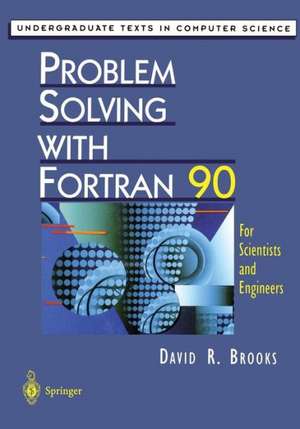
Problem Solving with Fortran 90: For Scientists and Engineers: Undergraduate Texts in Computer Science
Autor David R. Brooksen Limba Engleză Paperback – 23 oct 2012


Preț: 347.97 lei
Preț vechi: 434.96 lei
-20%
Puncte Express: 522
Carte tipărită la comandă
Livrare economică 22 august-05 septembrie
Livrare prin curier în România Termenul estimat este afișat lângă disponibilitate.
Transport gratuit de la 400.00 lei Plată online sau ramburs, în funcție de opțiunile comenzii.
Retur gratuit în 14 zile Comandă securizată și suport în română.
Specificații
ISBN-13: 9781461273530
ISBN-10: 1461273536
Pagini: 720
Ilustrații: XXXIV, 682 p.
Dimensiuni: 178 x 254 x 38 mm
Greutate: 1.23 kg
Ediția:Softcover reprint of the original 1st ed. 1997
Editura: Springer
Colecția Springer
Seria Undergraduate Texts in Computer Science
Locul publicării:New York, NY, United States
ISBN-10: 1461273536
Pagini: 720
Ilustrații: XXXIV, 682 p.
Dimensiuni: 178 x 254 x 38 mm
Greutate: 1.23 kg
Ediția:Softcover reprint of the original 1st ed. 1997
Editura: Springer
Colecția Springer
Seria Undergraduate Texts in Computer Science
Locul publicării:New York, NY, United States
V-ar putea interesa
-
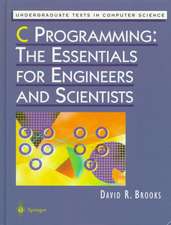 C Programming: The Essentials for Engineers and ScientistsDavid R. Brooks-20%Preț: 640.21 lei800.27 lei
 -
 Distributed and Parallel Database Object ManagementElisa Bertino-20%Preț: 947.70 lei1184.63 lei
 -
 An Artificial Intelligence Approach to Test GenerationNarinder Singh-15%Preț: 618.19 lei727.28 lei
 -
 Statistical Methods for Recommender SystemsDeepak K. Agarwal-20%Preț: 379.13 lei473.91 lei
 -
 Bringing the Sun Down to EarthDavid R. Brooks-15%Preț: 618.50 lei727.65 lei
 -
 Guide to HTML, JavaScript and PHPDavid R. Brooks-20%Preț: 411.52 lei514.41 lei
 -
 An Introduction to HTML and JavaScriptDavid R. Brooks-20%Preț: 318.09 lei397.61 lei
 -
 An Introduction to PHP for Scientists and EngineersDavid R. Brooks-20%Preț: 287.59 lei359.48 lei
 -
 Internet of Things. IoT InfrastructuresRaffaele Giaffreda-20%Preț: 327.54 lei409.42 lei
 -
 Enhanced Building Information ModelsUmit Isikdag-20%Preț: 309.76 lei387.19 lei
 -
 -20%Preț: 332.60 lei415.75 lei
 -
 Introducing the Oscillations Based ParadigmDarius Plikynas-20%Preț: 632.64 lei790.81 lei
 -
 Euro-Par 2016: Parallel ProcessingPierre-François Dutot-20%Preț: 344.27 lei430.34 lei
 -
 PRIMA 2016: Principles and Practice of Multi-Agent SystemsMatteo Baldoni-20%Preț: 329.35 lei411.69 lei
 -
 Critical Systems: Formal Methods and Automated VerificationMaurice H. Ter Beek-20%Preț: 320.32 lei400.41 lei
 -
 Internet ScienceFranco Bagnoli-20%Preț: 324.22 lei405.27 lei
 -
 Music, Mind, and EmbodimentRichard Kronland-Martinet-20%Preț: 332.39 lei415.48 lei
 -
 -20%Preț: 340.00 lei425.01 lei
 -
 Communication Technologies for VehiclesAlain Pirovano-20%Preț: 314.81 lei393.51 lei
 -
 Programming in HTML and PHPDavid R. Brooks-20%Preț: 432.63 lei540.79 lei
 -
 Knowledge Acquisition, Modeling and ManagementRudi Studer-20%Preț: 328.49 lei410.62 lei
 -
 Computer-Based Problem Solving ProcessTeodor Rus-20%Preț: 781.87 lei977.34 lei
Public țintă
GraduateCuprins
1. Computing Environments for Problem Solving.- 1.1 A Brief History of Electronic Computing.- 1.2 The Academic Computing Environment.- 1.3 What Do You Need to Know About Your Computing Environment?.- 1.4 Fortran and the Personal Computing Environment.- 1.5 Is Programming Necessary Anymore?.- 1.6 Exercises.- 2. Solving Problems with a High-Level Programming Language.- 2.1 Structured Programming and Problem Solving.- 2.2 Designing Algorithms for Procedural Programming Languages.- 2.3 Program Modularization.- 2.4 Applications.- 2.5 Debugging Your Algorithms.- 2.6 Exercises.- 3. Getting Started with Fortran: Writing Simple Programs.- 3.1 A Simple Problem and a Fortran Program to Solve It.- 3.2 Program Layout.- 3.3 Declaring Variables and Defining Constants.- 3.4 List-Directed Input and Output.- 3.5 Arithmetic Operators, Assignment Statements, and Calculations.- 3.6 Program Termination.- 3.7 Compiling and Executing a Program.- 3.8 Applications.- 3.9 Debugging Your Programs.- 3.10 Exercises.- 4. Using Functions to Expand the Power of Fortran.- 4.1 Fortran Intrinsic Functions.- 4.2 Fortran Statement Functions.- 4.3 Applications.- 4.4 Debugging Your Programs.- 4.5 Exercises.- 5. Gaining Control Over Program Output.- 5.1 The Formatted PRINT Statement.- 5.2 The WRITE Statement.- 5.3 Saving Program Output.- 5.4 Applications.- 5.5 Debugging Your Programs.- 5.6 Exercises.- 6. Program Control: Branching and Repetitive Calculations.- 6.1 Using Program Control Structures.- 6.2 Relational and Logical Operators and the Fortran IF… Construct.- 6.3 The SELECT CASE Construct.- 6.4 Fortran Loop Constructs.- 6.5 Using Implied DO… Loops in Output Statements.- 6.6 Applications.- 6.7 Debugging Your Programs.- 6.8 Exercises.- 7. Program Modularization.- 7.1 Designing Modularized Algorithmswith the CALL and SUBPROGRAM Pseudocode Commands.- 7.2 Fortran Subroutines.- 7.3 Fortran Functions.- 7.4 Using Subroutines and Functions.- 7.5 Applications.- 7.6 Debugging Your Programs.- 7.7 Exercises.- 8. Using Arrays to Organize Information.- 8.1 Arrays in Structured Programming.- 8.2 Basic Array Implementation.- 8.3 Using Statically Allocated Arrays in Subprograms.- 8.4 Allocatable Arrays.- 8.5 Treating Strings of Characters as Arrays of Characters.- 8.6 The TYPE Statement, Records, and Arrays of Records.- 8.7 Applications.- 8.8 Debugging Your Programs.- 8.9 Exercises.- 9. Using Formatted Sequential Access and Internal Files.- 9.1 The Text File Concept.- 9.2 OPEN, READ, and CLOSE Statements for Sequential File Access.- 9.3 Files and Arrays.- 9.4 More About Formatted READ Statements.- 9.5 Writing Text Files.- 9.6 Applications.- 9.7 Debugging Your Programs.- 9.8 Exercises.- 10. Some Essential Programming Algorithms.- 10.1 Introduction.- 10.2 Searching Algorithms.- 10.3 Sorting Algorithms.- 10.4 Recursive Algorithms.- 10.5 The Recursive Quicksort Algorithm.- 10.6 Applications.- 10.7 Debugging Your Programs.- 10.8 Exercises.- 11. Basic Statistics and Numerical Analysis with Fortran.- 11.1 Introduction.- 11.2 Basic Descriptive Statistics.- 11.3 Numerical Differentiation.- 11.4 Numerical Integration.- 11.5 Solving Systems of Linear Equations.- 11.6 Finding the Roots of Equations.- 11.7 Numerical Solutions to Differential Equations.- 11.8 Exercises.- 12. A Closer Look.- 12.1 Introduction.- 12.2 Using More Than One Program Unit.- 12.3 The Internal Representation of Numbers and Extended Precision.- 12.4 Array Operations and Array Inquiry and Reduction.- 12.5 Direct Access and Unformatted (Binary) Files.- 12.6 The COMPLEX Data Type.- 12.7 Data Sharing With COMMON Blocks.- Appendices.- Appendix 1. Table of ASCII Characters for IBM-Compatible PCs.- Appendix 2. Summary of Pseudocode Commands and Fortran Statement Syntax.- Appendix 2.1 Pseudocode Commands.- Appendix 2.2 Fortran Statement Syntax.- Appendix 3. Source Code File Name Summary.- Appendix 4. Accessing the System Time and Date.
Caracteristici
A thorough guide to problem-solving and algorithm design using pseudo-code * Each chapter includes at least two complete programming applications which become progressively more challenging * Students new to computing will find the wide range of problems both accessible and relevant to their other studies * Includes a brief introduction to computing in general