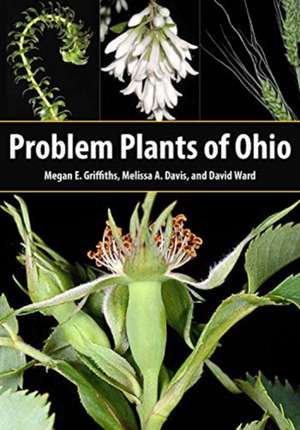
Problem Plants of Ohio
Autor Megan E Griffiths, Melissa A Davis, David Warden Limba Engleză Hardback – 8 dec 2020
Problem Plants of Ohio is an informative guide, providing information on the identification and control of nonnative plant species formally listed as invasive or prohibited noxious weeds in Ohio. In addition, the book treats many additional species that are considered a nuisance in gardens, landscaping, or natural settings.
The book includes more than 900 photographs of diagnostic features to aid in the identification of 148 plant species. The accompanying text details the origin of the species' introduction to North America, provides thorough and accessible botanical descriptions, explains the economic and environmental impacts of each species, and includes basic information on control measures. The authors also include suggestions for native alternatives to use in gardens in place of problematic horticultural species.
The first book of this kind written specifically about the state, Problem Plants of Ohio presents new research on the change in nonnative species over time and discusses how climate change will further exacerbate the issue of invasive species. It includes current distribution maps for each plant species.
A useful resource for master gardeners, landscapers, farmers, academics, and natural areas managers, Problem Plants of Ohio will be of interest to nonspecialists as well.
Preț: 255.90 lei
Puncte Express: 384
Carte disponibilă
Livrare economică 18 mai-01 iunie
Specificații
ISBN-13: 9781606354025
ISBN-10: 1606354027
Pagini: 384
Dimensiuni: 185 x 262 x 23 mm
Greutate: 1.18 kg
Editura: Kent State University Press
ISBN-10: 1606354027
Pagini: 384
Dimensiuni: 185 x 262 x 23 mm
Greutate: 1.18 kg
Editura: Kent State University Press
V-ar putea interesa
-
 AlcatrazDavid A WardPreț: 192.92 lei
 -
 Moods of the Ohio MoonsGilfillanPreț: 98.05 lei
 -
 A Vision of NatureMichael TobiasPreț: 194.28 lei
 -
 Visit the ZooFrederick FichmanPreț: 54.98 lei
 -
 Field and Woodland PlantsW. S. FurneauxPreț: 78.40 lei
 -
 Probation: Working for JusticeDavid Ward-25%Preț: 512.98 lei682.41 lei
Descriere
An informative guide that provides information on the identification and control of non-native plant species formally listed as invasive or prohibited noxious weeds in Ohio. In addition, the book treats many additional species that are considered a nuisance in gardens, landscaping, or natural settings.