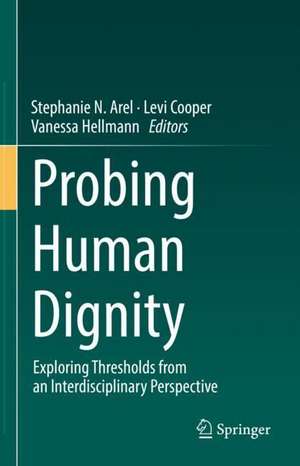
Probing Human Dignity
Editat de Stephanie N. Arel, Levi Cooper, Vanessa Hellmannen Limba Engleză Hardback – 24 ian 2025
Remarcăm în „Probing Human Dignity” o schimbare de paradigmă necesară în discursul juridic și filosofic contemporan. Modelul propus de editori nu se limitează la o definiție abstractă, ci investighează demnitatea umană ca un concept situat „la prag” — acel punct critic în care crizele sociale, dezastrele sau nedreptățile sistemice transformă un drept teoretic într-o dilemă acută. Această abordare funcționează deoarece forțează cititorul să privească demnitatea nu ca pe un dat imuabil, ci ca pe o valoare care trebuie apărată și renegociată constant în sfera publică și legală. Notăm cu interes cum volumul este structurat pentru a ghida această explorare: după o introducere conceptuală, analiza progresează de la soluțiile din dreptul constituțional și gândirea juridică iudaică, spre spații de vulnerabilitate extremă precum sărăcia, excluziunea socială și criza refugiaților, culminând cu impactul traumei asupra demnității. Abordarea diferă de cea din Human Dignity de Edward Sieh prin gradul ridicat de specificitate aplicată și prin utilizarea lentilei fenomenologice asupra traumei; în timp ce volumul lui Sieh oferă o privire de ansamblu globală, lucrarea de față este mai puțin abstractă și mai mult aplicabilă în contexte de criză imediată. De asemenea, spre deosebire de The Cambridge Handbook of Human Dignity, care se concentrează pe istoria noțiunii, acest volum editat de Stephanie N. Arel și colegii săi se ancorează în realitățile post-moderne ale muncii, locuirii și identității. Cartea rafinează preocupările constante ale lui Stephanie N. Arel pentru mecanismele rușinii și traumei, vizibile în lucrările sale anterioare Post-Traumatic Public Theology și Affect Theory, Shame, and Christian Formation, oferindu-le de această dată un cadru de manifestare riguros juridic și sociologic.
Preț: 934.14 lei
Preț vechi: 1139.19 lei
-18%
Carte disponibilă
Livrare economică 30 noiembrie-14 decembrie
Specificații
ISBN-10: 3031424360
Pagini: 360
Ilustrații: XIII, 335 p. 11 illus., 4 illus. in color.
Dimensiuni: 160 x 241 x 24 mm
Greutate: 0.72 kg
Ediția:1st ed. 2024
Editura: Springer
Locul publicării:Cham, Switzerland
De ce să citești această carte
Această lucrare este esențială pentru specialiștii în drepturile omului, sociologi și teologi care caută să înțeleagă cum se manifestă demnitatea în condiții de presiune extremă. Cititorul va câștiga o perspectivă interdisciplinară rară, învățând să identifice încălcările demnității nu doar în acte de violență directă, ci și în structurile economice și legale care gestionează sărăcia, migrația și munca. Este un instrument analitic puternic pentru oricine dorește să treacă de la teorie la politici publice bazate pe empatie și rigoare.
Despre autor
Stephanie N. Arel este un cercetător consacrat, a cărui operă explorează intersecția dintre teologie, psihologie și etică, cu un accent deosebit pe natura traumei și a emoțiilor sociale. Experiența sa în analizarea vulnerabilității este evidentă în lucrări precum Unaccompanied Migrant Children, unde pune în centrul discuției etica migrației infantile. În „Probing Human Dignity”, ea colaborează cu Levi Cooper și Vanessa Hellmann în cadrul rețelei UBIAS, aducând laolaltă o perspectivă globală și academică riguroasă asupra modului în care societățile post-moderne pot restaura demnitatea în urma traumelor colective și individuale.
Descriere scurtă
Alas, the denial of a person’s dignity continues to manifest in contemporary life, through injustices often related to personal hardship, crisis, unrest, or upheaval. This collection confronts such injustices with sensitive, complex, nuanced, and academically rigorous engagement.
Each chapter begins from the understanding that recognizing and investigating Human Dignity often occurs “at the threshold”, where in times of societal crisis or individual hardship questions of Human Dignity turn into ethical, moral, and legal dilemmas. The objective of this volume is to draw on theoretical and conceptual distinctions of Human Dignity in order to inform new perspectives that probe its ambiguity. The contributors offer greater clarity and push beyond existing thresholds to develop new paradigms that cross disciplinary lines while speaking to the goals and needs of post-modern societies and individuals. Each contributor crosses into new territory to examine a pressing legal or societal issue with a new lens. The authors worked together as an international and interdisciplinary research group within the framework of the 2nd Intercontinental Academia of the UBIAS network (University-Based Institutes for Advanced Studies). This volume reflects their journey, their fruitful collaboration, and their scholarly endeavors. The result is a collection that serves as a fresh and exciting contribution to the contemporary Human Dignity discourse.
Cuprins
Notă biografică
Levi Cooper is originally from Melbourne, Australia. He teaches at the Pardes Institute of Jewish Studies in Jerusalem and at Tel Aviv University’s Faculty of Law. He holds a Ph.D. in law from Bar-Ilan University, as well as an LL.M. and LL.B. He is a member of the Israel Bar Association, and served as the internal auditor of the National Library of Israel Readers Association. He has held postdoctoral positions at University of Oxford and at Ben-Gurion University of the Negev. Most recently he was a Visiting Academic at the Max Planck Institute for Legal History and Legal Theory in Frankfurt. His research focuses on legal history and interplays between Jewish legal writing and broader legal, intellectual, and cultural contexts. His book, Relics for the Present, offers a contemporary commentary on the Talmud. His forthcoming book Hasidic Relics, explores cultural aspects of Hasidism and their underlying religious meanings. Levi volunteers as a communal rabbi in Zur Hadassa, Israel
Vanessa Hellmann is a Senior Lecturer at the Law Faculty of the University of Bielefeld, taking a special interest in Constitutional Law. Following her studies in Law at the University of Bielefeld and the University of Edinburgh, sponsored by the German National Academic Foundation, she worked as a Lecturer and Research Fellow at the Chair of Public Law at the University of Bielefeld (Prof. Dr. Dr. h.c. Gertrude Lübbe-Wolff, then Justice of the German Federal Constitutional Court). She completed her legal clerkship with assignments to the Ministry of Justice of North Rhine-Westphalia, the law firm Hengeler Müller, and the German Federal Constitutional Court. For four years she was a Law Clerk at the German Federal Constitutional Court (Departments of Justices Prof. Dr. Dr. h.c. Gertrude Lübbe-Wolff, and now Vice President Prof. Dr. Doris König). She recently completed her book “No Legal Protection in German Electoral Law” and is currently working on a book tentatively titled “A Legal Doctrine of Constitutional Rights”.