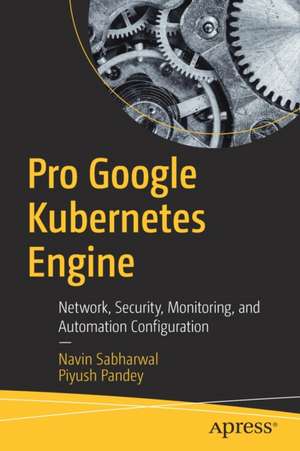
Pro Google Kubernetes Engine
Autor Navin Sabharwal, Piyush Pandeyen Limba Engleză Paperback – 8 noi 2020
You will see how Kubernetes makes it easier for users to manage clusters and the container ecosystem. And you will get detailed guidance on deploying and managing applications, handling administration of container clusters, managing policies, and monitoring cluster resources. You will learn how to operate the GKE environment through the GUI-based Google Cloud console and the "gcloud" command line interface.
The book starts with an introduction to GKE and associated services. The authors provide hands-on examples to set up Container Registry and GKE Cluster, and you will follow through an application deployment on GKE. Later chapters focus on securing your GCP GKE environment, GKE monitoring anddashboarding, and CI/CD automation. All of the code presented in the book is provided in the form of scripts, which allow you to try out the examples and extend them in interesting ways.
What You Will Learn
- Understand the main container services in GCP (Google Container Registry, Google Kubernetes Engine, Kubernetes Engine, Management Services)
- Perform hands-on steps to deploy, secure, scale, monitor, and automate your containerized environment
- Deploy a sample microservices application on GKE
- Deploy monitoring for your GKE environment
- Use DevOps automation in the CI/CD pipeline and integrate it with GKE
Who This Book Is For
Architects, developers, and DevOps engineers who want to learn Google Kubernetes Engine
Preț: 311.62 lei
Preț vechi: 389.52 lei
-20%
Puncte Express: 467
Carte disponibilă
Livrare economică 09-23 noiembrie
Livrare prin curier în România Termenul estimat este afișat lângă disponibilitate.
Transport gratuit de la 400.00 lei Plată online sau ramburs, în funcție de opțiunile comenzii.
Retur gratuit în 14 zile Comandă securizată și suport în română.
Specificații
ISBN-13: 9781484262429
ISBN-10: 1484262425
Pagini: 432
Ilustrații: XIV, 418 p. 499 illus.
Dimensiuni: 155 x 235 x 24 mm
Greutate: 0.6 kg
Ediția:First Edition
Editura: Apress
Locul publicării:Berkeley, CA, United States
ISBN-10: 1484262425
Pagini: 432
Ilustrații: XIV, 418 p. 499 illus.
Dimensiuni: 155 x 235 x 24 mm
Greutate: 0.6 kg
Ediția:First Edition
Editura: Apress
Locul publicării:Berkeley, CA, United States
V-ar putea interesa
-
 Modern App Deployment with Azure KubernetesDawid Borycki-20%Preț: 326.88 lei408.60 lei
-
 DevSecOps in Oracle CloudAhmed Aboulnaga-20%Preț: 412.10 lei515.13 lei
-
 -20%Preț: 384.66 lei480.83 lei
-
 -20%Preț: 339.88 lei424.85 lei
-
 -20%Preț: 284.40 lei355.51 lei
-
 Preț: 189.21 lei
-
 Kubernetes in ActionMarko Luksa-20%Preț: 332.50 lei415.63 lei
-
 Openshift in ActionJamie Duncan-20%Preț: 369.33 lei461.66 lei
-
 Kubernetes for DevelopersWilliam Denniss-20%Preț: 370.34 lei462.93 lei
-
 GitOps and KubernetesAlexander Matyushentsev-20%Preț: 340.34 lei425.42 lei
-
 Pipeline as CodeMohamed Labouardy-20%Preț: 343.10 lei428.88 lei
-
 Core KubernetesJay Vyas-20%Preț: 318.24 lei397.80 lei
-
 Learn Kubernetes in a Month of LunchesElton Stoneman-20%Preț: 392.56 lei490.71 lei
-
 Platform Engineering on KubernetesMauricio Salatino-20%Preț: 341.89 lei427.36 lei
-
 -20%Preț: 337.30 lei421.62 lei
-
 -36%Preț: 299.90 lei465.16 lei
-
 Observability for Kubernetes ApplicationsVikram Venkataraman-20%Preț: 232.58 lei290.72 lei
-
 Generative AI with KubernetesJonathan Baier-20%Preț: 232.52 lei290.65 lei
Cuprins
Chapter 1: Introduction to GKE.- Chapter 2: Setting Up Environment on GCP.- Chapter 3: Container Image Management Using Google Container Registry.- Chapter 4: GKE Networking.- Chapter 5: Deploying Containerized Applications with GKE.- Chapter 6: GKE Security.- Chapter 7: GKE Dashboarding Using Stackdriver and Grafana.- Chapter 8: Monitoring Using Sysdig.- Chapter 9: GKE Monitoring Using Prometheus.- Chapter 10: Automation of GKE: Cluster, Application, and Monitoring Deployments.
Notă biografică
Navin Sabharwal is currently Chief Architect and Head of Strategy for Autonomics, named "DRYiCE" at HCL technologies. He is responsible for innovation, presales, and delivery of award-winning autonomics platforms for HCL technologies. Navin is an innovator, thought leader, author, and a consultant in areas of AI and machine learning (ML), observability, AIOps, DevOps, DevSecOps, engineering, and R&D. He is responsible for IP development & service delivery in the areas of AI and ML, automation products, cloud computing, public cloud AWS, Microsoft Azure, VMWare private cloud, Microsoft private cloud, data center automation, analytics for IT operations, and IT service management.
Gaurav Bhardwaj is a seasoned IT professional and technology evangelist with expertise in service assurance, cloud computing, AI/ML-based software product development, engineering, and data analytics. He has international experience in developing and executing IT automation strategies and solutions that are aligned with business goals as well as heading multi-million USD services globally. Gaurav has a proven track record of achievements in roles of enterprise architect and consultant for large and complex global engagements (includes multiple Fortune 500 companies) leveraging automation as the pivot for business development as well as for transforming legacy environments/platforms into next-generation IT environments powered by cloud-native and containerized apps, SDI, and AIOps and DevOps methodologies.
Textul de pe ultima copertă
Discover methodologies and best practices for getting started with Google Kubernetes Engine (GKE). This book helps you understand how GKE provides a fully managed environment to deploy and operate containerized applications on Google Cloud infrastructure.
You will see how Kubernetes makes it easier for users to manage clusters and the container ecosystem. And you will get detailed guidance on deploying and managing applications, handling administration of container clusters, managing policies, and monitoring cluster resources. You will learn how to operate the GKE environment through the GUI-based Google Cloud console and the "gcloud" command line interface.
The book starts with an introduction to GKE and associated services. The authors provide hands-on examples to set up Container Registry and GKE Cluster, and you will follow through an application deployment on GKE. Later chapters focuson securing your GCP GKE environment, GKE monitoring and dashboarding, and CI/CD automation. All of the code presented in the book is provided in the form of scripts, which allow you to try out the examples and extend them in interesting ways.
You will:
- Understand the main container services in GCP (Google Container Registry, Google Kubernetes Engine, Kubernetes Engine, Management Services)
- Perform hands-on steps to deploy, secure, scale, monitor, and automate your containerized environment
- Deploy a sample microservices application on GKE
- Deploy monitoring for your GKE environment
- Use DevOps automation in the CI/CD pipeline and integrate it with GKE
Caracteristici
Covers setting up Google Container Registry and Google Kubernetes Engine (GKE) with network, security, monitoring, and automation configurations Provides step-by-step guidance, hands-on examples, and sample code Includes best practices for GKE adoption