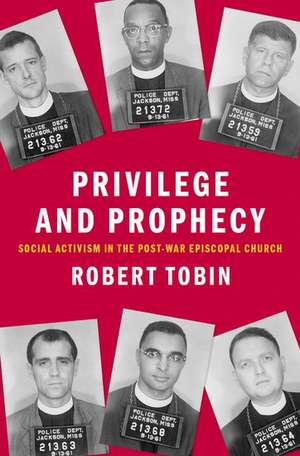
Privilege and Prophecy: Social Activism in the Post-War Episcopal Church
Autor Robert Tobinen Limba Engleză Hardback – 3 iul 2026
Preț: 227.08 lei
Preț vechi: 264.85 lei
-14%
Puncte Express: 341
Carte tipărită la comandă
Livrare economică 04-15 decembrie
Livrare prin curier în România Termenul estimat este afișat lângă disponibilitate.
Transport gratuit de la 400.00 lei Plată online sau ramburs, în funcție de opțiunile comenzii.
Retur gratuit în 14 zile Comandă securizată și suport în română.
Specificații
ISBN-13: 9780190906146
ISBN-10: 0190906146
Pagini: 388
Dimensiuni: 229 x 157 x 38 mm
Greutate: 0.66 kg
Editura: Oxford University Press
Colecția OUP USA
Locul publicării:New York, United States
ISBN-10: 0190906146
Pagini: 388
Dimensiuni: 229 x 157 x 38 mm
Greutate: 0.66 kg
Editura: Oxford University Press
Colecția OUP USA
Locul publicării:New York, United States
Recenzii
In Privilege and Prophecy, Robert Tobin has written the definitive history of the Episcopal Church in the post-World War II era.
To readers in the Church of England, Tobin poses a resounding challenge to those tempted to follow in the footsteps of the Episcopal Church, now 'a denomination at cross purposes with itself'. Without their common commitment to every community in the land, Anglicans would quickly lose any sense of coherence and disintegrate into a sectarian future defined by various competing tribes.
This is one of the most important works in Episcopal history to be published in recent years. Robert Tobin's tone throughout seeks deeper understanding,rather than arguing a position. Notably, this is a book about elite white men that includes other social identities. Tobin's ability to interrogate sources with an intersectional awareness of race, sex, and class is exemplary.Privilege and Prophecy is an elegant and multi-lay-ered history suitable for scholars, as well as general readers interested in Anglican identity and the evolution of the Episcopal Church in the 20th century.
In reading this excellent book, one learns much about the Church in the US, but Privilege and Prophecy helps us deeply to ask hard questions about the Church here in Britain.
Tobin has produced a close study of a cohort of lay and ordained leaders of the Episcopal Church in the United States that came into prominence in the 1950s and 1960s. Although most were from professional or upper-class families and had been educated at Ivy league or other elite schools, the members of the cohort were committed to ministry to the working class, the poor, and racial minorities, and critical of the social class from which they came. The policies and programs they supported changed the Episcopal Church, but also undermined its ability to command resources and demand attention needed for social transformation.
From the moment you pick up Robert Tobin's book, you will find it hard to put down. Familiar names come alive both to inspire us and to challenge our historical assumptions about the prophetic role of the Church. Tobin admirably pushes us to ask ourselves, as he puts it, which parts of our heritage are worth fighting for and why.
Robert Tobin explores this significant period in the Episcopal Church with critical insight and generosity of spirit. Analyzing the fascinating interplay of class, race, social change, politics, and personality is a bold and worthy challenge. The thoughtful and clear-eyed portraits of John Hines and others are a gift, and Tobin's history is a vital resource for all who participate in the church's life and strive to lead with integrity in the present.
Robert Tobin has written a superbly researched and documented account of the various forms of social activism which moved and shaped the Episcopal Church in the decades following World War II.
In Privilege and Prophecy, Robert Tobin explores the thought and actions of two generations of liberal, white, male Episcopal clergy...As a study of the inner thought and action of a prominent group of male clergy, Tobin's book succeeds.
To readers in the Church of England, Tobin poses a resounding challenge to those tempted to follow in the footsteps of the Episcopal Church, now 'a denomination at cross purposes with itself'. Without their common commitment to every community in the land, Anglicans would quickly lose any sense of coherence and disintegrate into a sectarian future defined by various competing tribes.
This is one of the most important works in Episcopal history to be published in recent years. Robert Tobin's tone throughout seeks deeper understanding,rather than arguing a position. Notably, this is a book about elite white men that includes other social identities. Tobin's ability to interrogate sources with an intersectional awareness of race, sex, and class is exemplary.Privilege and Prophecy is an elegant and multi-lay-ered history suitable for scholars, as well as general readers interested in Anglican identity and the evolution of the Episcopal Church in the 20th century.
In reading this excellent book, one learns much about the Church in the US, but Privilege and Prophecy helps us deeply to ask hard questions about the Church here in Britain.
Tobin has produced a close study of a cohort of lay and ordained leaders of the Episcopal Church in the United States that came into prominence in the 1950s and 1960s. Although most were from professional or upper-class families and had been educated at Ivy league or other elite schools, the members of the cohort were committed to ministry to the working class, the poor, and racial minorities, and critical of the social class from which they came. The policies and programs they supported changed the Episcopal Church, but also undermined its ability to command resources and demand attention needed for social transformation.
From the moment you pick up Robert Tobin's book, you will find it hard to put down. Familiar names come alive both to inspire us and to challenge our historical assumptions about the prophetic role of the Church. Tobin admirably pushes us to ask ourselves, as he puts it, which parts of our heritage are worth fighting for and why.
Robert Tobin explores this significant period in the Episcopal Church with critical insight and generosity of spirit. Analyzing the fascinating interplay of class, race, social change, politics, and personality is a bold and worthy challenge. The thoughtful and clear-eyed portraits of John Hines and others are a gift, and Tobin's history is a vital resource for all who participate in the church's life and strive to lead with integrity in the present.
Robert Tobin has written a superbly researched and documented account of the various forms of social activism which moved and shaped the Episcopal Church in the decades following World War II.
In Privilege and Prophecy, Robert Tobin explores the thought and actions of two generations of liberal, white, male Episcopal clergy...As a study of the inner thought and action of a prominent group of male clergy, Tobin's book succeeds.
Notă biografică
Robert Tobin is a historian and priest in the Church of England. He was raised in Boston and Texas and took his first degree from Harvard. A Fulbright Scholar, he also holds degrees from Trinity College Dublin, Oxford, and Cambridge. He is the author of The Minority Voice: Hubert Butler and Southern Irish Protestantism, 1900-1991.