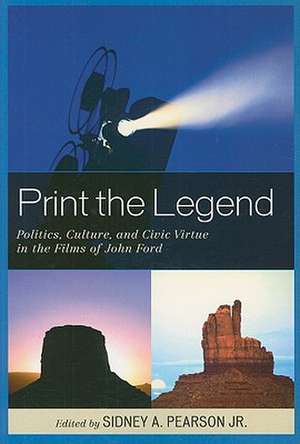
Print the Legend: Politics, Culture, and Civic Virtue in the Films of John Ford
Editat de Sidney A. Pearson Jr. Contribuţii de John Marini, Brigid McMenamin, David K. Nichols, Anne R. Pierce, Matthew J. Franck, Gwen Brown, Mary P. Nichols, Paul A. Cantor, J. David Alvis, John E. Alvis, James F. Pontusoen Limba Engleză Paperback – 16 iun 2009
Preț: 343.17 lei
Preț vechi: 482.74 lei
-29%
Puncte Express: 515
Carte tipărită la comandă
Livrare economică 23 noiembrie-07 decembrie
Livrare prin curier în România Termenul estimat este afișat lângă disponibilitate.
Transport gratuit de la 400.00 lei Plată online sau ramburs, în funcție de opțiunile comenzii.
Retur gratuit în 14 zile Comandă securizată și suport în română.
Specificații
ISBN-13: 9780739135631
ISBN-10: 0739135635
Pagini: 195
Dimensiuni: 156 x 232 x 12 mm
Greutate: 0.32 kg
Editura: Bloomsbury Publishing
Colecția Lexington Books
Locul publicării:New York, United States
ISBN-10: 0739135635
Pagini: 195
Dimensiuni: 156 x 232 x 12 mm
Greutate: 0.32 kg
Editura: Bloomsbury Publishing
Colecția Lexington Books
Locul publicării:New York, United States
V-ar putea interesa
-
 India in Transition: Freeing the EconomyJagdish Bhagwati-18%Preț: 328.65 lei401.98 lei
 -
 A Reader on RegulationRobert Baldwin-31%Preț: 825.17 lei1195.47 lei
 -
 Action Research MethodsS. Klein-8%Preț: 541.74 lei588.84 lei
 -
 Approximating PrudenceA. Yuengert-15%Preț: 659.86 lei776.31 lei
 -
 Health Reforms in South-East EuropeW. BartlettPreț: 402.81 lei
 -
 Government TransparencyT. ErkkiläPreț: 403.41 lei
 -
 Understanding Media PoliciesE. PsychogiopoulouPreț: 399.82 lei
 -
 Disposable PeopleKevin BalesPreț: 264.57 lei
 -
 Colorado Powder Keg: Ski Resorts and the Environmental MovementMichael W. ChildersPreț: 345.78 lei
 -
 Public Forces and Private Politics in American Big BusinessTimothy Werner-14%Preț: 720.28 lei837.54 lei
 -
 DebacleGrover Glenn NorquistPreț: 156.29 lei
 -
 Residential Care TransformedJ. JohnsonPreț: 380.41 lei
 -
 -15%Preț: 601.94 lei708.17 lei
 -
 Transportation Systems AnalysisEnnio Cascetta-18%Preț: 1507.84 lei1838.83 lei
 -
 Foreign Policy in Comparative PerspectiveRyan K. Beasley-27%Preț: 944.80 lei1294.25 lei
 -
 Congressional Limits on Military OperationsViolet L Turner-26%Preț: 502.36 lei676.05 lei
 -
 -26%Preț: 395.73 lei531.99 lei
Cuprins
Chapter 1 Introduction
Chapter 2 Chapter 1. Defending the West: John Ford and the Creation of the Epic Western
Chapter 3 Chapter 2. The Blessings of Civilization: John Ford's Stagecoach
Chapter 4 Chapter 3. John Ford's Revolutionary Americans: Drums Along the Mohawk
Chapter 5 Chapter 4. Modernity and the Destruction of Boundaries: John Ford's The Grapes of Wrath
Chapter 6 Chapter 5. On the Threshold of Modernity: John Ford's How Green Was My Valley
Chapter 7 Chapter 6. Heroes and Political Communities in John Ford's Westerns: The Role of Wyatt Earp in My Darling Clementine
Chapter 8 Chapter 7. The Western and the Western Drama: John Ford's The Searchers and the Oresteia
Chapter 9 Chapter 8. Heroic Virtue and the Limits of Democracy in John Ford's The Searchers
Chapter 10 Chapter 9. Honor, Duty, and Civic Virtue: John Ford's Mr. Roberts and The Last Hurrah
Chapter 11 Why it is Tough to be the Second Toughest Guy in a Tough Town: John Ford's The Man Who Shot Liberty Valance
Chapter 2 Chapter 1. Defending the West: John Ford and the Creation of the Epic Western
Chapter 3 Chapter 2. The Blessings of Civilization: John Ford's Stagecoach
Chapter 4 Chapter 3. John Ford's Revolutionary Americans: Drums Along the Mohawk
Chapter 5 Chapter 4. Modernity and the Destruction of Boundaries: John Ford's The Grapes of Wrath
Chapter 6 Chapter 5. On the Threshold of Modernity: John Ford's How Green Was My Valley
Chapter 7 Chapter 6. Heroes and Political Communities in John Ford's Westerns: The Role of Wyatt Earp in My Darling Clementine
Chapter 8 Chapter 7. The Western and the Western Drama: John Ford's The Searchers and the Oresteia
Chapter 9 Chapter 8. Heroic Virtue and the Limits of Democracy in John Ford's The Searchers
Chapter 10 Chapter 9. Honor, Duty, and Civic Virtue: John Ford's Mr. Roberts and The Last Hurrah
Chapter 11 Why it is Tough to be the Second Toughest Guy in a Tough Town: John Ford's The Man Who Shot Liberty Valance
Recenzii
As we are on the threshold today of what may prove to be revolutionary changes in the American regime, it is entirely fitting that Sidney Pearson calls our attention back to the cultural revolution of the 1960s, by way of looking to the director whose films most effectively and artfully probed the issues at stake in America's cultural revolution from the perspective of heroic America. It is also fitting that Pearson approaches the films of such a great director with such a talented lineup of essayists, including some of our most interesting commentators on political philosophy and culture. For all who admire Ford's work, and especially for those of us who draw on it in our courses, this is an important and compelling collection.
Although the marriage of political philosophy and film seems like a dubious exercise at best, these deftly crafted and persuasively argued essays show that the films of John Ford are as much entertainment as they are profound meditations on the nature and the meaning of the American experiment in self-government. One should go farther to say that in the absence of a keen understanding of American culture and political philosophy each of these authors bring their their analyses, we might never adequately appreciate and understand Ford's accomplishments. Ford's creations emerge at a critical time in American history, just as the cultural revolution of the 1960s gathered steam, when the meaning of America may have been indelibly transformed. These essays invite us to ponder, as Ford himself seems to have done, whether that transformation is in accord with our best hopes or our worst fears.
Although the marriage of political philosophy and film seems like a dubious exercise at best, these deftly crafted and persuasively argued essays show that the films of John Ford are as much entertainment as they are profound meditations on the nature and the meaning of the American experiment in self-government. One should go farther to say that in the absence of a keen understanding of American culture and political philosophy each of these authors bring their their analyses, we might never adequately appreciate and understand Ford's accomplishments. Ford's creations emerge at a critical time in American history, just as the cultural revolution of the 1960s gathered steam, when the meaning of America may have been indelibly transformed. These essays invite us to ponder, as Ford himself seems to have done, whether that transformation is in accord with our best hopes or our worst fears.