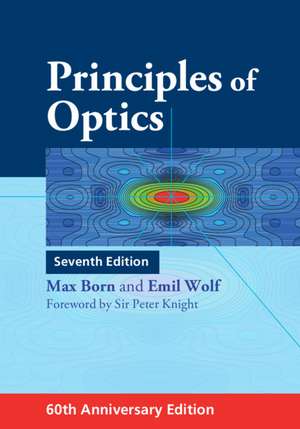
Principles of Optics
Autor Max Born, Emil Wolf, Tbden Limba Engleză Hardback – 19 dec 2019
Observăm în Principles of Optics mai mult decât un manual; este o lucrare monumentală fundamentată pe rigoarea matematică a lui Max Born, laureat al Premiului Nobel, și pe viziunea lui Emil Wolf. Această a șaptea ediție, publicată de Cambridge University Press, marchează prima revizuire majoră a textului original, aducând la zi un volum care a influențat generații de fizicieni. Ne-a atras atenția modul în care autorii reușesc să mențină echilibrul între fundamentele teoretice și aplicațiile moderne, cum ar si secțiunile nou introduse despre tomografia computerizată și teoria difracției Rayleigh–Sommerfield. Structura cărții este enciclopedică, debutând cu o introducere istorică necesară, urmată de o explorare sistematică a proprietăților câmpului electromagnetic și a opticii geometrice. Progresia narativă și tehnică este impecabilă: de la teoria aberațiilor și interferometrie, până la subiecte complexe precum difracția luminii prin unde ultrasonice sau optica metalelor. Cititorii familiarizați cu Basic Optics de Avijit Lahiri vor aprecia în acest volum profunzimea analizei matematice și detalierea fenomenelor de împrăștiere în medii neomogene, elemente care transformă lucrarea într-o referință de nivel avansat. Spre deosebire de alte lucrări ale lui Max Born, cum este Einstein's Theory of Relativity, unde accentul cade pe explicarea conceptelor pentru un public mai larg, Principles of Optics păstrează un ton academic înalt, fiind destinat cercetătorilor și studenților la master sau doctorat. Cele aproape 400 de ilustrații și tabelele incluse nu sunt simple anexe, ci instrumente de lucru esențiale care susțin demonstrațiile matematice complexe despre natura electromagnetică a luminii.
Preț: 577.34 lei
Preț vechi: 627.55 lei
-8%
Carte indisponibilă temporar
Specificații
ISBN-10: 1108477437
Pagini: 994
Ilustrații: 393 b/w illus. 30 tables
Dimensiuni: 175 x 250 x 57 mm
Greutate: 1.86 kg
Ediția:7Revizuită
Editura: Cambridge University Press
Locul publicării:Cambridge, United Kingdom
V-ar putea interesa
-
 Electromagnetic Scattering by Particles and Particle GroupsMichael I Mishchenko-14%Preț: 370.00 lei430.79 lei
 -
 -11%Preț: 498.61 lei560.24 lei
 -
 Preț: 187.82 lei
 -
 Quantum OpticsGirish S. Agarwal-8%Preț: 585.61 lei636.54 lei
 -
 Light Localisation and LasingMher Ghulinyan-29%Preț: 361.39 lei510.74 lei
 -
 Optical TweezersPhilip Jones-11%Preț: 528.03 lei593.28 lei
 -
 Preț: 103.25 lei
 -
 Preț: 283.95 lei
 -
 Basic Electromagnetism and MaterialsAndré MolitonPreț: 400.68 lei
 -
 Ultra-Wideband Short-Pulse Electromagnetics 8Carl E. Baum-18%Preț: 921.30 lei1123.53 lei
 -
 Integrated OpticsRobert G Hunsperger-15%Preț: 557.70 lei656.11 lei
 -
 Digital Holography and Three-Dimensional DisplayTing-Chung Poon-18%Preț: 923.52 lei1126.24 lei
 -
 -15%Preț: 640.59 lei753.63 lei
 -
 Complexity and Control in Quantum PhotonicsPeter Shadbolt-15%Preț: 615.83 lei724.51 lei
 -
 Preț: 401.80 lei
 -
 Quantum (Un)speakablesR. A. Bertlmann-24%Preț: 904.87 lei1190.62 lei
 -
 The Blue Laser DiodeShuji Nakamura-24%Preț: 1734.92 lei2282.79 lei
 -
 Photonic CrystalsJean-Michel Lourtioz-24%Preț: 902.74 lei1187.82 lei
 -
 Attosecond PhysicsLuis Plaja-15%Preț: 643.43 lei756.98 lei
 -
 Preț: 457.86 lei
 -
 Moderne PhysikMax BornPreț: 406.28 lei
 -
 Probleme der AtomdynamikMax BornPreț: 464.24 lei
 -
 Elementare QuantenmechanikPascual Jordan-20%Preț: 465.11 lei581.38 lei
 -
 Laser Measurement TechnologyAxel Donges-18%Preț: 1119.55 lei1365.30 lei
 -
 Field Models in Electricity and MagnetismPaolo Di Barba-15%Preț: 645.12 lei758.96 lei
 -
 Outdoor Lighting: Physics, Vision and PerceptionDuco Schreuder-18%Preț: 915.58 lei1116.57 lei
 -
 New Computation Methods for Geometrical OpticsPsang Dain Lin-15%Preț: 643.64 lei757.23 lei
 -
 -18%Preț: 943.96 lei1151.16 lei
De ce să citești această carte
Această carte este esențială pentru oricine dorește să stăpânească bazele teoretice ale opticii la cel mai înalt nivel. Cititorul câștigă acces la o moștenire științifică de neegalat, actualizată cu tehnologii moderne precum scanările CAT. Este o investiție pe termen lung în biblioteca oricărui fizician, oferind rigoarea necesară pentru cercetarea fundamentală și înțelegerea fenomenelor optice complexe.
Despre autor
Max Born (1882–1970) a fost unul dintre titanii fizicii moderne, ocupând catedre prestigioase la Göttingen, Cambridge și Edinburgh. A fost distins cu Premiul Nobel pentru Fizică în 1954 pentru cercetările sale fundamentale în mecanica cuantică. Opera sa variază de la cursuri susținute la MIT despre structura atomului, publicate în Problems of Atomic Dynamics, până la analize istorice și teoretice ale relativității. În Principles of Optics, Born își folosește pregătirea matematică riguroasă pentru a sistematiza întreaga teorie a luminii, lăsând o moștenire care continuă să ghideze comunitatea științifică internațională.
Descriere scurtă
Cuprins
Recenzii
'Since I have long had laboratories in two places, Göttingen and Heidelberg, I own not one but in fact two copies of this definitive compendium, for it should be on the shelves of any theorist and experimentalist working in optics.' Stefan W. Hell, Max Planck Institute for Biophysical Chemistry, Göttingen, and Max Planck Institute for Medical Research, Heidelberg, Nobel Prize in Chemistry 2014
'The anniversary issue of Born and Wolf invites reflection on how important this classic has been and continues to be. I learned optics in the last century, at the beginning of the laser revolution that breathed exciting and vibrant new life into what had become a crusty old subject. The optics I learned as a student had an antique, nineteenth-century feel. The optics I confronted as a researcher was explosive in its modernity, with Born and Wolf as the guidebook. Today, no optics practitioner's bookshelf is complete without Born and Wolf. For answers in classical optics, this is the first stop.' William D. Phillips, National Institute of Standards and Technology, and University of Maryland, Nobel Prize in Physics 1997
'I fondly remember Emil Wolf's genuine kindness. For example, he offered me a ride in a snow storm without recognizing that I was a student walking to his class. I wouldn't be without Principles of Optics in my office. So many times I have used it to better understand an optics concept that I am either teaching or using in my own research.' Donna Strickland, University of Waterloo, Nobel Prize in Physics 2018
'The book is really a graduate-level textbook, starting with the electromagnetic field description of optics, and ending with a chapter on the optics of metals and crystals. But undergraduates, too, may gain insight, for example from the discussion of image-forming instruments. Also noteworthy are the 12 appendixes, which add great utility to the volume. This jewel of 20th-century physical science belongs on every scientist's book shelf.' J. Lambropoulos, Choice
'The strength of the book is the mathematical lucidity derived from Born's extremely rigorous mathematical upbringing together with the then up-to-date ideas from Wolf … it has supported and influenced the four Nobel laureates whose plaudits cover the rear dust cover, and Sir Peter Knight (once editor of these reviews), who has written an extensive and enlightening introduction. It is still a hugely relevant resource which new researchers should be using as diligently as were their predecessors of nearly two generations ago.' R. S. Shorter, Contemporary Physics