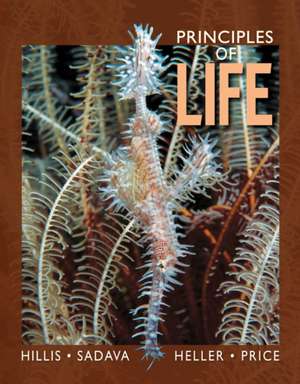
Principles of Life
Autor David M. Hillis, David Sadava, H. Craig Heller, Dr Mary V. Priceen Limba Engleză Paperback – 11 mai 2011
Observăm în ultimii ani o schimbare de paradigmă în predarea științelor vieții, trecându-se de la memorarea exhaustivă a detaliilor la înțelegerea profundă a mecanismelor fundamentale. Principles of Life reflectă precis această evoluție, fiind concepută special pentru a reduce volumul de informație brută în favoarea unei abordări bazate pe analiză și dovezi experimentale. Ne-a atras atenția modul în care autorii reușesc să sintetizeze biologia modernă în aproximativ 900 de pagini, oferind o alternativă mai suplă și mai aplicată manualelor mamut tradiționale.
Această lucrare acoperă aceeași arie tematică precum Campbell Biology in Focus, dar cu o abordare mai centrată pe procesul de investigație. În timp ce alte titluri prioritizează volumul de cunoștințe, Principles of Life pune accent pe 'Research Tools' și 'Investigation Skills', învățând studentul să gândească precum un cercetător prin interpretarea graficelor și a seturilor de date reale. Structura cărții urmărește o progresie logică, de la chimia vieții și genetică (Părțile I-II), la mecanismele evolutive și diversitatea biologică (Părțile III-IV), culminând cu forma și funcția organismelor vegetale și animale.
Poziționată ca o variantă condensată și axată pe principii a celebrei lucrări Life: The Science of Biology, la care David M. Hillis și David Sadava sunt co-autori, această ediție rafinează temele explorate în Purves Biologie. Apreciem în mod deosebit utilizarea elementelor vizuale de tip 'Teachable Art' și a linkurilor terminologice, care transformă lectura dintr-un proces liniar într-o experiență integrativă, esențială pentru studenții care se pregătesc pentru o carieră în cercetare sau medicină.
Preț: 381.03 lei
Carte disponibilă
Livrare economică 21-27 mai
Specificații
ISBN-10: 1429286571
Pagini: 900
Dimensiuni: 234 x 286 x 35 mm
Greutate: 2.51 kg
Editura: Sinauer Associates, Inc.
Colecția Sinauer Associates
Locul publicării:Sunderland, United States
V-ar putea interesa
-
 -11%Preț: 335.01 lei375.81 lei
 -
 -33%Preț: 543.27 lei812.92 lei
 -
 Collective EmotionsChristian von Scheve-27%Preț: 744.63 lei1024.69 lei
 -
 The Eye: A Very Short IntroductionMichael F. Land-22%Preț: 52.95 lei67.47 lei
 -
 Myth of Mirror NeuronsGregory HickokPreț: 272.31 lei
 -
 A Very Short Tour of the MindMichael Corballis-21%Preț: 42.54 lei54.08 lei
 -
 Transcranial Magnetic StimulationAlexander Rotenberg-18%Preț: 1349.34 lei1645.53 lei
 -
 -26%Preț: 50.95 lei69.30 lei
 -
 The Autistic BrainTemple Grandin-21%Preț: 91.42 lei115.55 lei
 -
 Biopsy Diagnosis of Peripheral NeuropathyJuan M. Bilbao-5%Preț: 1465.03 lei1542.15 lei
De ce să citești această carte
Recomandăm această lucrare studenților și profesorilor care caută un manual de biologie modern, axat pe gândire critică și nu pe memorare. Cititorul câștigă o înțelegere clară a modului în care se construiește o ipoteză științifică, exersând direct pe date experimentale. Este resursa ideală pentru cei care doresc să stăpânească conceptele cheie ale biologiei fără a se pierde în detalii tehnice secundare.
Despre autor
Echipa de autori reunește cercetători și pedagogi de elită. David M. Hillis este profesor de biologie integrativă la Universitatea din Texas, fiind recunoscut pentru studiile sale în filogenetică. David Sadava este profesor emerit la Keck Science Center, cu o vastă experiență în predarea biologiei la nivel universitar. H. Craig Heller și Dr Mary V. Price aduc expertiză suplimentară în neurobiologie și ecologie. Împreună, aceștia au dezvoltat unele dintre cele mai influente manuale de biologie din lume, precum seria 'Life', adaptând constant materialele la noile descoperiri din genomică și biotehnologie.
Descriere
Key features and benefits include:
OPENING STORIES
Capture attention from the outset with a story that sets up an interesting question in a recognizable real-world context (How does caffeine work at the cell membrane?). Students revisit this question and its answer at the end of the chapter, having learned the necessary information to comprehend it.
KEY CONCEPTS
* Each chapter is organized into sections, each of which explores a single essential concept in light of established facts and relevant experimental evidence.
* A 'Key Concepts' list begins each chapter.
* 'Do You Understand the Concept?' questions conclude each section, progressing from simple recall questions to questions that require critical thinking at higher levels of Bloom's Taxonomy.
* 'Apply the Concept' critical thinking exercises, embedded in the chapter, ask students to interpret data and draw conclusions. These exercises can be used in class or assigned as homework.
* A Summary provides a thorough review of the chapter content, including key figures, and directs students to relevant resources online.
RESEARCH TOOLS
This feature focuses on techniques and quantitative methods scientists use to investigate biological systems.
INVESTIGATION SKILLS
* 'Investigation' figures describe a key experiment's hypothesis, methods, results, and conclusion.
* 'Analyze the Data' are additional sections where students analyze real data from the experiments.
* 'Working with Data' exercises turn these figures into in-class inquiry problems, discussions, or homework assignments. They contain associated questions and expanded materials that are available online.
FRONTIERS FEATURE
In each chapter, these real-world applications of important concepts introduce students to fascinating ongoing avenues of research.
TEACHABLE ART
Investigation figures describe a key experiment's hypothesis, methods, results, and conclusion. Balloon Captions in the figures help students understand the story at a glance, without necessarily relying on the associated text.
TERMINOLOGY LINKS
These cross-references show students the integrative nature of biology by referring them to a more thorough discussion of a key term elsewhere in the book.
(This title may not be available in all areas. Please contact your representative for more information.)
Cuprins
Introduction
Life Chemistry and Energy
Nucleic Acids, Proteins and Enzymes
Cells: The Working Units of Life
Cell Membranes and Signaling
Pathways that Harvest and Store Chemical Energy
PART II: GENETICS
The Cell Cycle and Cell Division
Inheritance, Genes and Chromosomes
DNA and its Role in Heredity
From DNA to Protein: Gene Expression
Regulation of Gene Expression
Genomes
Biotechnology
Genes, Development and Evolution
PART III: EVOLUTION
Mechanisms of Evolution
Reconstructing and Using Phylogenies
Speciation
The History of Life on Earth
PART IV: DIVERSITY
Bacteria, Archaea, and Viruses
The Origin & Diversification of Eukaryotes
The Evolution of Plants
The Evolution and Diversity of Fungi
Animal Origins and Diversity
PART V: PLANT FORM AND FUNCTION
The Plant Body
Plant Nutrition and Transport
Plant Growth and Development
Reproduction of Flowering Plants
Plants in the Environment
PART VI: ANIMAL FORM AND FUNCTION
Physiology, Homeostasis, and Temperature Regulation
Animal Hormones
Immunology: Animal Defense Systems
Animal Reproduction
Animal Development
Neurons and Nervous Systems
Sensors
Musculoskeletal Systems
Gas Exchange in Animals
Circulatory Systems
Nutrition, Digestion, and Absorption
Salt and Water Balance
Behavior
PART VII: ECOLOGY
Organisms in Their Environment
Populations
Ecological and Evolutionary Consequences of Species Interactions
Ecological Communities
The Global Ecosystem
Notă biografică
DAVID E. SADAVA is the Pritzker Family Foundation Professor of Biology, Emeritus, at the Keck Science Center of Claremont McKenna, Pitzer, and Scripps, three of The Claremont Colleges, USA. In addition, he is Adjunct Professor of Cancer Cell Biology at the City of Hope Medical Center. Twice winner of the Huntoon Award for superior teaching, Dr. Sadava has taught courses on introductory biology, biotechnology, biochemistry, cell biology, molecular biology, plant biology, and cancer biology. For the past 15 years, he has investigated multi-drug resistance in human small-cell lung carcinoma cells with a view to understanding and overcoming this clinical challenge, and his current work focuses on new anti-cancer agents from plants.
H. CRAIG HELLER is the Lorry I. Lokey/Business Wire Professor in Biological Sciences and Human Biology at Stanford University, USA. Dr. Heller is a fellow of the American Association for the Advancement of Science and a recipient of the Walter J. Gores Award for excellence in teaching. His research is on the neurobiology of sleep and circadian rhythms, mammalian hibernation, the regulation of body temperature, the physiology of human performance, and the neuro-biology of learning. Dr. Heller has done research on a huge variety of animals and physiological problems ranging from sleeping kangaroo rats, diving seals, hibernating bears, photoperiodic hamsters, and exercising athletes. He has extended his enthusiasm for promoting active learning through the development of new curricula and Virtual labs for physiology.
MARY V. PRICE is Professor of Biology, Emerita, at the University of California, Riverside and Adjunct Professor in the School of
Natural Resources and the Environment at the University of Arizona. She has developed and taught general biology and ecology courses from introductory (majors and non-majors) to graduate levels. Her research focuses on understanding the ecology of North American deserts and mountains. She has asked why so many desert rodents can coexist, how best to conserve endangered kangaroo rat species, how pollinators and herbivores influence floral evolution and plant population dynamics, and how climate change affects ecological systems.
Caracteristici
Shorter and more accessible - appeals to a wide range of biology students
Active learning approach - students explore essential biological ideas in the context of the field's defining experiments
Covers all the major topics in the field - perfect for university courses