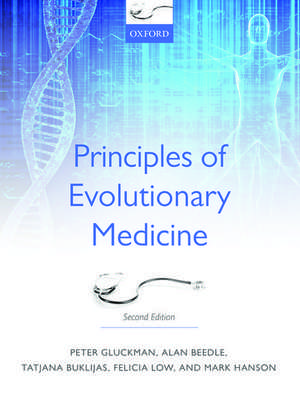
Principles of Evolutionary Medicine
Autor Peter Gluckman, Alan Beedle, Tatjana Buklijas, Felicia Low, Mark Hansonen Limba Engleză Paperback – 17 mar 2016
Bazându-ne pe datele furnizate de OUP OXFORD, reținem că a doua ediție a lucrării Principles of Evolutionary Medicine reprezintă o resursă academică esențială pentru integrarea biologiei evoluționiste în curriculumul medical modern. Credem că relevanța acestui manual rezidă în capacitatea sa de a transforma medicina dintr-o colecție de fapte disparate într-o disciplină integrată, susținută de mecanisme biologice fundamentale. Structura este riguros organizată: prima parte fundamentează teoretic cititorul, indiferent de expunerea sa anterioară la științele evoluției, în timp ce a doua parte aplică aceste principii în arii clinice critice, precum metabolismul, reproducerea și, în premieră pentru această ediție, oncologia.
Merită menționat că volumul extinde considerabil analiza coexistenței umane cu microorganismele, oferind un context evoluționist necesar în era rezistenței la antibiotice și a epidemiilor globale. Principles of Evolutionary Medicine completează perspectiva oferită de Evolutionary Medicine de Stephen C. Stearns, adăugând o dimensiune practică și clinică mai pronunțată, cu un accent deosebit pe căile prin care procesele evolutive modifică riscul de boală și simptomatologia.
În contextul operei autorului Peter Gluckman, acest manual sintetizează temele explorate în lucrări precum The Fetal Matrix sau Fat, Fate, and Disease. Dacă acele titluri se concentrau pe plasticitatea developmentală și originile timpurii ale bolilor netransmisibile, lucrarea de față plasează aceste concepte într-un cadru teoretic universal, adresându-se nu doar cercetătorilor, ci și practicienilor care doresc să înțeleagă „de ce”-ul biologic din spatele patologiilor.
Preț: 377.31 lei
Preț vechi: 421.20 lei
-10%
Carte disponibilă
Livrare economică 23-28 octombrie
Livrare express 09-15 octombrie pentru 96.40 lei
Specificații
ISBN-10: 0199663939
Pagini: 400
Dimensiuni: 190 x 245 x 20 mm
Greutate: 0.86 kg
Ediția:2
Editura: OUP OXFORD
Colecția OUP Oxford
Locul publicării:Oxford, United Kingdom
V-ar putea interesa
-
 Climbing Mount ImprobableRichard Dawkins-20%Preț: 73.59 lei92.22 lei
 -
 -28%Preț: 381.23 lei530.15 lei
 -
 Evolution of Biological DiversityAnne Magurran-32%Preț: 526.76 lei779.01 lei
 -
 How Homo Became Sapiens: On the evolution of thinkingPeter Gärdenfors-28%Preț: 437.70 lei612.11 lei
 -
 The Comparative Method in Evolutionary BiologyPaul H. Harvey-29%Preț: 450.80 lei630.64 lei
 -
 Perspectives in Animal Phylogeny and EvolutionAlessandro Minelli-25%Preț: 524.70 lei697.88 lei
 -
 -32%Preț: 533.28 lei782.96 lei
 -
 Human Evolution: Trails from the PastCamilo J. Cela-Conde-6%Preț: 377.40 lei399.60 lei
 -
 The Molecular Organography of PlantsQuentin Cronk-22%Preț: 397.65 lei510.31 lei
 -
 Fat, Fate, and Disease: Why exercise and diet are not enoughPeter Gluckman-23%Preț: 117.78 lei152.06 lei
 -
 The Moral Animal: Why We Are The Way We AreRobert Wright-26%Preț: 78.30 lei106.44 lei
 -
 The Fetal Matrix - Evol Dev DiseasePeter Gluckman-5%Preț: 592.56 lei623.75 lei
 -
 -25%Preț: 820.58 lei1100.61 lei
De ce să citești această carte
Această ediție este indispensabilă studenților la medicină și profesioniștilor din sănătate publică care doresc să înțeleagă rădăcinile biologice ale bolilor. Veți câștiga o perspectivă nouă asupra vulnerabilităților umane, de la cancer la tulburări metabolice, folosind un cadru teoretic ce explică interacțiunea dintre gene, mediu și timp. Este un instrument rar care îmbină rigoarea academică cu aplicabilitatea clinică imediată.
Despre autor
Professor Sir Peter Gluckman este unul dintre cei mai respectați oameni de știință din Noua Zeelandă, fiind profesor de biologie pediatrică și perinatală la Universitatea din Auckland. Fost director al Institutului Liggins pentru Cercetări Medicale, cariera sa este marcată de studii fundamentale privind plasticitatea developmentală și modul în care mediul prenatal influențează sănătatea pe termen lung. Expertiza sa în intersecția dintre biologie, medicină și politici publice este reflectată în structura acestui manual, care pune un accent deosebit pe modul în care evoluția modelează riscurile de boală în societatea contemporană.
Descriere
Recenzii
Notă biografică
Cuprins
- PART 1: FUNDAMENTALS OF EVOLUTIONARY BIOLOGY
- 1: Introduction
- 2: Evolutionary theory
- 3: The molecular basis of variation and inheritance
- 4: Evolution and development
- 5: The human life history
- 6: The molecular basis of variation and inheritance
- PART 2: EVOLUTION IN HEALTH AND DISEASE
- 7: An evolutionary framework for understanding human health and disease
- 8: Reproduction
- 9: Nutritional and metabolic adaptation
- 10: Coevolution, infection, and immunity
- 11: Psychology and behaviour
- 12: Cancer
- 13: Evolutionary principles applied to medical practice and public health
- 14: Evolution, medicine, and society