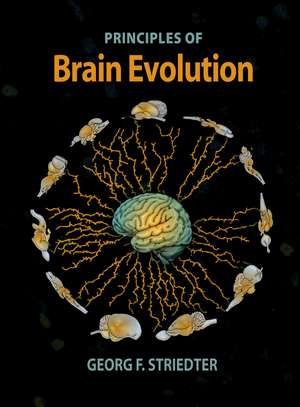
Principles of Brain Evolution
Autor Georg F. Striedteren Limba Engleză Hardback – 20 oct 2004
În analiza evoluției sistemului nervos, Principles of Brain Evolution se distinge prin modul în care utilizează datele comparative de la o gamă largă de vertebrate pentru a extrage principii generale de organizare. Ne-a atras atenția în special componenta analitică dedicată modului în care circuitele neuronale și regiunile cerebrale individuale își modifică dimensiunea și complexitatea în raport cu masa corporală. Autorul propune o temă centrală solidă: schimbările evolutive în mărimea creierului nu sunt izolate, ci corelează direct cu proporțiile regiunilor interne și cu arhitectura conexiunilor, influențând în mod previzibil comportamentul.
Recomandăm această lucrare pentru claritatea cu care Georg F. Striedter sintetizează regulile dezvoltării neurale, oferind cititorului instrumentele necesare pentru a înțelege de ce anumite trăsături sunt conservate la toate vertebratele, în timp ce altele sunt unice. Cartea acoperă aceeași arie tematică precum Evolutionary Neuroscience de Jon H. Kaas, însă abordarea lui Striedter este mai puțin tehnică și mai axată pe principii de design biologic, fiind accesibilă și cercetătorilor care nu sunt specialiști în neuroanatomie. Spre deosebire de volumul lui Michel A. Hofman, Evolution of the Primate Brain, care se concentrează pe o nișă specifică, această lucrare oferă un context mult mai vast, de la primele vertebrate până la Homo sapiens.
În contextul operei sale, volumul reprezintă o sinteză teoretică ce completează abordările aplicate din Neurobiology sau studiile specifice din Bird Brains and Behavior. Dacă în lucrările anterioare Striedter analiza funcția sau grupurile specifice, aici el construiește un cadru conceptual unitar despre „cum” și „de ce” s-au transformat creierele de-a lungul erelor geologice, făcând legătura între filogenie și mecanismele ontogenetice.
Preț: 1073.90 lei
Preț vechi: 1471.09 lei
-27%
Carte disponibilă
Livrare economică 17 noiembrie-01 decembrie
Specificații
ISBN-10: 0878938206
Pagini: 436
Ilustrații: 139 illustrations
Dimensiuni: 236 x 183 x 28 mm
Greutate: 1.06 kg
Editura: Oxford University Press
Colecția OUP USA
Locul publicării:New York, United States
V-ar putea interesa
-
 A Brief History of IntelligenceMax BennettPreț: 81.23 lei
 -
 Primate Adaptation and EvolutionJohn G. Fleagle-22%Preț: 392.86 lei504.30 lei
 -
 The Rhesus Monkey Brain in Stereotaxic CoordinatesGeorge Paxinos-29%Preț: 770.57 lei1081.48 lei
 -
 The Brain: A Very Short IntroductionMichael O'Shea-31%Preț: 49.06 lei71.12 lei
 -
 -29%Preț: 396.65 lei555.61 lei
 -
 The Evolutionary Roots of Human Brain DiseasesNico J. Diederich-32%Preț: 921.86 lei1347.43 lei
 -
 Evolutionary Psychology: A Very Short IntroductionMaryanne L. Fisher-18%Preț: 58.47 lei71.55 lei
 -
 Adaptation and the BrainSusan D. Healy-21%Preț: 352.55 lei446.08 lei
 -
 Bird Brains and BehaviorGeorg F. Striedter-14%Preț: 527.51 lei613.37 lei
 -
 Evolution of the Human HeadDaniel E. LiebermanPreț: 541.87 lei
 -
 -11%Preț: 104.92 lei117.90 lei
 -
 Principles of NeurobiologyLiqun Luo-5%Preț: 679.44 lei715.21 lei
 -
 Principles of Cognitive NeuroscienceDale Purves-27%Preț: 1436.98 lei1968.47 lei
 -
 Brain RulesJohn MedinaPreț: 94.98 lei
 -
 How the Mind Changed: A Human History of our Evolving BrainJoseph Jebelli-25%Preț: 92.52 lei123.07 lei
 -
 One Hand ClappingNikolay KukushkinPreț: 159.17 lei
 -
 The Little Book of Big Stuff about the BrainAndrew CurranPreț: 111.48 lei
 -
 Brain Evolution by DesignShuichi Shigeno-18%Preț: 1447.70 lei1765.48 lei
De ce să citești această carte
Recomandăm această carte studenților avansați și cercetătorilor care doresc să depășească simpla descriere a anatomiei cerebrale. Cititorul câștigă o înțelegere profundă a regulilor care guvernează evoluția creierului, explicând clar de ce creierul uman a devenit „special”. Este o resursă esențială pentru a înțelege legătura dintre dimensiunea organului, complexitatea structurală și adaptarea comportamentală, totul susținut de o bogată iconografie explicativă.
Despre autor
Georg F. Striedter este un renumit profesor de neurobiologie și comportament, recunoscut pentru contribuțiile sale fundamentale în neuroștiința comparată. Opera sa explorează intersecția dintre evoluție, dezvoltare și funcție neurală, publicând lucrări de referință precum Brains Through Time. Prin activitatea sa la University of California, Irvine, Striedter a promovat o viziune integrativă asupra creierului, analizând atât mecanismele celulare, cât și rezultatele evolutive macroscopice. Abordarea sa pedagogică pune accent pe claritate și pe eliminarea jargonului inutil, făcând subiecte complexe accesibile unei audiențe academice largi.
Descriere
Recenzii
This volume offers an enduring and succinct summary of the vast archive of morphological data that reveals the wondrous diversity of brains."
Georg Striedter has produced a wonderful book that discusses current understandings of brain evolution. Overall, this is a volume that most neuroscientists will enjoy reading, and some of them, myself included, will find it useful as a textbook for graduate students and advanced undergraduates."
In Principles of Brain Evolution, Striedter accomplishes several important goals: he conveys the many aspects of brain structure and function that are conserved across species; he illustrates in a clear manner why species differences are real and should not be dismissed; he explores the complex issue as to how conservation and divergence