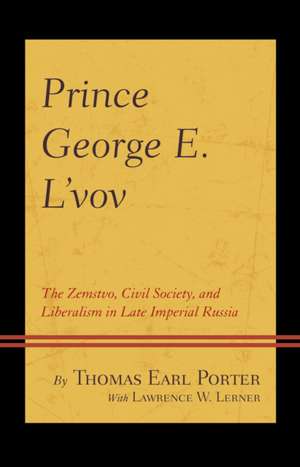
Prince George E. L'vov: The Zemstvo, Civil Society, and Liberalism in Late Imperial Russia
Autor Thomas Earl Porter Cu Lawrence W. Lerneren Limba Engleză Hardback – 4 oct 2017
Preț: 640.50 lei
Preț vechi: 958.98 lei
-33%
Puncte Express: 961
Carte tipărită la comandă
Livrare economică 03-17 decembrie
Livrare prin curier în România Termenul estimat este afișat lângă disponibilitate.
Transport gratuit pentru acest produs Plată online sau ramburs, în funcție de opțiunile comenzii.
Retur gratuit în 14 zile Comandă securizată și suport în română.
Specificații
ISBN-13: 9781498518673
ISBN-10: 1498518672
Pagini: 276
Dimensiuni: 160 x 237 x 24 mm
Greutate: 0.54 kg
Editura: Bloomsbury Publishing
Colecția Lexington Books
Locul publicării:New York, United States
ISBN-10: 1498518672
Pagini: 276
Dimensiuni: 160 x 237 x 24 mm
Greutate: 0.54 kg
Editura: Bloomsbury Publishing
Colecția Lexington Books
Locul publicării:New York, United States
Cuprins
Chapter 1: The Zemstvo and Russian Liberalism
Chapter 2: The "Small, victorious war" and the First Russian Revolution
Chapter 3: Russia's "Forgotten Decade": The Zemstvo, Politics, and the Emergence of Civil Society
Chapter 4: Russia's Liberal Experiment
Chapter 5: Russian Liberalism in Crisis
Chapter 6: The Zemstvo and Liberalism in Russia's Great War
Chapter 7: The Failure of Russian Liberalism
Chapter 2: The "Small, victorious war" and the First Russian Revolution
Chapter 3: Russia's "Forgotten Decade": The Zemstvo, Politics, and the Emergence of Civil Society
Chapter 4: Russia's Liberal Experiment
Chapter 5: Russian Liberalism in Crisis
Chapter 6: The Zemstvo and Liberalism in Russia's Great War
Chapter 7: The Failure of Russian Liberalism
Recenzii
"The ultimate failure of liberalism in Russia," the authors write in conclusion, "showed that the schism between Russia's unacculturated peasant masses and educated society had not yet been overcome" (p. 233). Pessimists long have agreed. What is new in this fine work of scholarship is the suggestion that it was the liberal belief in civil society that helped accelerate its demise.
Prince L'vov has long deserved more attention than he has gotten from historians. Thomas Earl Porter and Lawrence W. Lerner not only demonstrate his importance to Russian politics but also use his career to trace the tortured path of liberalism in the last years of Romanov rule. Their treatment of the moderate liberals who coalesced in the 'Progressist' faction after 1905 is equally interesting.
Thomas Earl Porter is the leading western historian of zemstvo liberalism and it is very useful to have his major writings brought together in this volume. They have been modified in order to create a continuous and partially updated narrative of the topic from 1861 to 1917. This has been achieved in part through incorporation of work in the same area by Lawrence W. Lerner. The main theme of the book is the link between 'small deeds' zemstvo (i.e. local government) activity and the extent of an independent civil society in Russia, for which zemstvo activists are seen as a barometer. The political activities of Russia's first post-tsarist prime minister, Prince George E. L'vov, also acts as unifying thread in what many scholars will find is a useful and insightful account of the topic.
Thomas Earl Porter has written an important study that deepens our understanding of the politics of Russian liberalism and of local self-government as exemplified in the career of zemstvo activist George E. L'vov.
The book is a useful addition to the very small amount of work available in English on L'vov.
Prince L'vov has long deserved more attention than he has gotten from historians. Thomas Earl Porter and Lawrence W. Lerner not only demonstrate his importance to Russian politics but also use his career to trace the tortured path of liberalism in the last years of Romanov rule. Their treatment of the moderate liberals who coalesced in the 'Progressist' faction after 1905 is equally interesting.
Thomas Earl Porter is the leading western historian of zemstvo liberalism and it is very useful to have his major writings brought together in this volume. They have been modified in order to create a continuous and partially updated narrative of the topic from 1861 to 1917. This has been achieved in part through incorporation of work in the same area by Lawrence W. Lerner. The main theme of the book is the link between 'small deeds' zemstvo (i.e. local government) activity and the extent of an independent civil society in Russia, for which zemstvo activists are seen as a barometer. The political activities of Russia's first post-tsarist prime minister, Prince George E. L'vov, also acts as unifying thread in what many scholars will find is a useful and insightful account of the topic.
Thomas Earl Porter has written an important study that deepens our understanding of the politics of Russian liberalism and of local self-government as exemplified in the career of zemstvo activist George E. L'vov.
The book is a useful addition to the very small amount of work available in English on L'vov.