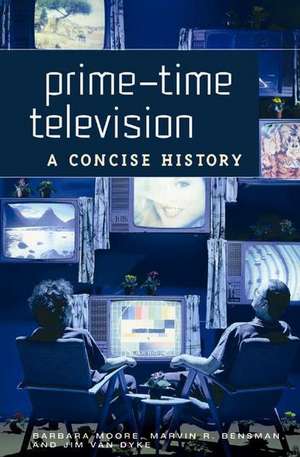
Prime-Time Television: A Concise History
Autor Barbara Moore, Marvin R. Bensman, Jim Van Dykeen Limba Engleză Hardback – 30 mar 2006
The chapters are organized chronologically, beginning with an examination of radio's influence on early television, and cover all major developments-technological, aesthetic, and to some extent cultural-in the medium. Concise sidebars cover more concise topics, such as the quiz show scandals, and the introduction of the three-camera filmed sitcom with I Love Lucy, a model that has remained the standard for over 50 years.
Preț: 475.49 lei
Preț vechi: 791.81 lei
-40%
Puncte Express: 713
Carte tipărită la comandă
Livrare economică 07-21 decembrie
Livrare prin curier în România Termenul estimat este afișat lângă disponibilitate.
Transport gratuit pentru acest produs Plată online sau ramburs, în funcție de opțiunile comenzii.
Retur gratuit în 14 zile Comandă securizată și suport în română.
Specificații
ISBN-13: 9780275981426
ISBN-10: 0275981428
Pagini: 320
Dimensiuni: 156 x 235 x 30 mm
Greutate: 0.64 kg
Editura: Bloomsbury Publishing
Colecția Praeger
Locul publicării:New York, United States
ISBN-10: 0275981428
Pagini: 320
Dimensiuni: 156 x 235 x 30 mm
Greutate: 0.64 kg
Editura: Bloomsbury Publishing
Colecția Praeger
Locul publicării:New York, United States
V-ar putea interesa
-
 The Political PunditsJames E. Combs-26%Preț: 192.61 lei259.44 lei
 -
 Mass Media in Greece: Power, Politics and PrivatizationManny Paraschos-30%Preț: 472.80 lei674.57 lei
 -
 The Age of Multimedia and TurbonewsJim Willis-25%Preț: 194.33 lei260.41 lei
 -
 Images of Germany in the American MediaJim Willis-30%Preț: 472.44 lei674.35 lei
 -
 The People, Press, and Politics of CroatiaStjepan Malovic-30%Preț: 473.90 lei675.21 lei
 -
 The War in Iraq and Why the Media Failed UsDavid Dadge-20%Preț: 340.40 lei425.88 lei
 -
 -22%Preț: 194.99 lei249.33 lei
 -
 Images That Injure: Pictorial Stereotypes in the MediaPaul Martin Lester-24%Preț: 385.33 lei505.45 lei
 -
 Politics on Demand: The Effects of 24-Hour News on American PoliticsProfessor Alison Dagnes-26%Preț: 393.28 lei534.90 lei
 -
 Philosophy through FilmAmy Karofsky-15%Preț: 444.92 lei523.44 lei
 -
 The Routledge Companion to Sound StudiesMichael Bull-8%Preț: 432.33 lei469.93 lei
 -
 Barbieri Zodiac OraclePaolo BarbieriPreț: 84.89 lei
 -
 The Beginning of Broadcast Regulation in the Twentieth CenturyMarvin R. BensmanPreț: 298.75 lei
 -
 The Broadside Ballad in Early Modern EnglandPatricia Fumerton-11%Preț: 624.84 lei702.06 lei
 -
 Preț: 82.17 lei
 -
 The Genes of CultureChristine L. NystromPreț: 331.27 lei
 -
 Hydrogen Peroxide Health Benefits and UsesBarbara MoorePreț: 76.80 lei
 -
 Juice Fasting for Weight LossBarbara MoorePreț: 76.37 lei
 -
 Juicing GuideBarbara MoorePreț: 76.37 lei
 -
 Flat Belly Diet for WomenBarbara MoorePreț: 77.37 lei
 -
 Critical Directions in Comics StudiesThomas GiddensPreț: 279.49 lei
 -
 The Age of DisinformationBurton Porter-23%Preț: 775.98 lei1007.77 lei
 -
 Cultural Policy and East Asian Rivalry: The Hong Kong Gaming IndustryAnthony Y. H. Fung-18%Preț: 254.62 lei311.58 lei
 -
 The Digital World of SportSam Duncan-23%Preț: 713.80 lei927.01 lei
 -
 -18%Preț: 897.79 lei1094.86 lei
Cuprins
Introduction
The Heritage of Radio Programming (1927-1947)
The Experimental Days of Television Programming (1939-1947)
Finding an Audience (1948-1952)
The Rise and Fall of Live Drama and Quiz Shows (1953-1959)
Detectives, Cowboys, and Happy Families (1960-1969)
Controversy in Prime Time (1970-1984)
Changes in Competition (1996-2005)
Conclusion
Abbreviations
Bibliography
The Heritage of Radio Programming (1927-1947)
The Experimental Days of Television Programming (1939-1947)
Finding an Audience (1948-1952)
The Rise and Fall of Live Drama and Quiz Shows (1953-1959)
Detectives, Cowboys, and Happy Families (1960-1969)
Controversy in Prime Time (1970-1984)
Changes in Competition (1996-2005)
Conclusion
Abbreviations
Bibliography
Recenzii
Barbara Moore, Marvin R. Bensman, and Jim Van Dyke have cobbled together a compendium of thoroughly researched evidence that America's top medium for news and information got to be No. 1 for prime-time reasons. The programs, the regulations and the history of television, accompanied by a generous collection of photographs, combine for an interesting addition to the shelves of TV buffs anywhere.
Organized chronologically, this text examines trends in the prime- time programming of the broadcast networks from its roots in 1920s radio to present day offerings. Writing as both academics and fans, Moore and co-authors discuss all of the major technical, aesthetic, and cultural developments in the medium. Sidebars cover such topics as the quiz show scandals and the introduction of the three-camera filmed sitcom.
[P]rovides a complete and accessible understanding of the media medium of television through the historical and modern study of sitcoms, dramas, and other prime-time television particulars. Delving deep into the intricacies of American popular culture and the influential role played by many television shows, Prime-Time Television features a scholarly analysis of the shows, producers, genres, trends, and ideals behind various influential television productions. A seminal contribution to university level Popular Culture reference collections, Prime-Time Television is very strongly recommended reading.
Well-written and clearly and intelligently laid out, this book's greatest strength for high-school researchers is the historically grounded contrasting of radio with television for students unaware of the similarities between the two. This work best serves those concerned with the macro-level of broadcast entertainment, rather than the micro-level of details about specific programs.
Organized chronologically, this text examines trends in the prime- time programming of the broadcast networks from its roots in 1920s radio to present day offerings. Writing as both academics and fans, Moore and co-authors discuss all of the major technical, aesthetic, and cultural developments in the medium. Sidebars cover such topics as the quiz show scandals and the introduction of the three-camera filmed sitcom.
[P]rovides a complete and accessible understanding of the media medium of television through the historical and modern study of sitcoms, dramas, and other prime-time television particulars. Delving deep into the intricacies of American popular culture and the influential role played by many television shows, Prime-Time Television features a scholarly analysis of the shows, producers, genres, trends, and ideals behind various influential television productions. A seminal contribution to university level Popular Culture reference collections, Prime-Time Television is very strongly recommended reading.
Well-written and clearly and intelligently laid out, this book's greatest strength for high-school researchers is the historically grounded contrasting of radio with television for students unaware of the similarities between the two. This work best serves those concerned with the macro-level of broadcast entertainment, rather than the micro-level of details about specific programs.