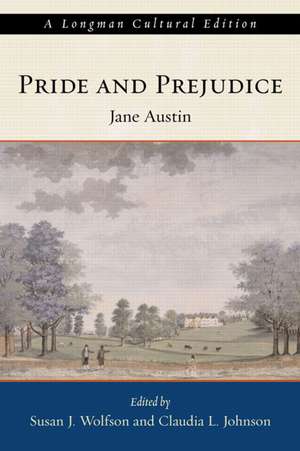
Pride and Prejudice
Autor Jane Austen, Claudia Johnson, Susan J. Wolfsonen Limba Engleză Paperback – 9 oct 2024
Abordarea interdisciplinară a volumului Pride and Prejudice din seria Longman Cultural Edition transformă lectura acestui clasic într-o analiză riguroasă a istoriei sociale, a studiilor de gen și a evoluției criticii literare. Considerăm că această ediție, coordonată de Claudia L. Johnson și Susan Wolfson, depășește formatul unui simplu roman de moravuri, oferind instrumentele necesare pentru a înțelege complexitatea societății britanice de la începutul secolului al XIX-lea. Găsim în această carte textul fidel al primei ediții, îmbogățit cu un aparat critic ce clarifică aluziile literare și ritualurile sociale care astăzi ar putea părea obscure cititorului nespecializat. Merită menționat că structura editorială pune un accent deosebit pe integrarea textului în fluxul istoriei contemporane autoarei. Cronologia inclusă nu se limitează la biografia lui Jane Austen, ci creează o paralelă constantă cu evenimentele politice și culturale ale epocii. Față de alte versiuni, volumul se distinge prin notele de subsol concise, dar exhaustive, care decodifică limbajul și uzanțele specifice gentry-ului englez. Această ediție reprezintă o alternativă solidă la Jane Austen's Pride and Prejudice de Robert Morrison pentru cursurile de studii literare, cu avantajul unei ancorări mai profunde în contextul cultural imediat și o documentare mai vastă a primelor reacții critice, oferind o perspectivă de ansamblu asupra modului în care romanul a fost perceput inițial.
Preț: 304.13 lei
Carte tipărită la comandă
Livrare economică 07-21 decembrie
Specificații
ISBN-10: 0321105079
Pagini: 496
Dimensiuni: 135 x 210 x 27 mm
Greutate: 0.58 kg
Ediția:1. Auflage
Editura: Pearson
Locul publicării:New York, United States
V-ar putea interesa
-
 -41%Preț: 215.05 lei364.88 lei
 -
 The Catcher in the Rye.J D SalingerPreț: 177.71 lei
 -
 How to Paint Like the Old MastersJoseph SheppardPreț: 161.25 lei
 -
 -19%Preț: 56.55 lei70.02 lei
 -
 Family BusinessD. Kenyon-Rouvinez-15%Preț: 550.12 lei647.20 lei
De ce să citești această carte
Această ediție din seria Longman este ideală pentru studenții și cercetătorii care doresc să exploreze Pride and Prejudice dincolo de intriga romantică. Cititorul câștigă o înțelegere profundă a codurilor sociale, a realităților economice și a uzanțelor lingvistice ale epocii, beneficiind de un aparat critic academic care face textul accesibil și relevant pentru studiul interdisciplinar modern.
Despre autor
Jane Austen (1775–1817) este una dintre cele mai influente figuri ale literaturii engleze, cunoscută pentru realismul său social și ironia fină prin care a analizat viața micii nobilimi rurale. Pride and Prejudice, publicat inițial în 1813, rămâne opera sa definitorie. Ediția de față este îngrijită de Claudia L. Johnson, profesor la Universitatea Princeton și expert recunoscut în studiile despre Austen, alături de Leslie J. Lamport, contribuind la consolidarea statutului academic al textului prin analize critice care evidențiază complexitatea temelor legate de căsătorie, moștenire și moralitate.
Descriere
Cuprins
About Longman Cultural Editions.
About this Edition.
Introduction.
Table of Dates.
Pride and Prejudice (1813).
Volume 1.Volume 2.Volume 3.Jane Austen's Letters.
“To Cassandra Austen,” 2 June 1799.“To Cassandra Austen,” 20-21 November 1800.“To Cassandra Austen,” 29 January 1813.“To Cassandra Austen,” 4 February 1813.“To Cassandra Austen,” 9 February 1813.“To Frank Austen,” 3 July 1813.“To Frank Austen,” 25 September 1813.“To Anna Austen,” 9 September 1814.“To James Stanier Clarke,” 11 December 1815.“To J. Edward Austen,” 16 December 1816.Contexts.
Money.
Money: From the 1790s to the Regency (1811-1820).Marriage and the Marriage Market.
Debates in the House of Commons on The Clandestine Marriage Bill. Jean-Jacques Rousseau, from Emile (1762, 1763).Revd. James Fordyce, Sermons to Young Women (1766, 1795).Mary Wollstonecraft, from A Vindication of the Rights of Woman (1792).Jane Austen, from Emma (1816).Lord Byron, Don Juan Canto 14. XVIII (1823).Female Character and Conduct.
Revd. James Fordyce, from Sermons to Young Women (1766, 1777).Dr. John Gregory, A Father's Legacy to His Daughters (1774).Mary Wollstonecraft, from A Vindication of the Rights of Woman (1792).Male Characters and Conduct.
Alexander Pope, from Epistle IV, To Richard Boyl, Earl of Burlington; Of the Uses of Riches (1731).Samuel Johnson, Rambler (1750).The Picturesque and Great Houses.
William Gilpin, from Observations, Relative chiefly to Picturesque Beauty, made in the year 1792, on Several Parts of England (1786) and Three Essays: On Picturesque Beauty, On Picturesque Travel, and on Sketching Landscape (1792).John Byng, Rules for Admission to Strawberry Hill. Reactions to Pride and Prejudice.
First Reviews and Readers.
British Critic XLI (1813).Critical Review 4/3 (1813).Anna Isabella Milbanke (1813).Walter Scott, Quarterly Review (1815).The Next Generation.
Henry Crabb Robinson.Richard Whatley, Quarterly Review (1821).Walter Scott, Journal, 1826-27.Maria Jane Jewsbury, The Athenaeum. Charlotte Bronte, letters.Further Reading.
Notă biografică
Susan J. Wolfson is professor of English at Princeton University. In addition to this present volume, her editorial work includes Felicia Hemans (Princeton UP, 2000) and the Longman Cultural Edition of John Keats. With Claudia Johnson, she is coeditor of the Longman Cultural Edition of Jane Austen's Pride and Prejudice. With Peter Manning, she is coeditor of the Romantics volume in The Longman Anthology of British Literature, and Selected Poems of Lord Byron (Penguin, 2005). Her critical books include the prize-winning Formal Charges: The Shaping of Poetry in British Romanticism (Stanford UP, 1997) and Borderlines: The Shiftings of Gender in British Romanticism (Stanford UP, 2007).
Caracteristici
- A chronology coordinating the events of Austen's life with key events in contemporary history and literary culture is included in the introduction.
- Footnotes identify cultural references, social codes and rituals, literary allusions, as well as unfamiliar word usages.
- Illustrations include the title page of the first edition (signed “By the Author of Sense and Sensibility,” which itself was signed anonymously, “By a Lady”); as well as images of the houses, forms of dress, and modes of conveyance that characterize the world of the novel.
- Contextual items including Austin's letters, an orientation to money; a look at the “marriage market” for young women; discussion of socially favored “female character and conduct;” discussion of male conduct; a passages on the aesthetics of “the picturesque” that helps explain the invisible planning of Darcy's grand, naturally tasteful estate, and the reviews the novel received.
- Austen's letters and the reviews the novel received upon its publication in 1813, over the next decade as Austen's fame emerged, and in comments from such readers as Lady Byron, William Wordsworth, and Charlotte and Emily Bronte illuminate the text.
- “A Guide to Further Reading” provides information about biography, editions, critical studies, films, and Web sites.