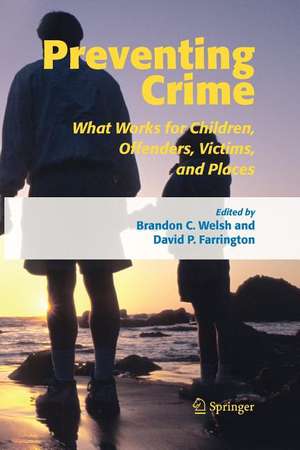
Preventing Crime
Editat de Brandon C. Welsh, David P. Farringtonen Limba Engleză Paperback – 19 oct 2010
A project of the Campbell Collaboration Crime and Justice Group, Preventing Crime brings together the leading scientific evidence on what works best for a wide range of interventions organized around four important domains in criminology: at-risk children, offenders, victims, and places. It is the first book to assess the effectiveness of criminological interventions using the most rigorous review methodology of the systematic review. It is an indispensable guide to the leading scientific evidence on what works best to prevent crime.
Preț: 641.55 lei
Preț vechi: 754.77 lei
-15%
Puncte Express: 962
Carte tipărită la comandă
Livrare economică 16-30 octombrie
Livrare prin curier în România Termenul estimat este afișat lângă disponibilitate.
Transport gratuit pentru acest produs Plată online sau ramburs, în funcție de opțiunile comenzii.
Retur gratuit în 14 zile Comandă securizată și suport în română.
Specificații
ISBN-13: 9789048170838
ISBN-10: 9048170834
Pagini: 256
Ilustrații: X, 244 p.
Dimensiuni: 155 x 235 x 15 mm
Greutate: 0.39 kg
Ediția:Softcover reprint of hardcover 1st ed. 2006
Editura: Springer
Locul publicării:Dordrecht, Netherlands
ISBN-10: 9048170834
Pagini: 256
Ilustrații: X, 244 p.
Dimensiuni: 155 x 235 x 15 mm
Greutate: 0.39 kg
Ediția:Softcover reprint of hardcover 1st ed. 2006
Editura: Springer
Locul publicării:Dordrecht, Netherlands
Public țintă
ResearchCuprins
Evaluation Research on Correctional Treatment in West Germany: A Meta-Analysis.- Evidence-Based Crime Prevention.- What Works for Children.- Early Parent Training.- Child Social Skills Training.- What Works for Offenders.- Cognitive-Behavioral Interventions.- Boot Camps.- Scared Straight and Other Juvenile Awareness Programs.- Incarceration-Based Drug Treatment.- Costs and Benefits of Sentencing.- What Works for Victims.- Mandated Batterer Intervention Programs to Reduce Domestic Violence.- Restorative Justice to Reduce Victimization.- Preventing Repeat Residential Burglary Victimization.- What Works for Places.- Policing Crime Hot Spots.- Closed-Circuit Television Surveillance.- Improved Street Lighting.- Policy Choices for a Safer Society.- Conclusions and Directions from Evidence-Based Crime Prevention.
Textul de pe ultima copertă
Crime prevention should be rational and should be based on the best possible evidence. Decision-makers should weigh heavily any available evidence on what works best. How can a program that has produced no discernable evidence of effectiveness, as shown through numerous evaluations, be considered for implementation? Unfortunately, this happens all the time. Evidence-based crime prevention attempts to overcome this and other obstacles by ensuring that the best available evidence is considered in any decision to implement a program designed to prevent crime. This book is about evidence-based crime prevention.
A project of the Campbell Collaboration Crime and Justice Group, Preventing Crime brings together the leading scientific evidence on what works best for a wide range of interventions organized around four important domains in criminology: at-risk children, offenders, victims, and places. It is the first book to assess the effectiveness of criminological interventions using the most rigorous review methodology of the systematic review. It is an indispensable guide to the leading scientific evidence on what works best to prevent crime.
A project of the Campbell Collaboration Crime and Justice Group, Preventing Crime brings together the leading scientific evidence on what works best for a wide range of interventions organized around four important domains in criminology: at-risk children, offenders, victims, and places. It is the first book to assess the effectiveness of criminological interventions using the most rigorous review methodology of the systematic review. It is an indispensable guide to the leading scientific evidence on what works best to prevent crime.
Caracteristici
The first book to examine evidence-based crime prevention through the use of the rigorous methodology of systematic reviews An indispensable guide to the leading scientific evidence on what works best to prevent crime Brings together the leading experts on evidence-based crime prevention from across the world Covers important and topical interventions, including child skills training, cognitive-behavioral therapy, restorative justice, repeat victimization, hot spots policing, and CCTV