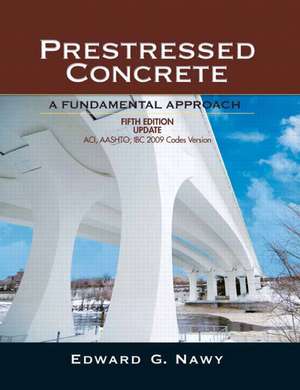
Prestressed Concrete: ACI, AASHTO, IBC 2009 Codes Version
Autor Edward G. Nawyen Limba Engleză Hardback – 31 iul 2009
Completely revised to reflect the new ACI 318-08 Building Code and International Building Code, IBC 2009, this popular book offers a unique approach to examining the design of prestressed concrete members in a logical, step-by-step trial and adjustment procedure. Integrates handy flow charts to help readers better understand the steps needed for design and analysis. Includes a revised chapter containing the latest ACI and AASHTO Provisions on the design of post-tensioned beam end anchorage blocks using the strut-and-tie approach in conformity with ACI 318-08 Code. Offers a new complete section with two extensive design examples using the strut-and-tie approach for the design of corbels and deep beams. Features an addition to the elastic method of design, with comprehensive design examples on LRFD and Standard AASHTO designs of bridge deck members for flexure, shear and torsion, conforming to the latest AASHTO specifications. Includes a revised chapter on slender columns, including a simplified load-contour biaxial bending method which is easier to apply in desiign, using moments rather than loads in the reciprocal approach. A useful construction reference for engineers.
Preț: 1550.41 lei
Preț vechi: 2013.53 lei
-23%
Carte tipărită la comandă
Livrare economică 21 noiembrie-05 decembrie
Specificații
ISBN-10: 0136081509
Pagini: 984
Dimensiuni: 209 x 253 x 40 mm
Greutate: 1.9 kg
Ediția:Nouă
Editura: Pearson
Locul publicării:Upper Saddle River, United States
Descriere
Completely revised to reflect the new ACI 318-08 Building Code and International Building Code, IBC 2009, this popular text offers a unique approach to examining the design of prestressed concrete members in a logical, step-by-step trial and adjustment procedure. Encouraging clear, systematic thinking, it integrates handy flow charts to help students better understand the steps needed for design and analysis. In addition, the major topics of material behavior, prestress losses, flexure, shear, torsion, and deflection-camber are sequentially self-contained and can be covered in one semester at the senior and graduate levels.
Cuprins
2. Materials and Systems for Prestressing
3. Partial Loss of Prestress
4. Flexural Design of Prestressed Concrete Elements
5. Shear and Torsional Strength Design
6. Indeterminate Prestressed Concrete Structures
7. Camber, Deflection, and Crack Control
8. Prestressed Compression and Tension Members
9. Two-Way Prestressed Concrete Floor Systems
10. Connections for Prestressed Concrete Elements
11. Prestressed Concrete Circular Storage Tanks and Steel Roofs
12. LRFD and Standard AASHTO Design of Concrete Bridges
13. Seismic Design of Prestressed Concrete Structures
Appendix A: Unit Conversions, Design Information, Properties of Reinforcement
Appendix B: Selected Typical Standard Precast Double Tees, Inverted Tees, Hollow Core Sections, and AASHTO Bridge Sections
Index
Notă biografică
Caracteristici
- A chapter detailing the latest ACI and AASHTO Provisions on the design of post-tensioned beam end anchorage blocks using the strut-and-tie approach in conformity with ACI 318-08 Code.
- A complete section with two extensive design examples using the strut-and-tie approach for the design of corbels and deep beams.
- Detailed chapter on the design of statically indeterminate multi-span prestressed concrete beams and portal frames with revised examples complying with new ACI code provisions on moment redistribution.
- Provides students with material consistent with the increased use of continuous members in bridge structures, and illustrates the use of the basic concepts method, the C-line method, and the balancing method presented in Chapter 1.
- Provides students with material consistent with the increased use of continuous members in bridge structures, and illustrates the use of the basic concepts method, the C-line method, and the balancing method presented in Chapter 1.
- Revised chapters on beams and columns to comply with the new limit strains approach (unified approach) to ultimate load design, including a simplified load-contour biaxial bending method.
- Shows students how to use the code recommendations for choice of the appropriate strains in the design of concrete elements.
- Shows students how to use the code recommendations for choice of the appropriate strains in the design of concrete elements.
- Detailed account of the analysis and design of prestressed concrete tanks and their shell roofs.
- Discusses the basics of the membrane and bending theories of cylindrical shells for use in the design of prestressed concrete tanks or the various wall boundary conditions of fixed, semi-fixed, hinged and sliding wall bases, as well as the incorporation of vertical prestressing, using wrapped wire as well as tendons, and seismic provisions. This is a unique chapter not available in any other standard textbook.
- Discusses the basics of the membrane and bending theories of cylindrical shells for use in the design of prestressed concrete tanks or the various wall boundary conditions of fixed, semi-fixed, hinged and sliding wall bases, as well as the incorporation of vertical prestressing, using wrapped wire as well as tendons, and seismic provisions. This is a unique chapter not available in any other standard textbook.
- Easy-to-follow flowcharts and over 300 illustrations integrated throughout.
- Simplifies the understanding and application of the subject in design, using both customary US and the SI units in the numerical examples.
- Simplifies the understanding and application of the subject in design, using both customary US and the SI units in the numerical examples.
- Selected photographs involving various areas of the structural behavior of concrete elements at failure—Included in all chapters.
- Enables students to actually see what happens at failure of beams, columns, two-way slabs, torsional failures, shear failures, etc.
- Enables students to actually see what happens at failure of beams, columns, two-way slabs, torsional failures, shear failures, etc.
- Photographs of some major prestressed concrete "landmark" structures.
- Illustrates the versatility of design in pre-tensioned and post- tensioned prestressed concrete.
- Illustrates the versatility of design in pre-tensioned and post- tensioned prestressed concrete.
- Numerous design examples.
- Connects a common example to various topics in order to integrate a complete design.
- Connects a common example to various topics in order to integrate a complete design.
- Actual as-built design examples—Not found in other texts.
- Offers students a unique look at high-rise buildings in high seismicity zones using precast, prestressed concrete moment frame structures.
- Offers students a unique look at high-rise buildings in high seismicity zones using precast, prestressed concrete moment frame structures.