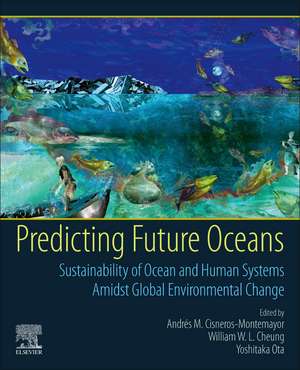
Predicting Future Oceans: Sustainability of Ocean and Human Systems Amidst Global Environmental Change
Editat de William Cheung, Yoshitaka Ota, Andres Cisneros-Montemayoren Limba Engleză Paperback – 20 aug 2019
În contextul programelor universitare de studii de mediu și oceanografie, Predicting Future Oceans se poziționează ca o resursă academică fundamentală pentru înțelegerea traiectoriei ecosistemelor marine sub presiunea schimbărilor globale. Lucrarea, publicată de ELSEVIER SCIENCE, reprezintă o sinteză a expertizei colective din cadrul rețelei Nereus Program, integrând perspective din 17 institute de cercetare de elită. Remarcăm abordarea holistică a editorilor William Cheung, Yoshitaka Ota și Andres Cisneros-Montemayor, care depășesc barierele disciplinare clasice pentru a analiza oceanele ca sisteme complexe, unde factorii ecologici și cei socio-economici sunt indisolubil legați.
Structura volumului este riguros organizată în secțiuni care ghidează cititorul de la mecanismele fizice ale schimbării (evenimente climatice extreme, acumularea de metilmercur) către dinamica biodiversității și, în final, către implicațiile umane profunde. Această progresie logică permite o analiză detaliată a modului în care biomasa marină și biogeografia speciilor exploatate se vor modifica în viitor. Subliniem relevanța capitolului dedicat echității și suveranității, elemente care transformă datele pur științifice în pârghii pentru politici publice.
Această lucrare completează perspectiva oferită de Oceans and Society de Ana Spalding, adăugând o componentă robustă de modelare predictivă și o bază de date extinsă provenită din cercetarea fundamentală în științele naturii. Dacă Sea Change, o altă lucrare coordonată de William Cheung, se concentra pe guvernanța și sustenabilitatea resurselor într-un context regional, volumul de față extinde analiza la scară globală, oferind un fundament teoretic și practic necesar pentru gestionarea resurselor naturale în Anthropocen.
Preț: 845.72 lei
Preț vechi: 1200.40 lei
-30%
Carte tipărită la comandă
Livrare economică 20 noiembrie-04 decembrie
Specificații
ISBN-10: 0128179457
Pagini: 582
Ilustrații: 300 illustrations (300 in full color)
Dimensiuni: 191 x 235 x 33 mm
Greutate: 0.99 kg
Editura: ELSEVIER SCIENCE
V-ar putea interesa
-
 Sustainability: A Very Short IntroductionSaleem H. Ali-19%Preț: 57.46 lei71.30 lei
 -
 Marine Biology: A Very Short IntroductionPhilip V. Mladenov-19%Preț: 58.13 lei71.69 lei
 -
 Future Sea: How to Rescue and Protect the World's OceansDeborah Rowan WrightPreț: 88.33 lei
 -
 The Blue CommonsGuy Standing-29%Preț: 76.67 lei107.95 lei
 -
 Ocean of LifeCallum Roberts-37%Preț: 99.41 lei157.04 lei
 -
 Forecasting the OceanCommittee for the 2025-2035 Decadal Survey of Ocean Sciences for the National Science FoundationPreț: 140.95 lei
 -
 Marine Fisheries EcologyJennings-19%Preț: 466.93 lei576.46 lei
 -
 World Without FishMark Kurlansky-24%Preț: 77.11 lei101.58 lei
 -
 Sea Change: Charting a Sustainable Future for Oceans in CanadaUssif Rashid SumailaPreț: 384.63 lei
 -
 Sink or Swim: How the world needs to adapt to a changing climateSusannah Fisher-26%Preț: 100.23 lei135.49 lei
 -
 Ocean: Earth's Last Wilderness - THE LANDMARK NEW BOOK BY DAVID ATTENBOROUGHSir David AttenboroughPreț: 158.83 lei
 -
 A Liveable Future is PossibleNoam ChomskyPreț: 78.95 lei
 -
 2052Jorgen RandersPreț: 146.93 lei
 -
 The High Seas: Ambition, Power and Greed on the Unclaimed OceanOlive Heffernan-18%Preț: 71.21 lei86.89 lei
 -
 Scales, H: What the Wild Sea Can BeHelen ScalesPreț: 107.97 lei
 -
 The Age of ExtractionTim WuPreț: 107.56 lei
 -
 How to Fall in Love with the FutureRob HopkinsPreț: 158.80 lei
 -
 The Ocean and UsFarah ObaidullahPreț: 382.05 lei
 -
 Ocean GovernanceStefan PartelowPreț: 309.99 lei
 -
 Global Challenges in Maritime SecurityLisa Otto-18%Preț: 757.15 lei923.35 lei
De ce să citești această carte
Recomandăm această carte studenților și profesioniștilor din domeniul conservării marine care au nevoie de o bază științifică solidă pentru a înțelege viitorul oceanelor. Cititorul câștigă acces la o sinteză multidisciplinară rară, susținută de 300 de ilustrații color, care explică nu doar cum se schimbă oceanele, ci și cum putem adapta sistemele umane pentru a asigura sustenabilitatea resurselor și sănătatea comunităților de coastă.
Descriere scurtă
This includes members at 17 leading research institutes, addressing themes such as oceanography, biodiversity, fisheries, mariculture production, economics, pollution, public health and marine policy.
This book is a comprehensive resource for senior undergraduate and postgraduate readers studying social and natural science, as well as practitioners working in the field of natural resources management and marine conservation.
- Provides a synthesis of our knowledge on the future state of the oceans
- Includes recommendations on how to move forwards
- Highlights key social aspects linked to ocean ecosystems, including health, equity and sovereignty
Cuprins
1. Rethinking oceans as coupled human-natural systems to achieve sustainability
Section 2: Changing ocean systems
2. Synthesis: Changing ocean systems
3. Drivers of fisheries production in complex social-ecological systems
4. Changing Seasonality of the Sea: Past, Present, and Future
5. Extreme climate events in the oceans
6. Pathways of methylmercury accumulation in a changing ocean
7. Building confidence in projections of future ocean capacity
8. Coastal upwelling and climate change
Section 3: Changing marine ecosystems and biodiversity
9. Sythesis: Changing marine ecosystems and biodiversity
10. Current and future biogeography of marine exploited groups under climate change
11. The role of cyclical oscillations in species distributions shifts under climate change
12. Changing biomass flows in marine ecosystems: From the past to the future
13. Jellyfishes in a changing ocean
14. Understanding fisheries using time series data: importance and opportunities emerging from models of bottom up forcing
15. The Sea Around Us as provider of global fisheries catch and related marine biodiversity data to the Nereus Program and civil society
16. Life history of marine fishes and their implications for the future oceans
Section 4: Changing fisheries and seafood supply
17. Synthesis: Changing fisheries and seafood supply
18. Projecting fishing effort dynamics and the economics of fishing in the 21st century under climate change
19. Prospect of mariculture under climate change
20. Tourist seafood consumption's role in tourism adaptation in Pacific Island Countries for coastal food security under climate change
21. Integrating environmental information into stock assessment models for fisheries management
22. The future landscape of the global seafood market
23. Climate change adaptations and spatial fisheries management
24. Climate Change, Contaminants, and Country Food: Collaborating with Communities to Promote Food Security in the Arctic
Section 5: Changing social world of the ocean
25. Synthesis: Changing social world of the oceans
26. The relevance of human rights to socially responsible seafood
27. The impact of environmental change on small-scale fishing communities: Moving beyond adaptive capacity to community response
28. Coastal Indigenous Peoples in global ocean governance
29. The role of corporate social responsibility for ocean sustainability
30. Ocean policy on the water – incorporating fishermen’s perspectives
31. Traditional ecological knowledge in displacement and migration
32. Can aspirations lead us to the oceans we want?
Section 6: Governance and well-being in changing oceans
33. Synthesis: The opportunities of changing ocean governance for sustainability
34. A Blue Economy: Equitable, Sustainable, and Viable Development in the World’s Oceans
35. Exploring the knowns and unknowns of international fishery conflicts
36. The future of mangrove fishing communities
37. The last commons: (Re)constructing an ocean future
38. New actors, new possibilities, new challenges - Non-state actor participation in global fisheries management
39. Climate change vulnerability and ocean governance
Section 7: Ocean governance beyond boundaries
40. Synthesis: The opportunities of changing ocean governance for sustainability with Erik
41. Conserving the great blue "beyond." Incorporating the dynamic and connected nature of the open ocean in the biodiversity beyond national jurisdiction (BBNJ) negotiations
42. Legitimacy as a resource for effective international marine management
43. Improving fisheries governance in a fragmented and decentralized world
44. The Trouble with Tunas: International Fisheries Science and Policy in an Uncertain Future
45. The road to implementing an ecosystem-based approach to high seas fisheries management
46. Ocean Pollution in an Era of Changing Oceans and Climate Change: Towards Ocean Conservation Solutions
47. Beyond prediction: Radical Ocean Futures– A science fiction prototyping approach to imagining our future oceans
Section 8: Conclusion
48. Future pathways for the oceans considering climate change and social equity