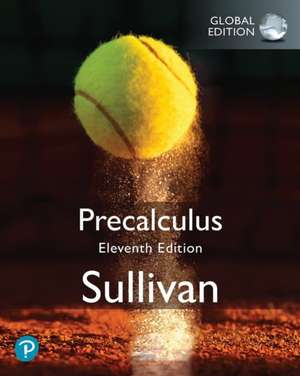
Sullivan, M: Precalculus, Global Edition
en Limba Engleză Paperback – 20 feb 2023
Ceea ce aduce nou cea de-a 11-a ediție a manualului Precalculus, Global Edition este rafinarea unui sistem pedagogic deja consacrat, adaptat cerințelor actuale ale studenților prin integrarea tehnologiei digitale. Apreciem modul în care Michael Sullivan a structurat această ediție pentru a răspunde nevoii de continuitate în învățare, punând un accent deosebit pe tranziția de la conceptele de bază la aplicații complexe. Ne-a atras atenția „ciclul Sullivan”, o metodologie care ghidează utilizatorul prin etape riguroase de pregătire pentru curs, exerciții practice și recapitulare sistematică. Structura cărții este organizată logic, debutând în primele capitole cu studiul graficelor, al distanțelor și al ecuațiilor liniare, pentru a construi fundamentul necesar abordării funcțiilor. Progresia către funcțiile polinomiale și raționale este susținută de exemple de modelare matematică bazate pe date reale, oferind o relevanță practică adesea absentă în textele pur teoretice. Putem afirma că rigoarea matematică este dublată de o claritate didactică ce reflectă experiența de peste trei decenii a autorului în cadrul Chicago State University. Această lucrare reprezintă o alternativă solidă la Mymathlab for Trigsted Precalculus pentru cursurile de algebră și analiză matematică elementară, având avantajul unei abordări hibride care combină profunzimea unui text tipărit de 1200 de pagini cu flexibilitatea platformei MyLab Math. În contextul operei sale, deși numele autorului apare și pe alte titluri diverse precum The Arts of China, Sixth Edition, Revised and Expanded, specializarea sa de bază rămâne matematica, acest volum fiind vârful de lance al unei serii de manuale utilizate la nivel internațional pentru pregătirea studenților în domeniul STEM.
Preț: 587.97 lei
Preț vechi: 675.82 lei
-13%
Carte disponibilă
Livrare economică 16-30 noiembrie
Livrare express 30 octombrie-05 noiembrie pentru 108.42 lei
Specificații
ISBN-10: 1292444525
Pagini: 1200
Dimensiuni: 221 x 276 x 47 mm
Greutate: 2.51 kg
Ediția:11. Auflage
Editura: Pearson
V-ar putea interesa
-
 Algebra 1, Student EditionMcGraw-Hill-18%Preț: 1128.98 lei1376.81 lei
 -
 Preț: 448.48 lei
 -
 The Homotopy Category of Simply Connected 4-ManifoldsHans-Joachim BauesPreț: 473.07 lei
 -
 The Q-Schur AlgebraStephen Donkin-11%Preț: 414.21 lei465.40 lei
 -
 Preț: 456.13 lei
 -
 Vectors, Pure and AppliedT. W. Korner-14%Preț: 1104.24 lei1284.00 lei
 -
 Matrix Theory and Applications with MATLABDarald J. Hartfiel-18%Preț: 1072.42 lei1307.82 lei
 -
 -18%Preț: 932.07 lei1136.67 lei
 -
 Preț: 130.20 lei
 -
 Beam DynamicsEtienne Forest-18%Preț: 1075.65 lei1311.76 lei
De ce să citești această carte
Această ediție este esențială pentru studenții care au nevoie de o bază solidă înainte de a trece la cursul de analiză matematică (Calculus). Cititorul câștigă o înțelegere profundă a funcțiilor prin exerciții de înaltă calitate și modele matematice aplicate. Este recomandată celor care preferă un ritm de studiu structurat, unde fiecare concept este testat și revizuit înainte de a trece la nivelul următor.
Despre autor
Michael Sullivan este profesor emerit în cadrul Departamentului de Matematică și Informatică de la Chicago State University, unde a activat timp de 35 de ani. Membru al American Mathematical Society și al Mathematical Association of America, Sullivan este o figură proeminentă în pedagogia matematicii, având în palmares 15 manuale publicate. Experiența sa vastă se reflectă în claritatea cu care explică procesele matematice complexe, fiind recunoscut la nivel mondial pentru capacitatea de a crea materiale didactice care facilitează retenția informațiilor pe termen lung.
Notă biografică
Mike Sullivan, III is a professor of mathematics atJoliet Junior College. He holds graduate degrees from DePaul University in bothmathematics and economics. Mike is an author or co-author on more than 20books, including a statistics book and a developmental mathematics series. Mikeis the father of three children and an avid golfer who tries to spend as muchof his limited free time as possible on the golf course.
Cuprins
1.1 The Distance and Midpoint Formulas 1.2 Graphs of Equations in Two Variables; Intercepts; Symmetry 1.3 Lines 1.4 CirclesChapter 1 Review, Test, and Projects
2.1 Functions 2.2 The Graph of a Function 2.3 Properties of Functions 2.4 Library of Functions; Piecewise-defined Functions 2.5 Graphing Techniques: Transformations 2.6 Mathematical Models: Building FunctionsChapter 2 Review, Test, and Projects
3.1 Properties of Linear Functions and Linear Models 3.2 Building Linear Models from Data 3.3 Quadratic Functions and Their Properties 3.4 Build Quadratic Models from Verbal Descriptions and from Data 3.5 Inequalities Involving Quadratic FunctionsChapter 3 Review, Test, and Projects
4.1 Polynomial Functions 4.2 Graphing Polynomial Functions; Models 4.3 Properties of Rational Functions 4.4 The Graph of a Rational Function 4.5 Polynomial and Rational Inequalities 4.6 The Real Zeros of a Polynomial FunctionChapter 4 Review, Test, and Projects
5.1 Composite Functions 5.2 One-to-One Functions; Inverse Functions 5.3 Exponential Functions 5.4 Logarithmic Functions 5.5 Properties of Logarithms 5.6 Logarithmic and Exponential Equations 5.7 Financial Models 5.8 Exponential Growth and Decay Models; Newtons Law; Logistic Growth and Decay Models 5.9 Building Exponential, Logarithmic, and Logistic Models from DataChapter 5 Review, Test, and Projects
6.1 Angles, Arc, Length, and Circular Motion 6.2 Trigonometric Functions: Unit Circle Approach 6.3 Properties of the Trigonometric Functions 6.4 Graphs of the Sine and Cosine Functions 6.5 Graphs of the Tangent, Cotangent, Cosecant, and Secant Functions 6.6 Phase Shift; Sinusoidal Curve FittingChapter 6 Review, Test, and Projects
7.1 The Inverse Sine, Cosine, and Tangent Functions 7.2 The Inverse Trigonometric Functions (Continued) 7.3 Trigonometric Equations 7.4 Trigonometric Identities 7.5 Sum and Difference Formulas 7.6 Double-angle and Half-angle Formulas 7.7 Product-to-Sum and Sum-to-Product FormulasChapter 7 Review, Test, and Projects
8.1 Right Triangle Trigonometry; Applications 8.2 The Law of Sines 8.3 The Law of Cosines 8.4 Area of a Triangle 8.5 Simple Harmonic Motion; Damped Motion; Combining WavesChapter 8 Review, Test, and Projects
9.1 Polar CoordinatesChapter 9 Review, Test, and Projects
9.2 Polar Equations and Graphs
9.3 The Complex Plane; De Moivres Theorem
9.4 Vectors
9.5 The Dot Product
9.6 Vectors in Space
9.7 The Cross Product
10.1 Conics 10.2 The Parabola 10.3 The Ellipse 10.4 The Hyperbola 10.5 Rotation of Axes; General Form of a Conic 10.6 Polar Equations of Conics 10.7 Plane Curves and Parametric EquationsChapter 10 Review, Test, and Projects
11.1 Systems of Linear Equations: Substitution and Elimination 11.2 Systems of Linear Equations: Matrices 11.3 Systems of Linear Equations: Determinants 11.4 Matrix Algebra 11.5 Partial Fraction Decomposition 11.6 Systems of Nonlinear Equations 11.7 Systems of Inequalities 11.8 Linear ProgrammingChapter 11 Review, Test, and Projects
12.1 Sequences 12.2 Arithmetic Sequences 12.3 Geometric Sequences; Geometric Series 12.4 Mathematical Induction 12.5 The Binomial TheoremChapter 12 Review, Test, and Projects
13.1 Counting 13.2 Permutations and Combinations 13.3 ProbabilityChapter 13 Review, Test, and Projects
14.1 Finding Limits Using Tables and Graphs 14.2 Algebra Techniques for Finding Limits 14.3 One-sided Limits; Continuous Functions 14.4 The Tangent Problem; The Derivative 14.5 The Area Problem; The IntegralChapter 14 Review, Test, and Projects
Descriere scurtă
Prepare. Practice. Review.
Michael Sullivans time-tested approach focuses students on the fundamental skills they need for the course: preparing for class, practicing with homework, and reviewing the concepts. The 11th Edition continues to evolve to meet the needs of todays students.
This series prepares and supports students with access to help, where and when they require it. The hallmark Sullivan cycle of continuous preparation and retention along with the high-quality exercises that Sullivan texts are known for gives students the reinforcement they need.
Also available with MyLab Math
MyLab Math is the teaching and learning platform that empowers you to reach every student. By combining trusted author content with digital tools and a flexible platform, MyLab Math personalizes the learning experience and improves results for each student. Learn more about MyLab Math.