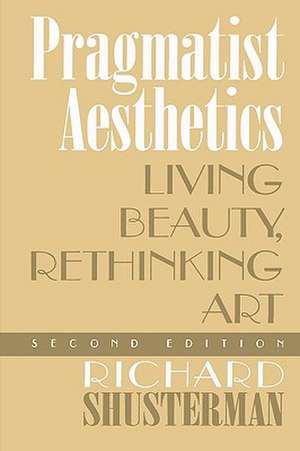
Pragmatist Aesthetics: Living Beauty, Rethinking Art
Autor Richard Shustermanen Limba Engleză Paperback – 22 feb 2000
Preț: 319.25 lei
Puncte Express: 479
Carte tipărită la comandă
Livrare economică 21 noiembrie-05 decembrie
Livrare prin curier în România Termenul estimat este afișat lângă disponibilitate.
Transport gratuit de la 400.00 lei Plată online sau ramburs, în funcție de opțiunile comenzii.
Retur gratuit în 14 zile Comandă securizată și suport în română.
Specificații
ISBN-13: 9780847697656
ISBN-10: 0847697657
Pagini: 368
Dimensiuni: 148 x 226 x 24 mm
Greutate: 0.56 kg
Ediția:Second Edition
Editura: Bloomsbury Publishing
Colecția Rowman & Littlefield
Locul publicării:New York, United States
ISBN-10: 0847697657
Pagini: 368
Dimensiuni: 148 x 226 x 24 mm
Greutate: 0.56 kg
Ediția:Second Edition
Editura: Bloomsbury Publishing
Colecția Rowman & Littlefield
Locul publicării:New York, United States
V-ar putea interesa
-
 Truth, Fiction, and Literature: A Philosophical PerspectivePeter Lamarque-28%Preț: 429.14 lei598.45 lei
 -
 The Aesthetic Mind: Philosophy and PsychologyElisabeth Schellekens-17%Preț: 370.70 lei443.96 lei
 -
 -28%Preț: 393.50 lei548.20 lei
 -
 Contemplating Art: Essays in AestheticsJerrold Levinson-21%Preț: 377.44 lei476.59 lei
 -
 -29%Preț: 409.10 lei573.48 lei
 -
 New Essays on Musical UnderstandingPeter Kivy-20%Preț: 364.56 lei453.39 lei
 -
 Arts and MindsGregory Currie-19%Preț: 367.63 lei454.99 lei
 -
 The Aesthetic Appreciation of NatureMalcolm Budd-29%Preț: 395.22 lei554.62 lei
 -
 Emotion and ValueSabine Roeser-31%Preț: 577.70 lei836.30 lei
 -
 The Aesthetics of Everyday LifeAndrew LightPreț: 254.51 lei
 -
 Thinking through the BodyRichard ShustermanPreț: 311.71 lei
 -
 A Companion to the Philosophy of LiteratureGarry L HagbergPreț: 421.78 lei
 -
 Four Arts of PhotographyDominic Mciver Lopes-23%Preț: 614.78 lei798.42 lei
 -
 Black is BeautifulPaul C TaylorPreț: 206.53 lei
 -
 Platform CapitalismNick SrnicekPreț: 480.00 lei
 -
 Politics of ModernismRaymond WilliamsPreț: 115.72 lei
Recenzii
Shusterman...has written a spirited, generous, powerful, and stylish essay in which the acuity of analytical philosophy is cross-bred to the vision of continental theory to produce a work that no one interested in the philosophy of art-or philosophy of life-can afford to ignore. It is clear, eloquent, fair, and urgent.
A deeply satisfying work. Shusterman's knowledge of aesthetic theory, and in particular, current trends in what constitutes art, seems unparalleled. Inasmuch as he pushes the envelope of what hitherto has consisted of pragmatists aesthetics, Shusterman deserves to be called an original thinker.
A challenging, deeply intelligent book.
The renovated, more everyday conception of aesthetic experience that he [Shusterman] champions inPragmatist Aesthetis is deeply embodied, occasionally political, and oriented around the practical art of living.
The first edition was a fine book. The additional chapter in this second edition expands the account of the aesthetic way of life. Shusterman's defense of popular culture as art is convincing, thorough, and welcome.
Through a generous and inspired reinterpretation of John Dewey, Richard Shusterman establishes a theory of aesthetics that is liberated from the traditional dualisms and capable of reconciling art and the political.
A deeply satisfying work. Shusterman's knowledge of aesthetic theory, and in particular, current trends in what constitutes art, seems unparalleled. Inasmuch as he pushes the envelope of what hitherto has consisted of pragmatists aesthetics, Shusterman deserves to be called an original thinker.
A challenging, deeply intelligent book.
The renovated, more everyday conception of aesthetic experience that he [Shusterman] champions inPragmatist Aesthetis is deeply embodied, occasionally political, and oriented around the practical art of living.
The first edition was a fine book. The additional chapter in this second edition expands the account of the aesthetic way of life. Shusterman's defense of popular culture as art is convincing, thorough, and welcome.
Through a generous and inspired reinterpretation of John Dewey, Richard Shusterman establishes a theory of aesthetics that is liberated from the traditional dualisms and capable of reconciling art and the political.