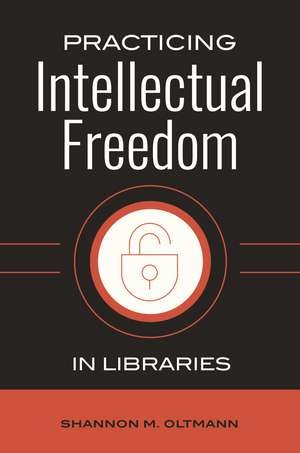
Practicing Intellectual Freedom in Libraries
Autor Shannon M. Oltmannen Limba Engleză Paperback – 15 aug 2019
Practicing Intellectual Freedom in Libraries is helpful for a wide range of people, from those only starting to learn about intellectual freedom to those more well-versed in the subject. For novices, it offers a solid introduction to intellectual freedom, grounded theoretically and empirically; for more experienced scholars and librarians, it provides a uniquely comprehensive analysis of intellectual freedom.
Intellectual freedom is important for librarians because it is a foundation of the profession and is truly central to librarianship in the United States. Situating intellectual freedom within freedom of speech theories, this book explains the legal and theoretical foundations for contemporary understandings of intellectual freedom within library science. Additionally, it depicts the importance of community to implementing intellectual freedom and exemplifies this importance in a discussion of actual library practices. Real-world scenarios provide a timely look at intellectual freedom in context, discussing Internet filtering, collection development and weeding, meeting rooms and exhibit spaces, programming, and fake news and misinformation.
Preț: 357.41 lei
Preț vechi: 429.46 lei
-17%
Puncte Express: 536
Carte tipărită la comandă
Livrare economică 09-23 noiembrie
Livrare prin curier în România Termenul estimat este afișat lângă disponibilitate.
Transport gratuit de la 400.00 lei Plată online sau ramburs, în funcție de opțiunile comenzii.
Retur gratuit în 14 zile Comandă securizată și suport în română.
Specificații
ISBN-13: 9781440863127
ISBN-10: 1440863121
Pagini: 208
Dimensiuni: 156 x 235 x 11 mm
Greutate: 0.3 kg
Editura: Bloomsbury Publishing
Colecția Libraries Unlimited
Locul publicării:New York, United States
ISBN-10: 1440863121
Pagini: 208
Dimensiuni: 156 x 235 x 11 mm
Greutate: 0.3 kg
Editura: Bloomsbury Publishing
Colecția Libraries Unlimited
Locul publicării:New York, United States
Cuprins
Acknowledgments
Introduction
Part One Conceptualizing Intellectual Freedom
ONE Intellectual Freedom and Access to Information
TWO Three Theories behind Access to Information
THREE The Freedom to Explore
FOUR Core Values and Intellectual Freedom
FIVE Intellectual Freedom in the Daily Lives of Libraries
Part Two Intellectual Freedom in Action
SIX How to Handle Materials Challenges
SEVEN Collection Development and Weeding
EIGHT Addressing the #MeToo Movement in Literature
NINE Programs, Meeting Rooms, and Exhibit Spaces
TEN Internet Filtering
ELEVEN Fake News, False Information, and Intellectual Freedom
TWELVE Law Enforcement and Intellectual Freedom
THIRTEEN Copyright Issues
FOURTEEN Intellectual Freedom Trends and Their Implications
Index
Introduction
Part One Conceptualizing Intellectual Freedom
ONE Intellectual Freedom and Access to Information
TWO Three Theories behind Access to Information
THREE The Freedom to Explore
FOUR Core Values and Intellectual Freedom
FIVE Intellectual Freedom in the Daily Lives of Libraries
Part Two Intellectual Freedom in Action
SIX How to Handle Materials Challenges
SEVEN Collection Development and Weeding
EIGHT Addressing the #MeToo Movement in Literature
NINE Programs, Meeting Rooms, and Exhibit Spaces
TEN Internet Filtering
ELEVEN Fake News, False Information, and Intellectual Freedom
TWELVE Law Enforcement and Intellectual Freedom
THIRTEEN Copyright Issues
FOURTEEN Intellectual Freedom Trends and Their Implications
Index
Recenzii
Oltmann's thoughtful work is an important resource for LIS students, librarians, and administrators alike.
As a whole, this book is an extremely valuable contribution, taking issues that can easily seem abstractions and instead demonstrating the ways in which they are essential to the nature of all libraries.
Shannon Oltmann has produced an accessible introduction to the American Library Association's guidance on the professional commitment to intellectual freedom as a foundational value in libraries. [Her book] is of value to practice and could be used for orienting library board members or library staff to the basic principles of intellectual freedom, which would be of benefit to a local community.
This holistic text considers the complexities of intellectual freedom in libraries and is a must for any collection.
As a whole, this book is an extremely valuable contribution, taking issues that can easily seem abstractions and instead demonstrating the ways in which they are essential to the nature of all libraries.
Shannon Oltmann has produced an accessible introduction to the American Library Association's guidance on the professional commitment to intellectual freedom as a foundational value in libraries. [Her book] is of value to practice and could be used for orienting library board members or library staff to the basic principles of intellectual freedom, which would be of benefit to a local community.
This holistic text considers the complexities of intellectual freedom in libraries and is a must for any collection.